Between the “Rage of Party”: Sir Walter Scott’s Prudential Answer to Ethnic Politics
Interest in heredity, kinship, and ethnic nationalism has made a resurgence in the last few years in public discourse. While many find themselves between the widening political dissent, the situation is bears resemblance to the “rage of party” in the 18th century over hereditary succession which Sir Walter Scott wrote his first novel to address. The dilemma in Scott’s Waverley; or, ’Tis Sixty Years Since (1814) is that political prudence and ethnic traditions are not always in alignment, and that sometimes citizens are forced to choose between either political prudence or heredity. Scott follows the political philosophy of Edmund Burke. His novel commends a conservative prudence in protecting ancient custom and civilizational roots without dying on the impracticable hill of the hereditary principle.
Scott’s novel situates the debate inside a critical turn in history. The novel takes place inside the moment of transition from hereditary government to constitutional monarchy from the 1688 Glorious Revolution to 1746 and the dissolution of the Scottish Highland clans. It acknowledges both the painful losses and constitutional gains of the age which historians have termed the “Rage of Party” between Whigs and Tories. Tory Jacobites favored prelacy and establishment in the church, hereditary aristocracy over elective representation, and the hereditary claim of the Stuart monarchy. Whigs favored the Protestant succession in 1688 with William and Mary and the elector of Hanover in the early 18th century, toleration for religious dissenters, and a moderate prelacy in the Church of England and Presbyterianism in Scotland. Between this divide were the classical aspirations of civility, dispassionate discourse, and good taste in the Age of Politeness during the long 18th century to which conservatives like Burke, Dr. Samuel Johnson, and Walter Scott aspired. The age remained partisan and deeply divided. The Highland clans and Lowland dissidents in Scotland rose up in rebellion against constitutional monarchy in favor of hereditary right and kin-clan privileges, while the English government suppressed these riots in 1689, 1715, and 1745.
Scott believed that the Jacobite uprisings were the perfect case study for the tension between hereditary government and constitutional monarchy. Scott takes a realistic view, realizing that the old noble families of Scotland and England were necessary for maintaining a guardianship of public duties, liberties, and rights at the local parish level, while also admitting the necessary revision in church and state away from a medieval notion of monarchy towards Protestant succession and elective and constitutional checks on heredity. That balance of order which Scott portrays in Waverley followed in Burke’s path. It is a conservative attempt at protecting old family and Christian law and custom in society through prudence rather than through blind heredity, kinship, or violent ethnic proto-nationalist rising, such as espoused by many of the Jacobite families who rose in rebellion to reclaim their ancient privileges.
The Novel
The novel opens in 1745, the year of the last Jacobite uprising. Waverley of Waverley-Honour in north England comes of age in a politically divided household. His father is a Whig and his uncle is a Tory, but neither are seditious to the government. Waverley is given a commission as captain in the government dragoons and is invited to the Baron of Bradwardine’s old estate in Perthshire, where he meets many characters who live in a contented country village and manor, including the Baron’s charming daughter Rose. The Baron had been “out” in the 1715 uprising and is an old Jacobite, but has a love for his home. Waverley here is invited to go with some Highlanders on a hunting expedition where he meets Fergus, chief of the Mac-Ivor clan and his sister Lady Flora, settled in their wild Highland estate of Glennaquoich. The chief hires highwaymen to extort blackmail from the locals in order to keep up his estate without the old ancient clan privileges which government policy has slowly eroded.
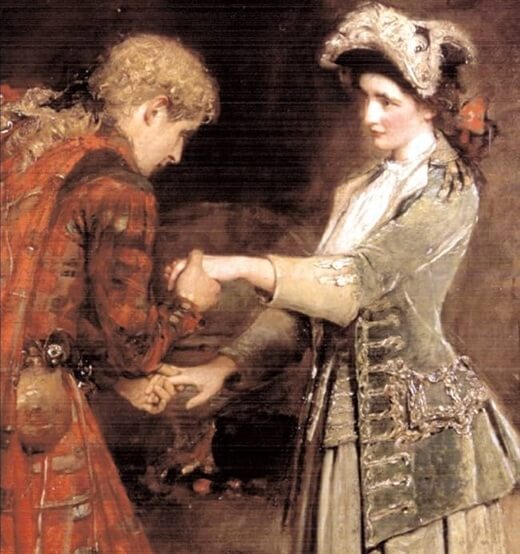
While away in the Highlands, Waverley finds out that some outlaws have intercepted his superior officer’s warnings to return to the regiment, and is dismissed before he can do anything. He is branded a rebel for deserting with a Highland band which had secretly been arming for rebellion. Waverley is arrested, but the Highlander band breaks him out, takes him to Doune Castle, and eventually brings him to Holyrood Palace, where he will meet the exiled Stuart Prince Charles who is leading the uprising to restore his father’s hereditary claim to the throne of Great Britain. Being escorted by a swell of bagpipes, feasted by plaided warriors, and dreaming of the charms of the Highland Lady Flora, Waverley pledges loyalty to the Prince the very moment he meets him. The Prince welcomes him with all the court protocol of a medieval knight. Waverley’s rashness leads him into battle against his own government. He meets his former colonel dying on the battlefield who now views Waverley as a traitor. He is constantly hearing Gaelic orders in a language which he does not fully understand. He gradually loses touch with both his romantic sensibilities and with his own native land, and learns to regret every step of the expedition as a weariness. The uprising fails. He hurries around the countryside as a branded outlaw and is eventually forced to watch his best Highland friend sent to the gallows. His lands and reputation are restored to him only by the good graces of another English colonel who acts the part of a gentleman out of respect for Waverley’s ancient and respectable English family. Waverley is restored but has learned a valuable lesson by his narrow escape; the necessity of prudence over heroic romance in matters of political loyalty. It almost cost him his life.
Scott’s Prudential Critique of Heredity
But of even more interest than the mere events of the novel, Walter Scott’s critique of political interests and the personal motivations behind them are especially applicable in properly understanding the attractiveness of hereditary right and an ethnic nationalist argument in various moments of political or constitutional change. It appeals entirely to a romantic sensibility. Glory and not conservation are its aims. Blind romance for the glories of heroic past with a warrior culture brings Waverley further and further from political prudence. There may have been a historical argument for Jacobite underpinnings, and both Scott and Dr. Johnson were sympathetic, but it gave way to a dangerous heroic romanticism. Waverley’s experience with the Highlanders shows what ethnic tribalism does at a national level without the common good moderating family and particular interests (more extensively treated in Aristotle’s Politics, Books I and IV). It is obvious from Walter Scott’s portrayal of the church that even the moderation of the Anglican order of worship is threatened by the hereditary principal, made still more tenuous by the radical disestablished Covenanters unsatisfied with the more moderate Presbyterian settlement in Scotland. Waverley himself is a hopeless romantic by temperament. He only reads historical romances and poetry rather than Classical grammar and rhetoric; a deficiency in his liberal education which leads to dreadful consequences. He cannot help but make medieval connections and chivalric allusions to every scenic destination, every clan pageant, every fair damsel, and every ballroom which attracts his eye. National politics becomes Waverley’s vanity project to indulge in fanciful dreams of knights and ladies; not unlike many single young men on X today who fantasize about warrior masculinity and ethnic nationalism from an armchair. Indeed, Waverley’s decision to take up arms comes because he feels himself obliged to the manly and courtly overtures of the Bonnie Prince himself, who treats him with more nobility than his station deserves.
But Scott’s political reason is no abstract Enlightenment doctrine, but rather a prudence rooted in place, law, and custom with the aim of conserving families and public duties, even as it insists also on civility, taste, polite manners, and moral virtue as safeguards against tyranny and decadence. Scott carefully weaves the tale so as to not diminish from the real ancient privileges of noble families, who are ever the custodians of local laws, duties, responsibilities, and rights, nor does Scott challenge the Protestant succession or settlement in church and state on the national level. Scott’s reader is carefully drawn towards prudence between the fanciful lusts of the “rage of party,” and with Burke, given an appreciation of ancient Highland custom, Lowland squirearchy, and English domesticity – all of which are threatened both by the Jacobite violence and the over-handed retribution of the Hanoverian government in the dissolution of the clans. Romance, ancient custom, ancient privilege, and duty are sacred principles to Scott, but never as a priori political abstractions which would threaten the constitutional settlement in church and state. Prudence and not heredity or romance is the fundamental principle of good government. That is the valuable lesson Waverley learns.
Scott is also nostalgic. He genuinely laments the dissolution of the Highlands and disruption of the clans, the Disarming Act, and the loss of so much ancient Scottish beauty and tradition, but he also lays blame on the Jacobites themselves for protracting a civil war which brought their culture into an all-win or an all-lose scenario. The Jacobite wars as portrayed by Scott were a desperate gambit to save all or none of ancient Scotland, but that gambit actually brought about its dissolution rather than adaptation into the present. What we know of Scott’s personal biography from Lockhart and others shows us that he did everything in his power to restore the ancient traditions, pageantry, and some of the privileges of the noble families of Scotland without arguing for Scottish independence or clan restoration, even inventing for Scotland its own national pageantry. He hoped to restore the spirit and traditions of Scottish Christendom without infringing upon Great Britain’s more modern alterations. Scott’s romanticism, such as it is, was Burkean, loving ancient customs, but seeing the change of tides and time which bring forth new customs from old and alter old customs. With Burke, Samuel Taylor Coleridge, and Washington Irving, Scott knew that the love for an old and vanished world would diminish if it was suddenly and forcefully brought back into he present by violent revolution. It would lose its archaism, its venerableness, its right to respect if not to rule. Yet Scott believed that the proper use of archaism is veneration and inspiration to reinvigorate the present in accord with a more noble past through prudential adaptation. Such is the restored Lowland estate and manner house of Tully-Veolan in the novel. It remains a squirearchy with happy tenants and living traditions of hearth and hall, an ancient house with hearty hospitality, like the Kirk home Piety Hill to many conservatives today. It provides a meaning to political association which no martial proto-nationalist Jacobite cause could ever do.
This novel has much to instruct our public discourse today, both in matters of conserving local and national culture and in the valuableness of prudence over either an inflexible hereditary principal or the modern obliteration of ancient customs, families, duties, and rights. Like most conservatives who admire Burke and are disgusted by the resurgence of the Romantic ethnic nationalism of Ernest Renan and Thomas Carlyle and its Teutonic racial nationalist counterpart in the Volkish thought of Carl Schmitt, Walter Scott was between the rage of party on heredity and government. He was in favor of ancient aristocracy underneath prudential and constitutional politics. He did not need a romantic revolutionary cause to defend them, only a love for custom and ordered liberty which gave rise to local variety and peculiar honors which give meaning to place and family under religion and law. As Scott himself says in his postscript to the novel, “This race has now almost entirely vanished from the land, and with it, doubtless, much absurd political prejudice; but also many living examples of singular and disinterested attachment to the principles of loyalty which they received from their fathers, and of old Scottish faith, hospitality, worth, and honour.”


Related Posts