Kubrick in the Trenches
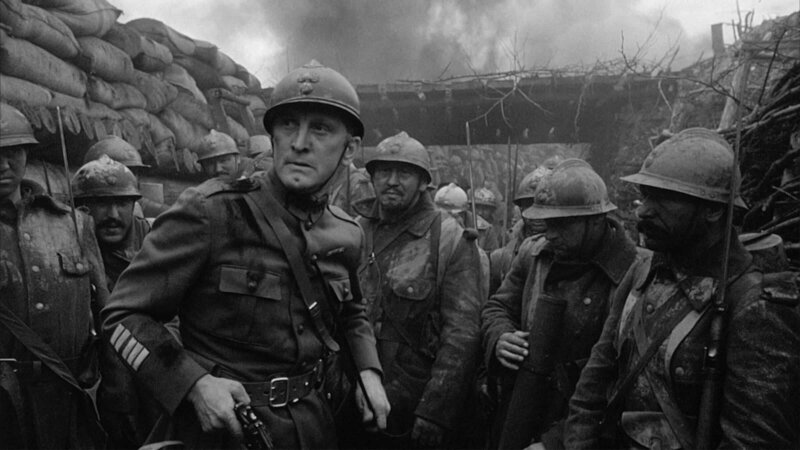
General Mireau: I can’t understand these armchair officers, fellas trying to fight a war from behind a desk, waving papers at the enemy, worrying about whether a mouse is gonna run up their pants leg.
Colonel Dax: I don’t know, General. If I had the choice between mice and Mausers, I think I’d take the mice every time.
~ “Paths of Glory”
Today, Stanley Kubrick is remembered for directing Dr. Strangelove, 2001: A Space Odyssey, and The Shining. Before making these classics, however, Kubrick directed what Turner Classics Movies host Ben Mankiewicz has labeled “part war picture, part courtroom drama,” and nothing less than “Kubrick’s best movie.”
The movie is Paths of Glory, from 1957, and based on Humphrey Cobb’s novel of the same name. George Stevens, the director of landmark ‘50s movies such as Shane and Giant, had once tried to adapt Cobb’s book, but the project never left the ground.
Like its source material, Kubrick’s adaptation takes place in the trenches of the First World War, ironically known to history as the “The Great War,” despite being anything but great.
Set in France in 1916, Paths of Glory depicts the conflict between French and German forces, who have reached a kind of stalemate. As the narrator says, “The front was stabilized and shortly afterwards developed into a continuous line of heavily fortified trenches zigzagging their way five hundred miles from the English channel to the Swiss frontier…[A]fter two grizzly years of trench warfare, the battle lines had changed very little.” Into this world, the viewer is dropped.
The opening credits feature a military-style rendition of “La Marseillaise,” but this marks the last time during the movie that the viewer is inspired by French nationalism.
The plot follows a French regiment that has been assigned the impossible mission of taking a German anthill. The regiment’s general, Paul Mireau, oversees the attack in an attempt to gain a new military position and add a star to his chest.
In the leadup to the battle scene, Kubrick’s camera glides through the trenches in terrific tracking shots which reveal the scores of men lining the trench walls. During the battle itself, Kubrick films part of the French advance by aiming his constantly mobile camera from a position parallel to the soldiers’ charge. These directorial flourishes add excitement and grace to the grim setting.
In fact, the battle scene succinctly captures the unique experience of crossing no man’s land during the First World War. Men charge, yell, and fall over dead, slain by unseen enemy gunfire. Hills of dirt and valleys of muddy water abound. Barbed wire riddles the ground, and smoke fills the air. Explosions ring out incessantly. The perpetual sound of a whistle urges soldiers onward. It is chaos. You can watch the battle scene, including the lead up here.
After the men retreat from the unsuccessful charge of the anthill—some never even leave the trenches—a furious Mireau orders that three soldiers be court-martialed, and thereby most likely executed, for cowardice.
George Macready plays Mireau with the same breathy-voiced ambition of Anne Baxter in All About Eve. While Eve Carrington sought fame from the theater, Paul Mireau uses the battleground as his stage for gaining glory—although he does not participate in the fighting himself.
The film depicts men with differing amounts of power who share one habit—the pattern of abusing that power. Lower down the totem pole from Mireau, a cowardly lieutenant dominates a heroic corporal by having him court-martialed.
There are good men, too. Kirk Douglas plays a brave colonel named Dax, who serves as defendant for the three soldiers on trial. Douglas portrays Dax with unfaltering manliness and a fiery, righteous anger. This is Douglas’s best performance.
The film also contains great moments of black humor. During the attack on the anthill, Mireau sees that one company has not even left the trenches. In an absurd twist, Mireau calls for the French battery to fire upon those French soldiers who have failed to advance as ordered. An underling, armed with a telephone, receives the unfortunate task of passing on this order to the battery commander. The order to fire at French soldiers naturally confuses the battery commander, and the underling relays to Mireau, “General, the battery commander reports those are own positions.” The understated performances of the underling and the battery commander bring the scene alive with comic absurdity.
Furthermore, composer Gerald Fried provides an excellent soundtrack. In one suspenseful scene depicting a night patrol, Fried makes drums sound like bombs.
Kubrick infamously demanded many takes from his actors. One scene in Paths of Glory involved a roast duck, a prop which proved to be inharmonious with Kubrick’s directorial style. According to producer James Harris, it reached the point where,
“We were running out of ducks, you know? Because once, once the duck comes in, they start tearing it apart; you need another duck, if you’re gonna do it again. It took fifty-seven times, and we got it, finally got it right.”
Whether or not fifty-seven ducks actually lost their insides to Stanley Kubrick—Hollywood people tend to exaggerate—Harris’ anecdote highlights the director’s abnormal inclination to retake scenes.
Paths of Glory features a runtime of only eighty-eight minutes, and its tight, economic storytelling separates it from Kubrick’s later works which became bloated and ponderous.
The gritty depiction of World War I, the beautiful black and white cinematography, and a powerfully humane ending make Paths of Glory a must-see for anyone who loves history and movies.
A version of this essay first appeared in Cana Academy, August 2024.


Related Posts