J.M.W. Turner, Victor Frankenstein, and the Hard Problem of Consciousness
In 1818 while visiting his friend and patron Walter Fawkes, artist J.M.W. Turner was requested to make a painting of a British war ship by Fawkes’ young son. Without notes or sketches, Turner spent the morning working on a watercolor of a British “first rate.” Fawkes’ teenage son’s description of his methods would be passed down in family lore for generations. Turner, so the account goes,
“… began by pouring wet paint onto the paper till it was saturated, he tore, he scratched, he scrubbed at it in a kind of frenzy and the whole thing was chaos – but gradually and as if by magic the lovely ship, with all its exquisite minutiae, came into being…”
Turner’s painting is an incredible feat of memory difficult for us living in an age of instant photography to even comprehend. The great warship’s bulging hull, ornate bow, masts, complex rigging, gun ports, sailors, attendant smaller boats etc. are all rendered convincing detail. Moreover, Turner conjures the sky, clouds and sea in broader brushstrokes evoking a breezy clear day.
But Turner’s painting is far more than a feat of memory. The painting itself lives; all parts interrelate in a meaningful dynamic whole. Turner represents a pinnacle of human cognitive power, a manifestation of the capacity of human consciousness to apprehend, remember and transform experience. Turner does not merely transmit so much objective knowledge about ships at sea; he makes manifest the nature of his own very own mind.
Turner’s early 19th century world was a time of great technological and social change. An introductory blurb of a recent exhibit entitled “’Turner’s Modern World’ claims that Turner, “more than any of his contemporaries, embraced these changes and developed an innovative painting style to better capture the new world.” But more was going on than technological and social change. Human consciousness itself was undergoing a profound transformation. “A new epoch has arisen” Hegel would pronounce in one of a series of lectures famously begun in Berlin also in 1818. “Finite consciousness has ceased to be finite; and in this way absolute self-consciousness has, on the other hand, attained to the reality it lacked before. That is the whole history of the world up to the present time.”
We were becoming self-aware of ourselves, not just as a force in the universe, but as the elemental force in the universe. Modern subjective consciousness was rearing up on its two legs and a gulf was opening between us and the world.
The Modern Prometheus
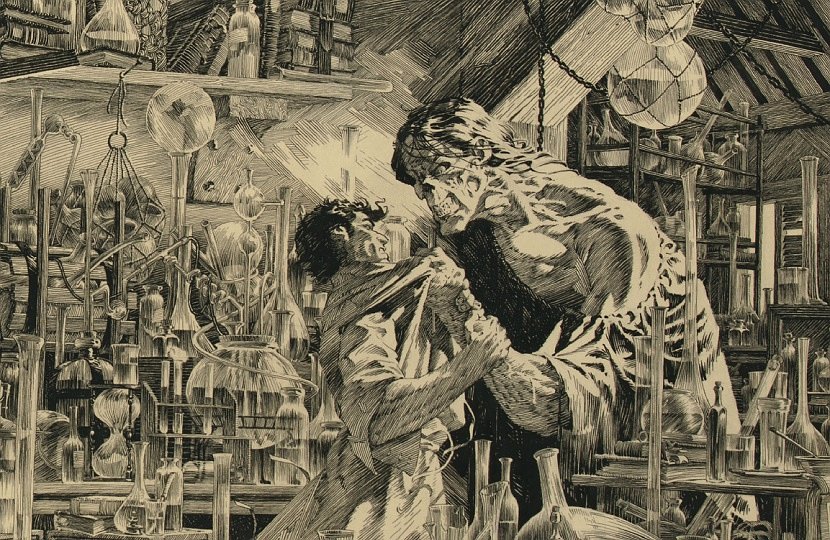
1818 also saw the publication in London of a very strange novel which would stir the imaginations of millions to this very day. Two years earlier while vacationing on the shores of a lake in Switzerland, the then eighteen-year-old Mary Godwin, along with her husband-to-be, poet Percy Bysshe Shelley, Lord Byron and his physician Dr. John Polidori, challenged each other to write some kind of “ghost story.” Mary struggled to come up with a compelling idea, but finally found herself “possessed” by a powerful “waking dream.”
“I did not sleep, nor could I be said to think. My imagination, unbidden, possessed and guided me… I saw – with shut eyes but acute mental vision, – I saw the pale student of the unhallowed arts kneeling before the thing he had put together. I saw the hideous phantasm of a man, stretched out, and then, on the workings of some powerful engine, show signs of life, and stir with an uneasy, half vital motion. Frightful must it be; for supremely fright would be, he opens his eyes, beholde the effect of any human endeavor to mock the stupendous mechanism of the Creator of the world. His success would terrify the artist, he would rush away from his odious handy-work, horror stricken…”
Mary Shelley was barely twenty years old upon the publication of Frankenstein. Her “pale student of the unhallowed arts” would become the infamous Victor Frankenstein, his goal: to make life from non-life. In Mary Shelley’s imaginary tale Victor Frankenstein apparently solves two of the great problems of modern science: He not only creates life, he creates a fully self-aware being. Though his exact means are obscured in the novel, Victor Frankenstein solves what philosopher David Chalmers almost two centuries later would call “the hard problem of consciousness” – how consciousness arises from what is not conscious.
The full title of Mary Shelley’s horror story is Frankenstein; or, the Modern Prometheus. In the early-nineteenth-century the myth of Prometheus was in the air. Mary Shelley’s story is a modern retelling of the Greek myth. The Titan Prometheus defies Zeus by giving man fire, by giving man powers over nature and for doing so he must perpetually suffer the wrath of Zeus. Modern man is Promethean man, Victor Frankenstein is Promethean man who “mock[s] the stupendous mechanism of the Creator of the world.”
Turner’s paintings of steamships, furnaces, and locomotives reveal Promethean man at work. Turner himself was an avid follower of current developments in modern science. He studied geology, meteorology, electromagnetism etc. But Turner and Frankenstein represent two radically different orientations to reality. Turner understands himself as continuous with nature, he creates in participation with what D.H. Lawrence would call “the living continuum.” He “suffers” and sublimates forces outside of himself. In contrast, Frankenstein embodies the emerging modern sensibility which recognizes no authority beyond the human mind. Frankenstein creates, not in sympathetic participation with greater forces, but the clever manipulation of the pieces.
Modern man’s growing self-awareness signified that the human mind could know reality and by this knowledge we could transcend our separation from nature. This virtual deification of the human mind represented for Hegel “the end of history.” We find ourselves in a state of “absolute self-consciousness” finally liberated from the apparently illusory authority of all powers beyond ourselves. Hegel claimed the mind of God fulfills itself through the mind of man—self-aware man is a manifestation of God. But if man is a manifestation of God, is not God a manifestation of man? Are not we then God? And do we not get to create everything?
When Hegel’s “theoretical ego finds itself as Supreme Being,” the human mind, which is to say, human consciousness, tends to experience itself as a thing-in-itself. Our inflamed egos become intoxicated with an ever greater sense of power and liberation. By knowing the world the modern mind presumes to simultaneously liberate itself and subdue the world to itself.
The human mind transcending the world turns the world into an object outside of ourselves. Specifically modern man’s way of knowing reality is by means of scientific methodologies which signifies an ever more refined knowledge of the pieces. Paradoxically we presume to “know” reality by separating ourselves from reality. Inevitably the modern world manifests, not as Hegel’s unified transcendent end of history, but with new kind division, a new kind of dialectic. Our “absolute self-consciousness,” our individual liberation and power comes at the cost of unprecedented separation from nature. Promethean man is alienated man.
Alienation
So modern man is simultaneously liberated and alienated. Mary Shelley’s novel dramatizes the ambiguous logic of the modern psyche. “I trod heaven in my thoughts,” boasts Frankenstein, “now exulting in my powers, now burning within the idea of their effects.” He creates, not out of sympathetic participation with the living continuum, but out of egoistic pride.
Mary Shelley’s tale is more than a metaphor for man’s alienation from nature; it is a dramatization of a radical alteration of consciousness itself. The consciousness of Promethean man is no longer part of the living continuum but a separate kind of power which finds itself confronted with a mindless material reality. As Hegel emphasizes, we aren’t simply conscious, we are self-conscious.
Our self-consciousness tends to convince us that all essential creative powers reside in ourselves. The more we arrogate power to our human minds, the more the world beyond us appears mindless. D.H. Lawrence would describe the nature of this “split” a century later:
“It seems to me that when a human being is too much divided in his subjective and objective consciousness, at last something splits in him and he becomes a social being. When he becomes too much aware of objective reality the core of his identity splits, his nucleus collapses, his innocence or his naivete perishes, and he becomes only a subjective-objective reality, a divided thing, hinged together, but not strictly individual.”
As social beings we find ourselves isolated from the living continuum, we are subjective beings in an objectified reality. We are simultaneously liberated and alienated, but are we fully human? “Paradoxical as it may sound,” writes Lawrence, “the individual is only truly himself when he is unconscious of his own individuality, when he is unaware of his own isolation, when he is not split into subjective and objective…” We only become fully human individuals as we “innocently” encounter, transform and adapt to the living continuum –“this is the primal or pristine or basic consciousness of the individual.” Ironically, the more self-conscious we become, the less conscious we are of ourselves as part of a whole living process.
Separating ourselves from the living continuum does give us great power, nonetheless, claims Lawrence, we live in a state of fear. So we console and protect ourselves by “material assurances;” we envelop ourselves in an increasingly objectified reality. We call this process “progress.”
But our ideas of progress consist of more than mere material assurances and they are driven by more than fear: We exalt the liberated self-conscious mind. We are skeptical of all claims to authority outside ourselves and bolstered by the powers of science we even think of ourselves as empirical. As self-conscious beings we tend to live in our heads. Like Frankenstein, we tread heaven in our thoughts and our ideas burn within our minds. But this self-consciousness comes with a cost: blindness of the whole
Frankenstein is a tragedy precisely because Victor Frankenstein is blind to the whole. Living in his egoistic fantasy he does not understand the implications of his creation until too late. He creates without acknowledgement of forces greater than himself. Leading up to the very creation of his Monster he finds himself is in a near hysterical state of ecstatic possession:
“No one can conceive the variety of feelings which bore me onward like a hurricane, in the first enthusiasm of success. Life and death appeared to me ideal bounds which I should first break through, and pour a torrent of light into our dark world. A new species would bless me as its creator and source; many happy and excellent natures would owe their being to me.”
This passage is emblematic of all kinds of modern “theoretical” minds who would imagine they could alleviate or even end human suffering and conflict by means of human ideas. Such hyper conscious minds may be very adept at ideation and manipulations of the pieces of reality but proportionately blind to the whole.
The modern project is not the reconciliation of the inner and outer, nor the healing of the division between our subjective consciousness with objective reality. Rather, our Promethean dreams require ever greater division, ever greater manipulations, and ever more self-consciousness. But can what Lawrence calls “the nasty disease of self-consciousness” truly be cured by more self-consciousness? Or is the cure the disease itself?
Revenge
Frankenstein is, above all, a story of revenge. The Monster is not a mindless brute wreaking havoc in the world of men, but a fully self-conscious creature avenging himself upon a world which has rejected him. He begins life as a highly sensitive and sympathetic creature who longs to be accepted and loved by human beings. “Everywhere I see bliss, from which I alone am excluded” laments the Monster. It is precisely the Monster’s self-awareness of its own agency which drives the poignancy, horror and tragedy of the tale. Fully conscious of its alienation, the “fallen angel becomes a malignant devil,” hell- bent on revenge upon its creator.
Having been created out of Frankenstein’s egoistic pride, the Monster’s alienation is baked in from the very beginning. Frankenstein does not account for the essentially unified creative/destructive nature of reality; he acknowledges no powers beyond himself; he thinks he can get something for nothing. The avenging Monster is reality’s way of bringing Frankenstein out of the delusions of his egoistic self-consciousness into a true consciousness. Like Prometheus, Frankenstein suffers the consequences of his actions: “… the beauty of the dream vanished, and breathless horror and disgust filled my heart.” Mary Shelley’s tale is a classic tragedy which affirms the persistence of a unified reality regardless of man’s hubristic dreams of domination and escape.
Frankenstein conducts a single great experiment and the unfolding tragedy of that experiment is a dark mirror of much of the modern world. We have become what Robert Calasso calls “the Experimental Society.” We are all, more or less, would be Frankensteins, not creative participants with the living continuum, but self-conscious theorists conducting one experiment after another on ourselves and the world. As we “pour [our] torrent of light into a dark world” society itself is an object to be manipulated and remade as we see fit.
Our experiments do indeed generate tremendous wealth and power. But as we are enveloped by an objectified reality our consciousness adapts; we become ever more isolated egos, hyper sensitized to fragments and blind to the whole. Living in euphoric states of ideation and abstracted from the consequences of our experiments, we confuse our “intentions” with reality itself. And the systematization of our ideations we call ideologies. Our ideologies conflict but, as Calasso points out, these are conflicts mostly over who controls the experimental apparatus. The suffering we see in the world is not a call for a re-immersion in the living continuum, but a call for more experiments, greater experiments, and finally even total experiments.
Experimentation inevitably generates alienation and a desire for revenge. We are simultaneously the creator of our world and our world turns on us. Unconscious of the whole, we are forever repeating the cycle of experiment-alienation-revenge.
We continually reenact the Frankenstein myth as long as we remain abstracted from the living continuum. What are the great totalitarian societies of the twentieth century with their visions of a “new man” but reenactments of Mary Shelley’s waking nightmare? What are the likes of Joseph Stalin, Adolph Hitler, Mao Tse-tung but monsters who arise out of mass alienation only to avenge themselves upon the very societies which created them? Remove the veneer of material assurances and we soon find ourselves acting out Mary Shelley’s frightening tale: Frankenstein is us; the Monster is us.
The Children of Frankenstein
Frankenstein was an immediate public success and has remained in print for generations. But the Frankenstein myth would achieve its greatest power on the modern psyche with its translation into film in the twentieth-century. Frankenstein’s Monster was taking on an iconic visual form precisely at the same time we were embarking on our greatest and most brutal theoretical social experiments. As we were acting out our Promethean experiments of liberation and power, our greater collective consciousness seems simultaneously to intuitively understand the underlying tragic forces at play.
Mary Shelley’s Promethean tale has remained as relevant as ever though it has gone through and continues to go through ever new iterations. Themes of experimentation, alienation and revenge continually appear in modern popular culture. Movies like, 2001, the Terminator and Alien series, Jurassic Park, Westworld and dozens more are cinematic dramatizations which appeal to a vestigial consciousness which understands that we never get something for nothing.
Nonetheless our consciousness is more divided than ever: we are more self-conscious than ever and our powers to objectify reality are greater than ever. Barely hinged, we inhabit a divided reality. Indeed, we celebrate our dividedness as modern education consists primarily in the cultivation of a hyper awareness that we are subjective beings in an objectified reality.
Our subjective/objective divide manifests as a world of egoists and experts. Virtue itself consists of perpetual displays of self-awareness and sensitivity to the arbitrariness of all claims to authority outside of ourselves. Our necessary connectedness to nature and history, which is to say, the living continuum, is ignored, forgotten or outright denied.
We are then in a new total experiment and cycles of hubris and revenge abide. Despite the emergence of environmental, social and psychological problems on a world wide scale, our response continues to be manipulation of the elements by ever more sophisticated classes of experts and bureaucrats. Our most ambitious and exalted Frankenstein minds, abstracted by wealth and privilege, tend to be among the last to experience and acknowledge the tragic interconnection of experiment, alienation and revenge.
Most recently we’ve determined that the world must be objectified into a vast “safe space” where every individual is not only entitled to all kinds of material assurances, but everyone is entitled to be free from any forces outside of their own emancipated egos. No one need suffer anything. No one seems to know who they are, but we are all entitled to create our own “identities.” We are creator and creation, experimenter and experiment; we are our very own Victor Frankenstein and our very own Monster.
Meanwhile the scientific quest for the great holy grail of consciousness continues. Modern science has made incredible progress in studying the workings of the mechanisms of the human mind. Which is to say, we have solved many of the “easy problems” of consciousness. But the hard problem remains: Surely we experience ourselves as self-conscious beings.
So we study the human mind the way we study everything else – as an object outside of ourselves. Huffing and puffing, many of our great scientific minds beat on the doors of the human mind. Consciousness must be in there somewhere… But where, exactly? And what is it? How could consciousness arise out of a mindless material universe? How could awareness arise out of unawareness? Clearly, we are aware that we are aware… and if we are aware that we are aware, are we not aware that we are aware that we are aware..?
Consciousness appears to be an elusive and ever receding homunculus always just beyond our reach, always requiring ever more and precise experiments. But if consciousness is not a thing in itself and if it cannot be understood apart from the whole, how can methodologies of separation understand unity? The hard problem of consciousness is indeed a very hard problem for those who have lost all sense of themselves as participants in a universe of greater powers.
Turner’s knowledge
“What would Turner be making art about today?” So asks the introductory chapter of the book of the Turner exhibit, “Climate change, pandemic disease, pollution, migration, deportation, refugees, trafficking, his country’s identity and place in Europe and the world, fires, floods, whatever is to replace vehicle and air travel, AI?” Perhaps Turner’s concerns would indeed coincide with those of us self-conscious modern human beings. Perhaps.
Interest in Turner persists, but generally we see Turner on our terms. We tend to value Turner insofar as he affirms us. In our divided subject/object universe artists are often exalted as icons of the liberated self-conscious human highly sensitized to living in a wholly ambiguous but objectifiable world. We tend to see Turner as either great objective observer or subjective innovator with little understanding of how such categories would be of little or no concern to Turner.
The question remains: Does Turner indeed “embrace” the Modern World? But we might well ask: Does Turner embrace a sunset, a shipwreck, a storm at sea, a great conflagration..? For Turner the modern world is itself a natural phenomenon. Turner did not simply invent a new “style” of painting to depict a new world. Turner depicts the modern world as he would any natural phenomenon: as spectacle.
Turner never leaves or denies the living continuum. When Turner paints a storm at sea in some way he becomes a storm at sea. He is a modern painter insofar as he immerses himself in and transforms the forces of the modern world. The enduring power and appeal of Turner is not simply that he is the great painter of the particular things and events of his day. He certainly is involved in representation, but, his later paintings in particular, reveal an elemental concern with the very nature of human experience, a concern with the relationship of energy and matter, a concern with the very moment the invisible becomes the visible, with the moment the whole individuates into reality as we know it. Turner paints sub specie aeternitatis – above all, he is involved in revelation.
A Turner painting is a revelation of human power encountering greater powers. The painting is evidence of this encounter, indeed, a kind of objective evidence. Turner doesn’t “explain” anything; he make manifest a human capacity to transform experience into meaningful wholes. He renders with pigments on a flat surface an analogue of the nature of his encounter with energies greater than himself.
Turner’s paintings have a kind of life and enduring power beyond any egoistic manipulation of elements. Partaking of greater energies, a Turner painting lives. And continues to live: We all can experience what Turner experiences, a painting is capable of resonating in the mind of a viewer. Our consciousness can resonate with Turner’s consciousness. Even those of us quite comfortable with our fragmented Frankenstein minds may realize that the living continuum persists: We too are simultaneously observer and participant; we too are J.M.W. Turner.
Turner represents a kind of consciousness which cannot be broken down into pieces or explained by science. For those, like J.M.W. Turner, who participate in the living continuum there is no hard problem of consciousness. There is only the hard problem of reality.


Related Posts