Jurassic Park: Chaos, Control, and Childrearing
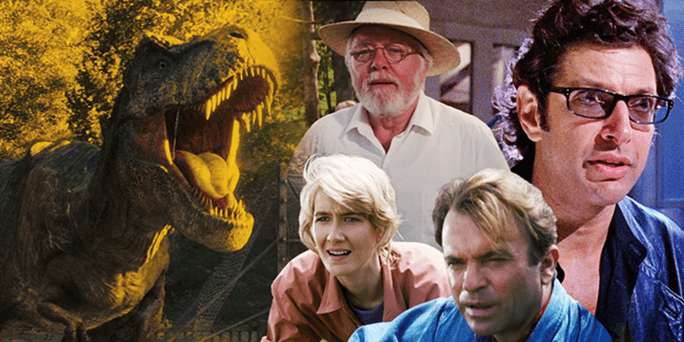
I do not know how many times I have seen Steven Spielberg’s 1993 film Jurassic Park in my lifetime. If I had to guess, I would put the number around a dozen. Even so, when I revisited the film lately (before the release of its latest sequel, Jurassic World: Rebirth), it seemed to me that I had never quite grasped what it is really about.
When I was young, long before I was actually allowed to watch it, I was drawn to the movie for the simple fact that it had dinosaurs in it. When I was older, around the time I entered film school, I was drawn to its mastery of cinematic technique, particularly in its virtuoso suspense sequences. Now, I watch it and find myself drawn to themes and emotions woven in so subtly as to be almost subliminal.
Like so many of Spielberg’s films, Jurassic Park is about the yearning to repair a broken family, though it does relatively little to announce this. The exposition of the situation facing the family of John Hammond (Richard Attenborough), Jurassic Park’s owner, is relegated to a single line of dialogue, almost a throwaway, spoken by an unnamed digger to the lawyer Gennaro (Martin Ferrero): “[Hammond] wants to be with his daughter. She’s getting a divorce.” On a first, second, or tenth viewing, the line hardly registers. When I watched the film as a sheltered adolescent, I thought nothing of the fact that the parents of Hammond’s grandchildren, Lex (Ariana Richards) and Tim (Joseph Mazzello), are completely absent from the picture – nor did I grasp the full emotional implications of the traumatized Lex repeatedly saying “He left us!” after Gennaro abandons them during a Tyrannosaurus Rex attack.
This theme of family – particularly parenthood – dovetails with the film’s larger (and more overt, and thus more oft-discussed) themes of chaos and control, as represented by the ongoing debate between John Hammond and the charismatic chaotician Ian Malcolm (a scene-stealing Jeff Goldblum). Becoming a parent, after all, is one of the ultimate acts of relinquishing control and assenting to the chaos of letting life run its course.
The film frames John Hammond as a controlling parental figure through an early scene where he watches the birth of an infant Velociraptor. “I insist on being here when they’re born,” he says proudly. “They imprint on the first creature they come in contact with… I’ve been present for the birth of every little creature on this island.” As the dinosaur emerges from its egg, his coaxing evokes an excited parent: “Come on. Come on, little one! … Push! Push!” The nature of the relationship is clear: Hammond thinks of the dinosaurs as his children, and he believes he can maintain absolute control over his children. Among other things, he controls their ability to reproduce by having his scientists engineer only females. On Hammond’s island, in Hammond’s world, dinosaurs cannot breed in the wild; they can only be born in the carefully controlled environment of Hammond’s lab.
However, in the very same scene, Ian Malcolm objects: “John, the kind of control you’re attempting is, uh, it’s not possible… Life will not be contained. Life breaks free.” Ideologically, Malcolm is at the opposite pole from Hammond, arguing from chaos theory that Hammond’s strategies of control are doomed to fail. The two characters are even positioned as opposites by their costumes: Hammond wears all white, while Malcolm wears all black. Hammond and Malcolm are also foils as parental figures: whereas Hammond is a controlling parent, Malcolm is a parent who blithely embraces chaos. He “loves kids” because “anything at all can and does happen” – because children, in other words, are the embodiment of chaos. Malcolm’s love for his children is suspect, though; like Hammond’s, they are completely absent from the picture, and we can only guess how they have been scarred by his serial marriages and divorces (“I’m always on the lookout for a future ex-Mrs. Malcolm,” he says glibly).
Between these two poles is the film’s protagonist, the old-fashioned paleontologist Alan Grant (Sam Neill). Grant’s antagonism to children, and to the idea of parenthood, is clearly established in the two scenes that introduce him. First, when a child at his dig site mocks a Velociraptor for not looking “very scary,” Grant compels his respect by scaring him with a fossilized raptor claw and a graphically violent description of how raptors would eat him alive. Then, when Grant’s partner Ellie Sattler (Laura Dern) chides him for his behavior, he replies by issuing a complaint against children in general: “They’re noisy, they’re messy, they’re expensive.” In other words, contra Malcolm, Grant objects to children precisely because they are chaotic.
It is not hard to infer that Grant’s aversion to parenthood stems from his desire to devote his life to his work. He scares the child with the Velociraptor claw because the child disrespects his line of work, and we can assume that his romantic relationship with the paleobotanist Ellie began through their shared work; indeed, they act as much like work partners as romantic partners. It is clear that Ellie wants children, but if Grant can stay childless, he can maintain a certain level of control over his life and remain insulated from the chaos of childrearing.
All of these themes come to a head in the sequence when the Tyrannosaurus Rex breaks out of its paddock and attacks Grant, Malcolm, and Hammond’s two grandchildren. The viscerally terrifying and thrilling scene is the centerpiece of the movie, and it is a masterclass in filmmaking for many reasons – but the secret ingredient that makes it so viscerally affecting is the way it weaves together the film’s themes, characters, and core emotions. The T-Rex’s escape definitively, dramatically obliterates Hammond’s pretenses of control; Malcolm’s theory is proven correct (“Boy, do I hate being right all the time,” he quips), but he proves to be an ineffective hero, quickly crippled and taken out of the equation. The scene’s greatest emotional charge comes from the children’s primal terror of parental abandonment, and from Grant’s long-evaded decision to step into the responsibility of fatherhood. “He left us! He left us!” Lex says, clearly talking as much about her absent father as the cowardly lawyer Gennaro. “But that’s not what I’m going to do,” Grant replies.
This scene sets the stage for the second half of the film, which revolves around Grant’s growth into Lex and Tim’s surrogate father while he guides them through the ruins of their grandfather’s hubristic attempts at control. Shortly after the attack, Grant helps Lex and Tim up into a tree to hide for the night, and the quiet, tender scene is clearly positioned as an answer to Grant’s introduction at the dig site: as the children cuddle up to him, he is poked by the fossilized Velociraptor claw he keeps in his pocket, which is both an icon of his work and a reminder of the way he scared the child who dared to disrespect that work. “What are you and Ellie going to do now, if you don’t have to dig up dinosaur bones anymore?” Lex asks. “I don’t know,” Grant says. “I guess we’ll just have to evolve, too.” Grant then throws the fossilized claw away, marking his shift from a man who would strike fear into children who come between him and his job to a man who has let his job go and is now determined to assuage children’s fears and keep them safe.
Shortly thereafter, Grant and the kids find a batch of broken eggshells in the wild, an image that directly contrasts the eggshells in the stringently controlled environment of Hammond’s lab. Despite Hammond’s precautions, his dinosaurs – his “babies” – are having babies of their own. Grant letting go of his own need for control and stepping into fatherhood is paralleled with the dinosaurs escaping Hammond’s controlling grip and achieving parenthood. On both levels, the chaos of life is breaking free from systems of control.
By the film’s end, Hammond and Malcolm, despite being at extreme opposite poles, are both crippled, alone, and ultimately helpless in a bunker. It is the steady and responsible Grant who protects Lex and Tim, becomes the father Ellie knew he could be, and forms a new, repaired family unit. The film closes with Lex and Tim sleeping peacefully on either side of Grant while Ellie looks on approvingly. Grant stares out the window at a flock of birds flying over the ocean, perhaps pondering his theory that dinosaurs evolved into birds – or, perhaps, reflecting on his own evolution into parenthood.


Related Posts