Lessons About Reality: or, On the Courage of Being Human
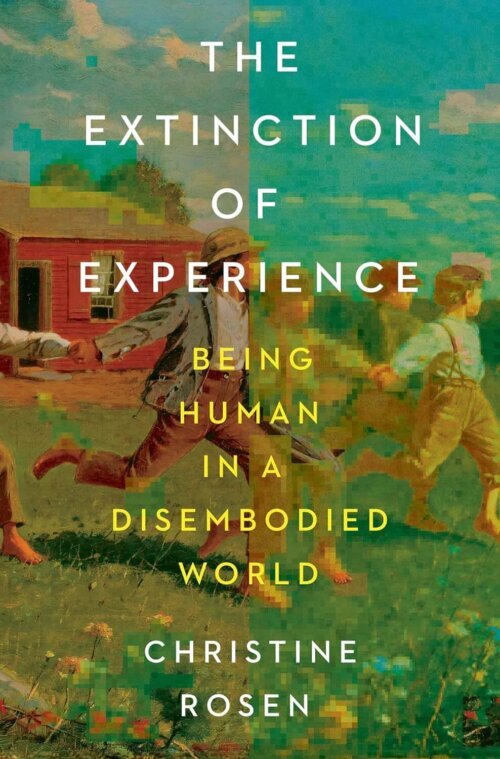
This is a joint review, of two books: John Tanyi Nquah Lebui, The Cross and the Flag: Papal Diplomacy and John Paul II’s Struggle Against the Tyranny of the Possible and Christine Rosen, The Extinction of Experience: Being Human in a Disembodied World. On the face of it, the books could not be more different: one is a historical study, about a person who died two decades ago: Pope John Paul II. The other is as contemporary as it is possible, about the impact of digital technologies on all of us, right here, right now. Yet, I do a joint review because I suggest a joint reading: the message of the two books comes out best, producing the greatest meaningful effect, if they are read literally together – a chapter from one, a chapter from the other, and so on – interspersed with reflections on both.
The Diplomacy of Pope John Paul II
The book by John Tanyi, a Cameroonian priest living in Boston, MA, is not a biographical account of the Saint Pope, and is not even a study of his religious or spiritual message, but is about an activity that one would exclusively associate with secular powers: international diplomacy. It is a most important book for many reasons, clearly indicated by having a Foreword from a Harvard Law Professor who was US ambassador to the Holy See, and an Afterword by the most recognized biographer and commentator of Pope John Paul II.
The book offers a comprehensive overview of the diplomatic activities, and initiatives, of Pope John Paul II, emphasizing its global character. Of this, the review selects two areas: Ostpolitik, or the way the Pope behaved, and encouraged others to behave, towards the former Communist bloc, and his treatment of the media – easily the two most important sections of the book.
Ostpolitik
Papal diplomacy with the former Communist bloc in the late 1970s and the 1980s would seem to be of purely historical interest. Yet, this is not so; for a variety of reasons, this theme is of extreme current interest.
This is due, first of all, to the seemingly trivial and yet extremely thorny question – never more so than in our days – of what is actually, really, reality. Pope John Paul II radically altered the diplomacy of the Vatican towards the Communist countries, and this was based on different views concerning realism, and even reality.
For the previous popes, and their diplomats, Soviet Communism was a reality; a threatening, frighteningly dangerous reality, that had to be handled with a care that approached trepidation. Pope Paul VI, for e.g., “saw the regimes in Eastern Europe as facts and realities with very long-term futures and life spans” (82). Papal diplomacy favored the politics of small steps and minimal interventions, so as not to irritate the beast. This policy of compromises, however, as it lacked internal force and courage, far from reaching its aim, to save the savable, “instead made matters worse in Czechoslovakia and Hungary” (77). In contrast, the diplomacy of Pope John Paul II was based on denying the realness of Soviet Communism. Of course, and needless to say, the Pope was not naïve: the Soviet Union existed, as an effective world power. But, for him, it was not really real, could not be real, as it was absurd.
This assessment was based on two different grounds; the two most important grounds of any policy, and not only: of any philosophy of life. One is a matter of principle: secular atheistic humanism is absurd, cannot be maintained on the long run, so it is not really real. Its activities can be perceived by the eye and touched by the hand, as any raving lunatic out there, but it cannot be accepted as real; cannot be taken seriously. He “was convinced that because communism was built on atheistic humanism, it would inevitably be defeated” (82). The Pope made the famous 1945 Potsdam dictum of Stalin, allegedly concerning Poland, “how many divisions does the pope have?”, together with its underlying Marxist-Leninist philosophy of history, stand on its head: “Culture (cultural diplomacy), and not military prowess, diplomacy, or economic might, according to John Paul II, is the driving force of history” (84). The second concerns personal experience: Pope John Paul II, as Karol Wojtyla, lived under Soviet rule, in Poland, so he had had first-hand experience about the everyday, untenable absurdity of the system, while “the old Ostpolitik was designed and executed by men who did not understand communism because they have not lived it” (89-90). He managed to stand up against this ludicrous nightmare-illusion, already in Poland, as a bishop, archbishop, and cardinal; now, as a pope, he had more chance to do this effectively; he felt this as something like a mission to which God raised him (79); and he proceeded without blinking an eye and without missing a chance.
Let me illustrate by a personal anecdote what the recognition of the unreality of Soviet Communism meant, then, in everyday life. For us, meaning my friends, most fellow students and colleagues, it was both a matter of principle and of everyday life conduct that we could not utter the word “Soviet Union.” We called it “Russia,” and “the Russians.” Strictly speaking, this was not true, as many Bolsheviks or Communists, starting from Stalin, and perhaps even Lenin, were not ethnic Russians. But we did not mean it in this way; this was irrelevant; what mattered is that Hungary was occupied in our youth by an Empire, pretending itself to be a “liberator of the people,” and this was a lie. By “Russia,” we meant this Empire, beyond the lie. But the same attitude was shown, much earlier (but this we didn’t, couldn’t know then), by the great Hungarian novelist, Sándor Márai, who refused to have any of his works printed in Hungary until there was a single Soviet soldier there. And even before that, he wrote two novels about Hitler, focusing first on his voice and then on his public performance, but could not bear himself once to write down the name. He went as far as indicating that the name contained six letters, and started with an “H”, but not more. This was because he considered Hitler as similarly unreal, a lie through and through, with his talk and behavior, the very tone of his voice being an affront to humanity, and so giving him a name in his book would have amounted to admitting the reality of that non-person.[1]
Thus, returning to the book, Pope John Paul II did not take “Soviet Communism” seriously, as a reality, though this did not mean that he acted recklessly. Quite on the contrary, he took extreme care concerning the manner to handle this absurd but dangerous beast. He did not take up the path of an impossible, direct confrontation – after all, it is written that “do not resist evil” – rather undertook ‘ “a struggle for man” ’ (79; a quote from Cardinal Stanislaw Dziwisz). In this way, step after step, managed to have his way – being, according to several most competent people, political analysts and politicians, the single most important factor in helping to dismantle Communism. Citing only one, according to the great historian of the Cold War, John L. Gaddis, ” ‘Real power rested, during the final decade of the Cold War, with leaders like John Paul II whose mastery of intangibles – such qualities as courage, eloquence, imagination, determination, and faith – allowed them to expose disparities between what people believed and the systems under which the Cold War obliged them to live’ ” (102).
This certainly required courage – the book discusses John Paul II’s “diplomatic fearlessness” (99), and also his conscious risk-taking, as even the 1981 attempt at his life did not diminish his propensity to travel (201). This was both part of his personal and national character – Tanyi mentions his “typical Polish fearlessness,” which was closely connected to his religiosity: “ ‘Do not be afraid’ is part of the Christian vocation,” and so it was also a “Christian fearlessness” (201). This fearlessness was particularly important as the 20th century was a century of fear and terror (97) – relevant also, perhaps even more, in our days, with its excessive obsession with security: it seems that “we” are ready to tolerate literally anything in the name of our “security.” But perhaps even more directly relevant for us is the “revolution of conscience” the pope inspired in Poland, and which directly led to the foundation of Solidarnosc: “He relentlessly reminded the Polish people that communists were deliberately attempting to alter their true identity. He told his fellow Poles: ‘If you take back the truth of your identity, you will find tools of resistance that totalitarianism cannot match’ ” (97).
Apart from his fearlessness, the pope was also helped in such fights, and in his treatment of the media, by his personal experience with the theatre – a quite stunning aspect of his personal character and formation, which even helped him to overcome his lack of diplomatic training (95-6). Intriguingly, his theatrical experience rhymed with his religious vocation, as in the theatre “John Paul II learned the ‘living word’, which is the ability to cut sharply and cleanly through the static lies and propaganda” (96). This was a quite shared purpose of theatre-playing around the former communist countries. A director of the Kaposvár theatre, the most important theatre in Hungary in the 1970s and 1980s, which also gained huge international acclaim in 1982, stated that their aim, with their performances, was ‘ ”to face the world of lies that surrounded us.’ ”[2]
The media
Concerning the media, John Paul II’s approach was quite similar. While this is not spelt out in the book, the media is just as unreal as the Soviet Union was – and this already should give some further food for thought about the vital contemporary importance of the book. We should become familiarized with the uncomfortable truth that whatever we watch in the media, anywhere anytime, is not real, but at best a representation of reality – which some people, for some reasons, sometimes good, but most often very bad, selected for us to see. This point can perhaps be best driven home by a famous painting of René Magritte, “This Is Not a Pipe,” which shows, with great realism, a huge pipe, under which, inside the frame of the painting, it is written: “This is not a pipe.” Michel Foucault published an entire book about this painting[3] – not surprisingly, given his interest in the problem of representation, to which his great book The Order of Things, originally entitled “The words and the things” (Les mots et le choses), was devoted.
The media, thus, is not real, but it has a tremendous impact on our lives, so it must be handled with great caution and care, as a particularly dangerous beast, but also with unswerving, solid determination. Here again, Pope John Paul II is exemplary, best seen in the way he defeated the Clinton administration in the 1994 Cairo Conference on population issues, which was turned into an “ideological battle [that] revolved around sexuality, abortion, the family, and the institution of marriage” (229) – a theme of utmost current relevance.
In the efforts of the Clinton administration to push through the world a policy of practically free abortion, following the pleasure principle, one could already identify the contemporary left-liberal intellectual-academic consensus, which is just as unreal – though obviously in a somewhat different manner – as Soviet Communism was. Most importantly, and again closely recalling both Soviet Communist officials and Marxist-Communist intellectuals, they displayed “their arrogance and smugness,” being “very confident of brushing aside abortion critics” in the Cairo conference (233), and thus inaugurate a “U.N.-sponsored libertinism” (234). But they, just as the Communists, failed to appreciate the character of Pope John Paul II, combining an utmost firmness in principles with a keen intelligence in fighting the enemy on its own ground. Thus, the pope, both directly and through his trusted intermediaries such as Joaquin Navarro-Valls, dominated the world press, demonstrating how strikingly “media-savvy John Paul II was” (235-6), and again managed to win: “Due to the fiery campaign of the Vatican [… t]he notion of enshrining abortion-on-demand as an internationally recognized basic human right – the centerpiece of the U.S. ideology at Cairo – had been abandoned by its proponents” (238).
This point is also vital, as it points to the paradoxical heart of the relevance of this book, and its theme, for the present. Pope John Paul II succeeded in helping to dismantle Communism as he took up, in an uncompromising manner, a vision of basic human rights, and Soviet Communism as a regime infringing such basic rights – most important of which, according to him, was religious freedom (85). However, already in 1994, the new – and distinctly unreal – forces of left-wing liberalism, with some success, appropriated the discourse of human rights for their own ends. Note that the previous, “classical” leftism had no interest in “human rights”; they were only concerned with the working classes, or the “masses”: for them any talk of “human rights” smacked bourgeois sensitivities. But they lost; so learned their lesson, and now started to use this discourse.
Legacy
The legacy of Pope John Paul II is still alive, probably everywhere, but nowhere as plainly as in Krakow, his city. Krakow is one of the most beautiful cities of East-Central Europe, this anybody can find in any tourist guidebook. Visiting personally the city, however, offers a quite different experience from visiting Prague, or even Budapest – which was my native town. In the latter, in city centers everything seems to be organized for the quick despoiling of the heedless tourists who ventured there, with natives seemingly having no other interest than making money, while looking mostly unhappy and dissatisfied, evidently due to the fact that they are not living in London or New York and are not making as much money as Mark Zuckerberg or Jeff Bezos. On a first look, the center of Krakow seems not much different, but passing a few days there, especially if you are not just a tourist – I was there for a research evaluation meeting, so met all kinds of “normal” people like secretaries, researchers, teachers, various employees – one gains a significantly different impression. Money, while to be sure important, is by no means an overriding concern; people were quite content enjoying a degree of well-being, and an evident, even blooming freedom. When I had been there, several times, almost half a century ago, Krakow, and Poland in general, was stuck in artificial poverty, induced by communism, looking desperate and desolate. A tourist from Hungary, even a simple student, was unspeakably rich, by selling trivial items as blue-jeans (Hungarian ones, not even Levi’s!). Now, perhaps not in actual monetary terms, but in spirit, in the atmosphere, the situation was reversed, in my experience. I felt no signs of people desperately trying to imitate the latest “Western” fads, which was my recurrent experience when I visited Budapest in recent decades – though the country-side even in Hungary remained quite different, closer in atmosphere to Krakow, indicating that the problem is indeed the unnatural unreality produced through globalization, especially in “global cities.”
The Extinction of Experience
The theme of the second book, again, is seemingly light-years away from the first – it is not about the past which seems eons away – meaning communism – but the very heart of the present, the current “revolution” in communication technology. However, one only needs to peruse shortly the book to realize the tight connections between the two: this one, just as the previous, is fundamentally about the problem of reality; of how reality itself could become a problem; of how it might happen that we live in a profoundly unreal world. Still, the modality of unreality seems quite different: not a rude, totalitarian regime, but a seemingly soft entrapment in advanced technology. However, one only needs to be reminded how communists, and indeed Marxists of all ilk, were absolutely obsessed with technology, since the beginnings, arguing that there is nothing inherently wrong with technology, the only problem is capitalism, and its inequalities. Raising the problem of technology thus implies a break with any kind of Marxism, with its focus on “inequality,” easily an ideology justifying a blank and blind acceptance of technology as the solution.
The book starts by defining upfront the two main and closely connected problems with technology. The first is that it alters reality, by shaping our understanding of what is real and what is possible, and by “interpos[ing] itself between us and the world’ (6). Thus, we need to defend “the real world […] from technology when it threatens things that are better left alone” (12). This last phrase, “better left alone,” is a particular gem, as it goes right at the heart of the technological mentality, which does not want to leave anything in peace, threatening, attacking, destroying everything in the name of “progress” and “change.” Just today I happened to notice a new slogan, perhaps on a coffee cup, “let’s make the world different”: no other culture ever had the audacity of formulating such an impious nonsense.
The second problem, captured in the title, is the destruction of experience: the book starts with the claim that “This book is about the disappearance of experience”; just after the motto, a quote from Max Frisch, a writer much appreciated by Voegelin, offering a definition of technology as ‘ “the knack of so arranging the world so that we need not experience it.” ’ (1).
All this, of course, just as it was the case with Soviet Communism, or for that matter Nazism, is absurd: the world simply is, it is a given, way out of our reach; reality simply is what is, while we humans exist so that we could experience it. Yet, such absurdity is not due to the mistaken perception of the writer; it is our “reality,” or rather our un-reality: our “unreal reality,” quoting Broch, or our “second reality,” quoting Doderer, two other writers most highly valued by Voegelin.
Such unreality, thus, had its precedents; but now, if I may risk another play with the same word, it seems to be here, now, for real.
Christine Rosen offers a perceptive approach to experience, through the idea of presence: actual, physical presence, something that is beyond any mediation – a term central for the modern vision of the world, at least since Hegel. While the word “experience” is often abused, more recently by the – again, sorry! – absurd term “experience economy,” this is false, as experiences are concrete, and unique to every single person, so they cannot be “marketed” (18-9). Experiences are connected to concrete events and gestures, generate facial expressions, they are personal and form the personality, contributing to memory formation. They require, again, presence, and face-to-face direct contact (Chapter 2). If “[m]ediated life is becoming normal life” (44), as it is now happening to us, it means that we are giving up the very possibility of experience, and thus are losing the realness of reality. In characterizing experience, Rosen uses two authors, Brian Sutton-Smith on play (75), and Mihály Csikszentmihályi on flow (96), who were both close colleagues of Victor Turner, the anthropologist of rites of passage and liminality, at the University of Chicago. Turner not only much used their work, but also managed to offer a solution to the great problem of Wilhelm Dilthey, about capturing experience beyond the rationalistic philosophies of Descartes and Kant, by arguing that the structure of rites of passage offers a way to understand the very structure of lived experience, making ample use of the etymology of experience in the way.[4]
Experience, thus, requires presence, play, face-to-face contact, encounters, the direct testing and trying of each other, not in the sense of a formal test, but being engaged in a verbal, gestural, and metacommunicative dialogue, which is only possible through direct presence. Mediation, on the other hand, is the problem, as this is incompatible with all these features of direct presence, and thus of the possibility of experience. Under certain conditions, mediation might be inevitable, even necessary; but a prolonged reliance on mediated communication can be lethal, as “spending a lot of time in mediated environments undermines our ability to read others’ emotions” (117). Those with whom this happens simply stop acting as humans, requiring machines to understand others, to contact and judge others, thus become ready to be appendices to an “artificial intelligence.” They are also ready and eager consumers of propaganda, unable to tell the difference between the genuine and the fake, and here we move from the frightening to the terrifying, as propaganda, whether commercial or not, is a stepping stone towards control, and now increasingly a total control: “The real can’t be controlled in the same way as the virtual […] Programmed by others, virtualizations create ample opportunities to manipulate people” (178).
As the concern with propaganda, manipulation and control shows, the current Western technological obsession has direct parallels with the Communist “experience,” or rather unreality. A particularly good example, going into the heart of everyday life, is the increasing disappearance of family dinners (91). This directly rhymes with the book about John Paul II: the destruction of the family was a central aim of communist propaganda, turned into concrete policies: “Work was deliberately organized in multiple shifts so that families could hardly be together at the same time” (Tanyi 2024: 86). And here again, I can confirm this by personal experience: when I moved with my family to Italy in 1990, one of the most striking differences, from Hungary, was that families were actually eating dinner, and very often lunch, together, every day, while in Hungary in most families Sunday lunch was the only time when the family met and ate together. One might say that this is a minor manner, but it isn’t: this is life. And now, with further “irresistible progress,” it is gradually disappearing even in Italy.
The Conclusion of the book is just as sharp as its beginning. Real things, real food, real personal contact, eating together, cannot be and should not be a matter of privilege: “Defending reality is not a privilege; it’s crucial to ensuring a flourishing human future” (Rosen 2024: 209). Virtual replacements are not only insufficient, but are not even choices, rather imply the curtailing of choice itself. The last paragraph draws clearly the implications of the message of the book: “If we are to reclaim human virtues and save our most deeply rooted human experiences from extinction, we must be willing to place limits on the more extreme transformative projects proposed by our techno-enthusiasts” (218). It contains several crucial cues: life, reality, the world, we as humans, cannot and should not be “transformed,” this is simply absurd; “enthusiasm” is one of the most dangerous words, and states: it is fine if this implies a motivation to lead a full and meaningful life, but can be the most dangerous abomination if it is about the dogged pursuit of a fixed, abstract, lifeless ideal; and we absolutely must reclaim the value and importance of limits. The idea of “no limits” is fundamental for the enthusiasts of globalization, particularly clear around the “Open Society” project of George Soros; but an ”open society” is just as absurd as an “open marriage”: limits are fundamental for a meaningful human life, and they do not represent any infringement of freedom, rather render the pursuit of freedom meaningful. Limitlessness, the idea of ignoring and lifting all limits, is technically, and even etymologically, evil; it is hybris (a word also sharing etymology with evil), the greatest imaginable sin for the Greeks – for whom the greatest value was charis, grace, also and primarily in the sense of kindness: kindness to others, the exquisite pleasure that can only be derived from being in the direct company with familiar, appreciated others.
Modern Gnosticism
But how comes that a book about the diplomacy of a Polish pope, elected almost half a century ago, and one about the human consequences of the most recent technological developments strike so many common chords? We certainly need to find a way to understand the stunning similarities between the moribund Communist regimes and the current left-liberal intellectual establishment, ruling almost unchallenged in the media and – stunningly – even in the academia, which is thus increasingly becoming an “aka media.” This would certainly require further VoegelinView essays, and much more. But one thing is sure. Voegelin’s “Modern Gnosticism” thesis is one of the best available approaches toward such understanding. Which is another good reason to appreciate its importance, and the relevance of these questions for this forum.
Notes
[1] See Sándor Márai, Sértődöttek 1: A hang (“The Offended Ones 1: The Voice”), vol.4. of The Garrens, Budapest: Révai, 1947 (it was withdrawn from circulation and destroyed after the 1948 communist takeover; I have a copy), and Sértődöttek 2: Jelvény és jelentés (“The Offended Ones 2: Badge and meaning”), vol.5. of The Garrens, Budapest: Révai, 1948 (it was printed but destroyed before publication after the 1948 communist takeover; I have a copy of the 1988 re-edition). Márai’s 1942 novel Embers became a bestseller all over Europe in the 21st century; its Italian edition, published by Adelphi, the publishing house guided for four decades by Roberto Calasso, a few years ago was their second most reprinted volume, only behind Tolkien’s Hobbit.
[2] See Arpad Szakolczai, “Coping with Permanent Liminality: Social understanding and action through theatre in late communist Hungary’, Social Sciences 12 (2023), 12: 652.
[3] Michel Foucault, This Is Not a Pipe, Berkeley, CA: University of California Press, 1983.
[4] See Victor Turner, From Ritual to Theatre: The Human Seriousness of Play, New York, NY: PAJ Publications, 1982, “Introduction”; and On the Edge of the Bush, edited by Edith Turner, Tucson, AZ: University of Arizona Press, 1985, “Experience and Performance: Towards a New Processual Anthropology,” and “The Anthropology of Performance.”


Related Posts