Machiavelli and the Modern World
I have rarely had the pleasure of reviewing a book written by a former teacher. In this case, it is also a daunting task given that the author is Harvey Mansfield and the book’s subject is Machiavelli. As a student in Boston, I had the privilege of attending two courses with Professor Mansfield. The first, a seminar course, covered Plato’s Gorgias and Aristotle’s Rhetoric. The second was a directed reading course in Professor Mansfield’s office, and the book was Machiavelli’s The Prince. At the time, I was also studying Dante’s Divine Comedy, so I was immersed in the writings of two of Florence’s greatest minds with all their rhetorical powers.
That was almost thirty years ago, and coming back to read Mansfield now remains a singular experience. My normal approach to writing a book review is to summarize the author’s key arguments, highlight those I find most insightful or banal, and provide my assessment. To say the least, Mansfield’s writings do not lend themselves to such an approach. With his inimitable style, full of irony and humor, the reader must tread a different path. The rewards of such a journey, however, are worth the excursion.
An important interpretive tool I learned from Professor Mansfield is that one always pays attention to the Letters Dedicatory, or in this case, the Preface. The Preface is Mansfield speaking in his own name, outlining the theme of his book, which he states upfront to be “effectual truth,” a phrase used only once by Machiavelli and found in the famous fifteenth chapter of The Prince. It is here that Machiavelli tells us that he is departing from the “orders of others” to write “something useful to whoever understands it” and that in doing so, he will go to “the effectual truth of the thing” rather than “the imagination of it.” Later, in the same paragraph, Machiavelli informs the reader that a prince seeking to “maintain himself” must also learn “to be able not to be good, and to use this and not use it according to necessity.” In these few words, a whole world comes into view.
As Mansfield informs us, his interest is in the meaning of these new orders contained in the notion that one must look not to the imaginary perception but to the fact, a concept invented by Machiavelli. But given the need to propagate this new order of effectual truth, one must maintain it by providing for one’s succession. Of course, ensuring succession is to enact the effectual truth of one’s teaching, to direct its practical outcome.
Machiavelli and his Enterprise of Necessity
In this vein, the book is divided into two parts. Part One deals with Machiavelli’s enterprise, both in terms of his introduction of a wholly new approach to truth as effectual and to the matter of providing for the succession addressed in Chapter 15 of The Prince. Part Two addresses Machiavelli’s fortuna, meaning his treatment by his successors, or, as Mansfield would have it, the effectual truth of Machiavelli’s teaching as revealed by those coming after him. In addition, there is the aforementioned Preface, followed by the customary Acknowledgement section, both preceding Part One. There is also an Appendix at the end, consisting of a brief book review chastising a contemporary historian’s attempt to place Machiavelli in the context of his times.
Part One consists of four chapters. The first chapter is written for this book and not previously published. Mansfield tells us it is an introductory chapter linking the book’s dual themes. The first theme, as noted, is the effectual truth, which is distinct from the abuse of imagination resulting in ineffectual truth. The second theme is Machiavelli’s effectual truth, which is revealed in the thought of his successors. In the first chapter, Mansfield covers the quintessential Machiavellian themes, including his emphasis on fact over imagination, necessity over intent, and, in the third and central section, Machiavelli’s enterprise as a simplification of truth and reality. It is in this section that Mansfield addresses Machiavelli’s views on Christianity and how to overcome them while employing the propaganda of the one unarmed prophet who conquered. The centrality, if you will, of this central section is not just its placement but its subject. It addresses the dangers of introducing new modes and orders in a world dominated by Christianity, which is often treated as the effectual truth of Platonism and its imagined ideas.
Machiavelli the simplifier, in other words, the one who dispenses with the imaginary world of forms popularized in the invisible other world of Christianity, is most engaged in his new enterprise when introducing his new modes and orders. The remainder of this introductory chapter addresses what happens on the heels of the Machiavellian simplification, covering the topic of successor philosophers (which will be addressed more fully in Part Two) and Machiavelli’s glory—as opposed to honor—which must make room for future philosophers to share this glory while acting as Machiavelli’s captains.
That I have emphasized Mansfield’s placement of Machiavelli’s enterprise and his relationship to Christianity in the central section of Chapter One, is intentional and I believe it was intentional on Mansfield’s part as well. One of the recurrent themes in Mansfield’s book is Machiavelli as the star of his own writing. Indeed, Mansfield tells us in his Preface that this book is a companion to his earlier 1996 book, entitled Machiavelli’s Virtue. That this might remind us of Machiavelli’s own statement that all he knew was contained in two books—The Prince and The Discourses on Livy—would perhaps not be an unwarranted comparison. In effect, what comes to light is the centrality, both for Machiavelli and Mansfield, of the strategy used by Machiavelli, on his own (uno solo) to found and then pass on his enterprise, which is nothing less than the founding of modernity. Rather than simply considering the principles of modernity manifest in Machiavelli’s thought, we are also called to consider how Machiavelli carried out his revolution. Or, perhaps more accurately, why the principles Machiavelli introduces should themselves lead him to enact his new enterprise, if almost by the very necessity that Machiavelli counsels.
Comedy and the Cuckold
While Mansfield indicates the centrality of the Machiavellian enterprise in his first chapter, the second discusses the world Machiavelli creates. This chapter, unlike the first, was previously published. Here Mansfield lays out in more detail the themes introduced in the first sections of the introductory chapter.
Chapters three and four move us in a somewhat different direction. Chapter three, also previously published, departs from Machiavelli’s world to present us with Leo Strauss’s reading of Machiavelli. Mansfield is known as a Straussian and considers Strauss’ Thoughts on Machiavelli to be one of the best books ever written on Machiavelli. Mansfield goes so far as to classify all scholarly writings on Machiavelli as those that come before Strauss and those that come after, placing Strauss in the center, at the pinnacle, of Machiavelli’s scholarly readers.
The charm of this third Straussian chapter is that it points to how Strauss read Machiavelli, as well as how Strauss responded to Machiavelli. Of note, Mansfield draws our attention to Strauss’ frequent use of “we” rather than the Machiavellian “I.” He also mentions that, unlike Machiavelli, Strauss did not claim to engage in an “enterprise,” founding a school instead. So, what is the point of this Straussian chapter, placed third among seven? I believe the answer to that is found in chapter four, the central chapter of Mansfield’s book.
Chapter four deals with one of Machiavelli’s lesser-known works, his comedy, Mandragola. Mansfield’s first sentence of this comic chapter is: “The Mandragola makes for a good introduction to Machiavelli.” Again, I will mention two important points I learned from Professor Mansfield. One is that the depth of things, especially in Machiavelli, is on the surface of his writing. In this context, we could rephrase that to mean that the entirety of Machiavelli is in the introduction. This “introductory” work, we suspect, contains the whole, or at least the core, of Machiavelli, just as this chapter contains a core indication of Mansfield’s intention in this book.
The second relevant point I learned from Mansfield is that if you have read Machiavelli and not chuckled under your breath at the end of each paragraph, you have not understood the great Florentine. Comedy of one sort or another, is present throughout Machiavelli’s works so it would not be implausible to place Mandragola centrally in a book about Machiavelli allowing us to laugh out loud. The theme of Mandragola is the cuckold, the rather pathetic husband (Messer Nicias—an inversion of Machiavelli’s own initials, N.M.) who, unable to impregnate his wife Lucrezia (with all the implications that name has from both Greek and Christian sources) employs necessity and conspiracy, breaking all bonds of trust, to obtain his goal of an heir. Ironically, as the only character to fully realize his goal, Messer Nicias also allows those around him to partially realize their own goals, even allowing them to revel in the glory of their limited achievements.
In Mansfield’s book, this chapter is among the most enjoyable and revealing as it weaves its way from levity to morality while recreating comedy in line with Machiavelli’s principles. What it also does, I suggest, is draw us back to the previous chapter on Strauss. Indeed, in the Preface, Mansfield previews each of the book’s chapters, giving most of the chapters their own summarizing paragraph within the Preface. He does not do this in two instances. He combines the previews of chapter three on Strauss and chapter four on Mandragola into one paragraph, which has something of the effect of merging the two chapters into one. Mansfield does this one other time in the Preface. He discusses the very long chapter on Montesquieu in the same summary paragraph with the much shorter chapter on Tocqueville, again merging their subjects and themes. By doing so, Mansfield appears to reduce the number of chapters from seven to five, resulting in the combined chapter on Strauss and Mandragola falling third, in the center, of the five reformed chapters.
That this reading is not fanciful is, I believe, justified by the image of Strauss himself as the cuckold among Machiavelli scholars. Often criticized for his approach to reading texts and his reinterpretation of Platonic philosophy, Strauss could very much be seen as the star of his own comic play, introducing his own modes and orders—uno solo—all while denying that he is engaging in an enterprise equivalent to that of Machiavelli himself. Mansfield, in his book, points us to the centrality of Strauss for his own reading of Machiavelli, but also as a model for how to respond to Machiavelli in our own times.
Further justification for this reading is found in that oddest yet most customary of places: the Acknowledgements, as Mansfield tells us:
It is customary most of the time to consider it appropriate to thank those who help in the writing of a book while accepting oneself full responsibility for the result. According to the doctrine of effectual truth, however, no one can prudently help another without considering the outcome of his help and thus sharing responsibility for the book that results.
The rather dense first sentence with its qualifications and mixture of “customary” and “appropriate” indicates in the Acknowledgements that Mansfield will suggest what is not customary and perhaps not appropriate, this being one of the few times as opposed to “most of the time”, in which such departure from the customary and appropriate is, one might assume, necessary. The departure from custom consists in the recruitment of those who helped him with the book in the responsibility and the honors, that go with the finished product, even when it is customarily appropriate not to burden one’s comrades with such responsibility.
Mansfield goes on to list several “Machiavellians” who helped him with this book, noting at the end of the enumeration: “with Leo Strauss holding a place in the list inconspicuously at its center.” Of course, Mansfield does not literally place Strauss’ name at the center of the list, even though he tells us it is inconspicuously there; a contradiction suggesting that Strauss is, effectually centered, inconspicuously, elsewhere. That elsewhere may be in the central chapter of the book in its combination of two apparently separate chapters on Strauss and the comic Mandragola.
It is fitting and appropriate that Mansfield ends this paragraph of lists with the comic admission: “My Harvard colleagues have been collegial and my students too many to name.” Here collegiality would suggest the indifference, also remarked upon by Mansfield in other circumstances, of his university colleagues who would see him as the outdated cuckold. Whether Mansfield is a cuckold, like Messer Nicias, engaging in an enterprise is not clear. What the Acknowledgements do suggest is that Mansfield’s helpers are involved in a Machiavellian activity, perhaps as captains, of something akin to an enterprise, perhaps a Straussian one, that might also be Machiavellian in spirit but not necessarily in specifics.
Effectual Successors
Part Two, which consists ostensibly of three chapters, addresses Machiavelli’s fortuna, his treatment by his successors. The first of the three chapters questions recent efforts to treat Machiavelli, somewhat like his predecessor, Leonardo Bruni, as a “civic humanist,” an effort Mansfield dismisses.
The next two chapters, which I have noted are summarized together in one paragraph in the Preface, are oddly matched. The first is a virtual book-length chapter of its own entitled: “Montesquieu and Machiavelli.” The second is one of the shortest chapters in the book, written originally by Mansfield’s late wife, Delba Winthrop, with enough revisions by Mansfield to merit his name as joint author: the marshaling of intellectual forces that we saw earlier in the Acknowledgements. The title of this short chapter is “Tocqueville’s Machiavellianism.” That Tocqueville might be Machiavellian while Montesquieu will seek to cure us of that state suggests a means to follow the Italian master in spirit even if departing from his effectual truth.
In the Montesquieu chapter, Mansfield takes us on a tour of The Spirit of the Laws, highlighting some of the gems, especially its diffusion of uno solo into the diversity of influences that make up the plural laws. Mansfield draws our attention to perhaps the most famous of Montesquieu’s criticisms regarding Machiavelli: that “one has begun to be cured of Machiavellianism.” Seemingly, Montesquieu set his task as departing from Machiavelli’s unified necessity and reinstitution of tyranny in founding with his own more commercial and communicative order that appears before our eyes in contemporary England, relieving us of the need to search for a principle when the reality is in front of us. Indeed, Montesquieu will align Machiavelli with the ancients, including Plato, who relied too much on Socrates alone.
What is indicative about The Spirit of the Laws on first reading is its length. However, as Mansfield will point out, the bulk is not the result of the working out of a single principle, such as the state of nature for Hobbes or Locke, but a series of brief incidents, a collection of data coming together, apparently, without a foundation. Unlike Machiavelli’s uno solo, Plato’s idea of the Good, or Aristotle’s arche, Montesquieu disperses power (though Locke also diffused the Hobbesian notion of power, Montesquieu banishes, even replaces him, as the philosopher of moderation without naming him). Machiavelli’s failure, which Montesquieu will correct in his diversity of examples, was his inability to go beyond disruptive passion to the plurality of interests pacified on the model of commerce. In doing so, Montesquieu will reform or refound what Machiavelli founded and will disperse the effectual truth of Machiavellianism by multiplying interests. He will also rehabilitate the ancient philosophers and their imaginary republics that Machiavelli tyrannized over by making each a participant in the interchange of ideas that commerce makes possible.
This brings us to the brief chapter on Tocqueville, with its dual authorship. Winthrop and Mansfield draw our attention to the one place where Tocqueville discusses Machiavelli in Democracy in America. Found, appropriately in chapter 26 of part 3 of volume 2 (26 being twice 13—Machiavelli’s favorite number), we are told that Tocqueville partially misconstrues Machiavelli’s discussion of the difficulty of acquiring and maintaining states depending on whether the state in question has a prince and barons, or a prince and slaves. As Winthrop and Mansfield point out, this partial misrepresentation is a sign of Tocqueville’s familiarity with Machiavelli, the master of erroneous quotation.
The effect of Tocqueville’s revision is to blur the difference between acquiring and holding in a state with a prince and slaves. The meaning of this change is to point to the effectual truth of the means Machiavelli uses to overcome the weakness of we moderns who are subject to the unarmed prophecy of Christianity. Tocqueville, with the benefit of Montesquieu’s pacifying commerce before his eyes and Rousseau’s intervening lament of such pacification, directs us to his great concern that the egalitarian democracy that is the effectual truth of Machiavelli’s reduction of the spirited imaginary to the materially necessary has now fallen prey to an even the even more insidious “mild despotism” that is the nature of egalitarian democracy.
Rather than follow Rousseau into the arms of a generalized will, Tocqueville’s well-known answer to this state of decline is to reconstruct the imaginary in the form of the associations of the American republic. Turning from the nature of democracy in equality to its art in the aristocratic promotion of liberty, Tocqueville counters Machiavelli’s great act of founding modernity with his own counter-ambition, as Winthrop and Mansfield call it. Here we have two great philosophers engaged in a discussion bridging three centuries. That these two philosophers downplay their philosophic credentials, focusing primarily on effects rather than first principles, shows they are each at odds with the reigning philosophy of their day and so challenge it through a degree of cloaked subversion.
Mansfield’s book can end with Tocqueville’s counter-ambition for philosophy, because it shows us Mansfield himself pointing to the effects of the doctrine of effectual truth and how a philosopher who avoids openly donning the noble philosopher’s tunic, preferring instead to be seen somewhat as the comic cuckold, might, on his own, challenge those effects in a hostile world. Of course, there is an Appendix remaining in which Mansfield demolishes the reading of Machiavelli, which puts him in his context, diminishing his achievement while domesticating the doctrine of effectual truth. Here Mansfield shows us the philosopher at work. This book is not just about Machiavelli, the founder of a doctrine that necessarily requires us to look at succession and its effectual truth, but about how one also becomes a captain in an army that seeks to counter the effectual truth of Machiavelli’s own philosophy while acting in a Machiavellian spirit. In his inimitable style, employing the tools he analyses, and with his teacher, uno solo, at the center of his book, Mansfield places, inconspicuously, the whole of a world before our eyes in the company of philosophers who, downplaying their philosophic credentials, nonetheless show themselves among the greatest.
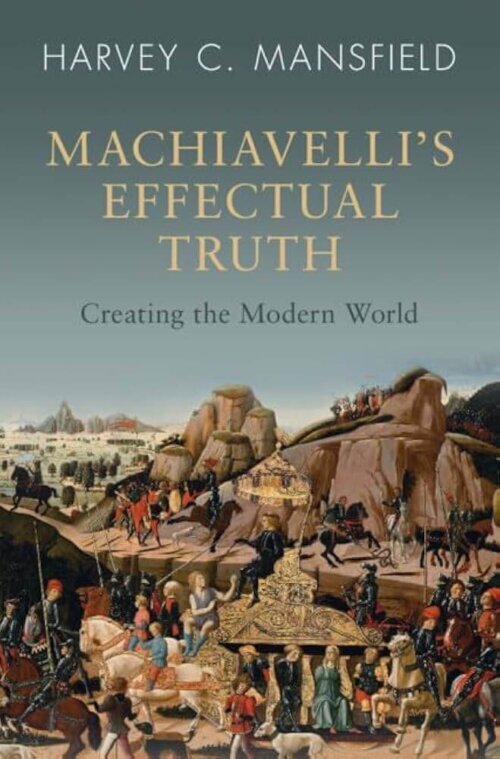
Machiavelli’s Effectual Truth: Creating the Modern World
By Harvey C. Mansfield
Cambridge University Press, 2023; 298pp


Related Posts