Marcus Aurelius the Artist
Today, Marcus Aurelius’ Meditations is undisputedly the number one best seller among classic works of philosophy. Numerous editions of Meditations, from deluxe editions with sprayed edges to novelty translations in the style of “Gen Alpha slang,” have recently been published. Aaron Poochigian, in his translation, claims that 100,000 copies of Meditations were sold in 2019. Every new translator of a classic text attempts to justify his translation by claiming he is doing something new and different, and with a text as popular as Meditations this attempt proves even more difficult. Poochigian, a poet and a translator of poetry, might seem like an odd choice to translate Meditations, a private journal of thoughts by an austere Roman emperor. However, his translation fits Marcus’ style. In fact, a poetic translation of Meditations might be exactly what this work needs.
It is undeniable that Marcus Aurelius wrote his Meditations to help orient himself in a world where things are always in flux. He wrote Books 2 and 3 of Meditations while he was commanding the Roman army against the Quadi. The burden of being a Roman emperor took a toll on Marcus, a sensitive soul who delighted in theoretical studies, as found in his dedications to his various teachers from Diogenetus to Alexander the Platonist. For Marcus, the Meditations acted as a form of mental therapy. Perhaps inspired by his philosophic and artistic education, Marcus used many poetic metaphors. Consider 2.17, where he compares human existence to a number of things: “The way of flesh is a river, and the soul’s affairs are a fever dream. Life is fighting in a foreign war, and posthumous fame is oblivion.” The draining nature of life must have been apparent to him when he was fighting the Quadi. He ends the aphorism on a somewhat happier note, saying that one should not fear transience and decay, which are simply part of the nature of things. We see more poetic metaphors in 3.2, where Marcus observes that “figs burst in their prime, and an olive’s imminent peril of dropping into decay lends a peculiar beauty.” In the hands of Poochigian, Marcus’ reflections on the transience of nature comes alive.
Another artistic maneuver Marcus employs comes in the form of polyphony, or the use of multiple points of view. Marcus uses three points of view in Meditations: the instructor, the aspirant and the objector. The instructor is a self-assured voice that addresses the aspirant’s concerns with various aspects of life. The instructor, however, is still presented with some humility in the form of the objector, who sometimes questions the instructor’s self-assurance. Poochigian makes sure that these three different voices are captured in the correct register.
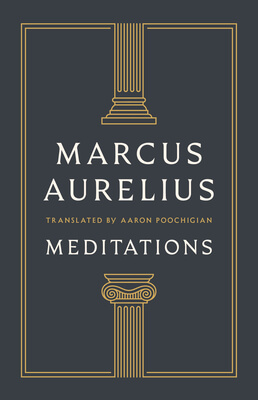
Liveright, the publisher of this work, also deserves some credit for publishing this poetic translation in a handsome volume. A simple illustration of a Roman column adorns the cover, and the edges are marbled with various calming colors. The book also comes with a gold ribbon as a bookmark, and there are ample spaces on the edges for personal notes to be taken.
Poochigian’s new translation is a welcoming addition to the studies of Marcus Aurelius because he pays attention to the personal character of the author. Meditations is a personal work of philosophy; we, the readers, should also take its lessons from it and apply them to our lives.
Meditations
By Marcus Aurelius, Translated by Aaron Poochigian
New York: Liveright, 2026; 288pp


Related Posts