Movies and the Soul
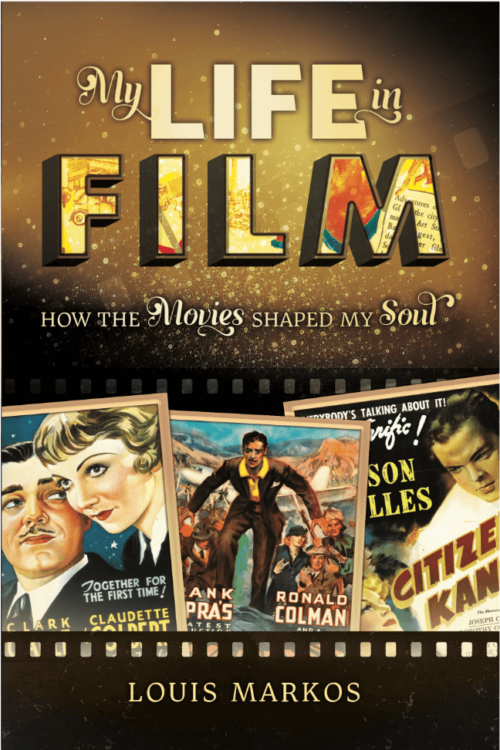
The Golden Age of American cinema, which is another way of saying the foundational cornerstone of cinematic techniques, lighting and sound, spirited motifs and joie de vivre, takes center stage in Louis Markos’ My Life in Film: How the Movies Shaped my Soul.
The twenty films that the author discusses in the book, beginning with Casablanca, Queen Christina being the concluding chapter, date between 1932 and 1951. The film genres included in the book are Golden Age American cinema staples: screwball comedy, musicals, film noir and dramas.
Markos approaches these films from several angles and perspectives that are hardly mentioned today by academic film ‘critics.’ While the author underlines the plotlines of the films, relevant backstories, actors and directors, and their commercial run and reception, his main contribution as a film buff is the cultural and moral impact of these films on himself, American culture and the appeal of American cinema for an international audience.
The modus operandi of the author in My Life in Film: How the Movies Shaped my Soul is to showcase these films to readers today by highlighting the cultural high-water impact that popular culture once had on American and world culture. This is a necessary corrective, especially for film audiences who have been molded by the throwaway films post 1980.
The author’s moral and cultural perspective explores twenty films and suggests many others that fit the bill of being what today are properly considered vintage Americana. One cannot easily sidestep the contributions of vintage Golden Age cinematic Americana without delving into the cultural and moral development that these films have ushered.
The author’s experience of ‘how the movies shaped his life’ is a common thread of film enthusiasts who value cinema from the Golden Age of American cinema. Why is that?
Acceptance of the cinematic convention that cinema is the illusion of reality brought about through the visual and sound magic that celluloid plastic film captures is only the beginning of why films from the Golden Age matter as classics of cinema. This cinematic illusion enables viewers to reflect on the relationship between realism and make-believe, appearance and reality.
For instance, citing some of the intrinsic qualities of Mr. Smith Goes to Washington, Markos writes, “Art was not meant to reflect the degradation of society, as it has done for much of the last century, but to lift us up to a higher vision and a nobler purpose.”
Mr. Smith Goes to Washington will come as a surprise to moviegoers who have never thought of cinema as uplifting, but as mere entertainment; a descriptive sociological snapshoot of our time, as if living-conditions today are the result of natural process, something akin to avocados falling from avocado trees and oranges from orange trees.
Markos refutes the ‘descriptive’ cinema cliché as a hackneyed ideological bias of postmodernity. Instead, he addresses the life-affirming and slice-of-life qualities of cinema. The author includes many examples of such films in the book: An American in Paris, The Palm Beach Story, It happened One Night, The Philadelphia Story, The Wizard of Oz, Meet Me in St. Louis and Top Hat. Also, included in the book are Frank Capra’s cynicism-busting films, It’s a Wonderful Life and It Happened One Night. The inclusion of Capra’s 1938 You Can’t Take it With You, a hilarious celebration of family life, would have quadrupled Capra’s contribution to the book. Perhaps in another book.
Also included in the book are what this reviewer considers philosophical films that entertain and explore topics of life and death, subjectivity, personal identity, happiness and contentment. In short, existential concerns that, whether we want to or not, eventually force their way into the fabric of human life. These include Casablanca, Lost Horizon, The Maltese Falcon and Citizen Kane. The inclusion of the latter four films rounds off My Life in Film.
Capra’s Lost Horizon is a poignant example of a film that attempts to do justice to existential motifs in cinematic form. Lost Horizon is a tale that sits well with literary magical realism, a genre that underlines the role of appearance and reality, and aspects of human reality that deliver us to reflection on the sublime and transcendence.
Lost Horizon is a story of place and time, which much to the chagrin of the main characters, either pins them to the reality they already know or delivers them to an enchanting world ripe for self-reflection. Markos writes, “To mark the threshold between the wasteland where nothing can live and the utopia where life can be lived as it was meant to be lived Capra places a simple wooden post.” The post is a metaphor for the embrace of existential self-reflection that can lead to self-knowledge, an arrow that points to the possibility of cultivating awe and wonder, and the hierarchy of being couched within the contingencies of the here-and-now.
Citizen Kane is considered by many critics the number one rated film of all time. While this is a subjective ranking system, it is true that the young and visionary Orson Welles was a pioneer in filmic depth perception and cinematic sound recording. Welles uses floor level and fish-eye camera angles that offer reflective vestiges of daily reality that depart from the ordinary. In effect, many aspects of Citizen Kane are truly surrealistic, especially many scenes inside Kane’s ‘castle.’ He also shows ceilings of rooms that highlight the emotions and thoughts of his characters, making characters and situations seem larger than life.
Welles’ cinematic photography and overlapping, often cacophonous dialogue – as one often experiences in gatherings that contain more than one person – in addition to long duration shots, translate into a panoramic expression of self-identity.
Who is Charles Foster Kane? This is the question that sets the stage for the film from the beginning, and which continues to be asked as the film closes. Citizen Kane is a study in biography, where sentences are left dangling in midair, to be finished by observant others. Such is life.
One of the finest lines of Citizen Kane is spoken by one of the many characters who attempt to piece together the life of Charles Foster Kane: “I don’t think any word can describe a man’s life.” Is this because people rarely pay close attention to what others say and do? Is it perhaps because Kane is a greater man than those who try to figure him out? Or, is it because human communication in the modern world has become a lost art? The young Welles is savvy about human relations in Citizen Kane, wise beyond the scope and attention span of his critics. Citizen Kane is vintage Americana.
My Life in Film: How the Movies Shaped my Soul is a viable tool for high school and university courses on American culture and values. While it is a book about American cinema, Markos’ work is also a celebration of filmic Americana, which is today a neglected term.
Markos’ book contributes to the ongoing legacy of American culture and its arts in a time of dissolution and deconstruction of all things American and Western culture. Thus, the importance today, perhaps more than ever, of the contributions of America to world culture and sustainable values.
My Life in Film: How the Movies Shaped my Soul
By Louis Markos
Middletown, RI: Stone Tower Press, 2024; 256pp


Related Posts