Plato, Nietzsche, and Strauss in Beijing
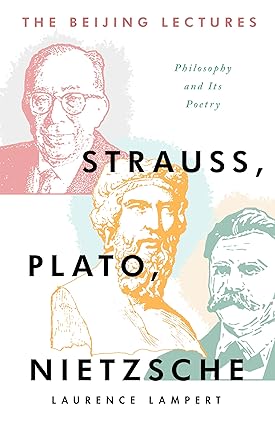
In the spring of 2015, Professor Liu Xiaofeng of Renmin University in Beijing invited Laurence Lampert to give a series of lectures at three of China’s leading universities. The purpose of these lectures was to explain the origins of the West, its deepest roots, and its subsequent development. The lectures were well attended and led to intense debates among Lampert’s auditors. Lampert described the visit as “the best intellectual experience of my life.” The importance of these lectures to the Chinese intelligentsia is also indicated by the fact that they were almost immediately translated and published in China in 2021. The current volume, The Beijing Lectures: Strauss, Plato, Nietzsche, presents the lectures in English to a western audience.
Why did Chinese intellectuals invite Lampert to Beijing and pay such close attention to his analysis? Lampert himself was unquestionably an important scholar: he had a distinguished career at Indiana University that spanned for 35 years. Moreover, he wrote 8 books (not including the Lectures) on figures ranging from Plato to Descartes to Nietzsche. Certainly, Lampert’s books are noteworthy for their clarity and depth. But this does not fully explain why Chinese intellectuals would be interested in them. Would not an economist, historian, or political scientist offer more insight into the emergence of the west?
To understand the interest in Lampert, we must consider one of his most fundamental and extraordinary claims, namely that the history of thought presents the deepest and fullest explanation of the history of the west. This is an insight that Lampert learned from Nietzsche, that genuine philosophers — in sharp contrast to scholars or “philosophical laborers” — command and legislate in such a way that they have had the most profound impact on the development of the west. This includes, of course, the west’s outward facing or global disposition, which is especially prominent in the development of modern science and technology. The Beijing Lectures demonstrate the truth of this claim and offer Lampert a chance to review his main discoveries over the past forty years of intense study.
Such insights are hard to come by. Even if we concede that philosophers are the best guide to understanding the development of the west, it is unclear that non-philosophers have access to their teaching. If the hallmark of a philosopher is his wisdom, how can non-philosophers judge the merit of their arguments? Moreover, the teachings in these books are often far from self-evident and difficult for the casual reader to comprehend. These books — written by the greatest intellects, working at their greatest intensity – demand the greatest concentration to penetrate their meaning. Thus, the first reason that Lampert’s work attracts attention from China is that he presents himself as a guide, and more importantly, he shows us how to navigate the works themselves. Lampert permits us to read over his shoulder while he works through a text. He presents decades of work in all of its original excitement and freshness.
To begin his lectures, Lampert turns first to an unusual source, Strauss’s private correspondence with Jacob Klein in 1938-9. Strauss never published this correspondence, but Lampert suggests that he never destroyed it either. The correspondence shows Strauss’s discovery of the philosophical art of writing in real-time. For the first time, he is able to discern the deepest teachings of elusive authors like Maimonides and Plato. This leads him to several radical insights: “What Strauss sees [in Plato] is radical: the true, hidden Socrates is, in his very different way, a kind of ruler and a kind of founder. Through Socrates, a theoretical man, a philosopher, a new kind of empire comes into existence, the empire of a philosophical ruler.” Following Nietzsche, Strauss argues that the genuine philosopher is a legislator who commands and legislates at turning points in the history of civilization.[1]
Lampert’s interpretation of Strauss’s discovery of esotericism is among his most original and valuable insights. Following Strauss, Lampert argues that philosophers cannot simply teach their discoveries because they are so shocking that they will be persecuted and canceled for doing so. However, the purpose of esotericism extends well beyond hiding radical teachings that threaten the safety of philosophers. The hidden teachings must be concealed because they are “deadly truths” that destroy the very societies within which philosophers live. Such poetry, then, benefits the philosopher and also provides non-philosophers with a life-affirming teaching. “Philosophic poetry” is essential for a healthy society, and only the philosopher is capable of creating it because only the philosopher is capable of making a spiritual diagnosis of his time and addressing it properly.
By announcing the discovery of esotericism, Strauss and Lampert appear to undermine the practice. This is not the case, however, because as Strauss wrote: “The problem inherent in the surface of things, and only in the surface of things, is the heart of things.” The surface of a great text often appears chaotic. To make matters worse, there is no a priori method to discovering its meaning, other than reading it carefully and paying attention to the details. Strauss shows his students how to do this, but leaves many discoveries up to their own efforts in order to preserve the excitement of the original discovery. Lampert goes further than Strauss in sharing his discoveries with his readers. His goal is to move beyond recruiting potential students of Socrates and Plato, and as a result, the need to preserve esotericism is less urgent.
A good example of this difference is found at the center of this book, where Lampert offers an interpretation of Plato’s Republic. The chapter begins by following Strauss’s account of Plato in the City and Man but quickly moves to the question of “how Socrates came to understand the fundamental truths of being and knowing.” To explain his development as a philosopher, Lampert must first explain how Plato presents Socrates, that is, how Socrates “came to understand what it was necessary for a philosopher to do in his time and place.” In other words, we must begin with Socrates’ discovery of political philosophy before we have access to his account of being. Lampert deliberately puts this framing of philosophy as a “theological-political question” – a phrase that Strauss generally uses to refer to the tension between reason and revelation. Lampert does so to emphasize the tension between philosophy and politics.
In addition to following Strauss, Lampert also reads carefully Strauss’s student Seth Benardete, who argues in the Bow and the Lyre, that Odysseus is Homer’s philosopher-king who returns home in disguise after a long absence to set things right in his kingdom. Socrates, after just having returned to Athens from the battle of Potidaea, likewise sets things right in the Charmides and Republic. Socrates too hides his wisdom in favor of a political project that can restore justice. In both cases, the political program is, according to Lampert, a theological-political program because it relies on a new teaching about the gods. In the Republic, the new teaching is preceded by a display of the effects of old, Homeric teaching about the gods. As Glaucon remarks in the Republic, speaking for the well-raised youth of Athens, he has become confused regarding the best way of life and whether justice is better than injustice. Homer’s portrayal of the gods is the source of this confusion; it corrupts the Athenian youth by establishing the superiority of thumos rather than reason as the ruler of the soul. Socrates introduces a new teaching about the soul, where reason directs the passions toward justice and virtue. The gods reward just individuals with happiness in the afterlife.
The Socratic teaching in the Republic is an exoteric teaching aimed at healing the youth who no longer know what to believe. For most young people, this teaching about the soul, justice, and the good life is sufficient to resolve their perplexity and set them on a course toward virtue. The Phaedo is set forty years after the Republic and it repeats the main teachings of the Republic. Lampert explains, with recourse to the Parmenides, that the narrative dating is meant to demonstrate that Adeimantus and Glaucon remain satisfied with the exoteric teaching of the Republic. But Socrates is also interested in recruiting potential philosophers, as he was recruited by Parmenides as a young man. For these careful readers, the same philosophic poetry points toward a more complex teaching about the gods and justice.
Lampert shows that Socrates’ restrained critique of Homer has a salutary effect on the Athenian youth while quietly making room for a more radical critique of the Homeric gods. But Lampert describes the birth of philosophy in anything but cautious terms: “Socrates teaches that Homer deserves to die… Socrates exoterically and actually killed off Homer.” It is true, Lampert concedes, that Socrates learned a great deal from Homer but “[t]imes change, gods die and politic wisdom must change with the times by teaching new gods.” The incendiary nature of Lampert’s rhetoric is intended to prepare the way for his endorsement of Nietzsche’s rhetoric and teaching. It also exposes the gulf between Strauss and Lampert’s solutions to the theological-political problem. Strauss argues for a modified return and restoration of the tension between reason and revelation, while Lampert argues that Nietzsche has “made every effort to kill off Plato” and with him, the God of revelation.
Why does Nietzsche adopt such heated rhetoric? The last two lectures address this issue. Lampert begins by revealing his debt to Nietzsche: “It was from Nietzsche, not from Strauss, that I first learned what a philosopher is and what a philosopher can know.” Paradoxically, Lampert learned how to read Nietzsche by applying Strauss’s discovery of esotericism to Nietzsche’s work and by reading carefully Strauss’s analysis of Beyond Good and Evil. Strauss’ last book, Studies in Platonic Political Philosophy, follows a mostly chronological order from ancients to moderns. But Strauss inserts his Nietzsche essay, “Note on the Plan of Nietzsche’s Beyond Good and Evil,” in the center of the book so that it follows his essay on “Jerusalem and Athens.” The placement encourages us to consider Nietzsche in light of the conflict between reason and revelation. It also implies that Nietzsche fits squarely within the tradition of Platonic political philosophy.
How can Lampert maintain with Strauss that Nietzsche sets out to destroy Plato and yet remains with the tradition of Platonic political philosophy? Both Nietzsche and Plato shared their devotion to preserving philosophy as a way of life for their rare followers. They disagreed, however, on the question of the content of philosophic poetry. For Nietzsche, Plato’s invention of the pure mind and the idea of the good in itself were assimilated into the God of Christianity. Among the causes that have undermined belief in this God, Lampert highlights the birth of modern science: “Modern times are the times of the technological mastery of nature based on the scientific understanding of nature.” Such mastery was the result of a philosophical project, by thinkers such as Francis Bacon and René Descartes, who judged it to be necessary and who outlined a corresponding theological-political program to ensure its success.
Whereas the medieval enlightenment had worked within a religious system, the early moderns viewed religion as an enemy of science and fought against it in the name of philosophy. They unleashed a ferocious wave of skepticism that seeks to destroy the good such that we believe in the good without knowing it. “Skepticism gives permission to place morality about knowing. The epistemological skepticism of the free minds is really a sign of bound minds, minds that are merely moral.” As such, skepticism threatens to destroy philosophy. To make matters worse, these modern skeptics “no longer know what religions are good for,”[2] The only God that they can imagine is the one that they have killed off. What remains of Christianity is secularized and takes on the form of the mastery of nature to abolish suffering and inequality in this world.
According to Strauss, Nietzsche identified the “highest, most difficult problem” in modern times, which is that “man is conquering nature and there are no assignable limits to that conquest.” Lampert points out that this is largely an ecological problem. Strauss’s focus is different. He warns that the conquest of nature, includes human nature, which must be must be conquered in the name of equality. This would destroy the very possibility of philosophy “because philosophy depends upon the recognition and encouragement of an order of rank and the continuation of suffering properly understood, understood as the human struggle to attain the high, most especially knowledge; that known suffering from a lack can be remedied only through sacrificial struggle—subordination of every drive to the drive for knowledge.”
Lampert’s lectures conclude on this note with a ringing endorsement of Nietzsche’s call for new gods and new poetry that speaks to modern man, particularly “the environmental disasters (that) are caused by human-initiated climate change.” He argues that such poetry is consistent with Plato’s critique of Homer and that as such, Nietzsche can be seen as a platonic political philosopher. Was this Strauss’s view, as Lampert alleges?
Strauss publicized his discovery of esotericism in books such as Persecution and the Art of Writing, which point to a radical layer of thought under the surface of the text. But Strauss also showed that radicalism in thought should be tempered by moderation in expression. In fact, the need for moderation is among the most important teachings of the philosophers. Strauss writes that “sôphrosunê [moderation] is essentially self-control in the expression of opinions.” If the moderation expressed in the art of writing is the expression of philosophic wisdom, then Nietzsche’s immoderation, his penchant for extreme or provocative prose, suggests a defect in his knowledge of nature and human nature. Has Nietzsche somehow confused the single-minded desire of the philosopher to know with the most pressing need for most people, knowing how to live well?
Strauss’s moderation is perhaps best expressed by the fact that on the one hand, he remains the best guide to grasping Nietzsche’s argument yet, on the other hand, he argues that reason and revelation remain vital traditions that animate the west. Lampert suggests that this unwillingness to expose more explicitly Nietzsche’s teaching is a failing that betrays a lack of courage: “Strauss, a philosopher who is a Jew and who had a lifelong sensitivity to the fate of Judaism in the twentieth century, refuses to speak about the theological-political project that Nietzsche suggested could be the center of a future world.”[3] If we take Nietzsche seriously, Lampert maintains that we must proclaim offensive truths, even at the risk of offending potential friends. Despite these differences, Strauss, Nietzsche, and Lampert share a dire analysis of our spiritual condition — a condition that gives rise only to deadly truths which destroy society and render meaningless the search for wisdom. It is indeed this shared sense of the dangers of modernity that makes Lampert’s book an important and necessary source, one that will reward the same close reading he gives to Strauss, Plato, and Nietzsche.
The Beijing Lectures: Strauss, Plato, Nietzsche
By Laurence Lampert
Philadelphia: Paul Dry Books, 2024; 211pp
NOTES:
[1] Lampert remarks in an interview that “basic to the notion of the Nietzschean history of philosophy is Nietzsche’s insight that the genuine philosopher commands and legislates (both words are important) and does so at particular turning points in the history of philosophy. So he calls for us to read the history of – not just of philosophy but the history of our civilization – in a way that brings out the active role played by these thinkers” (https://www.academia.edu/1066054/Interview_Laurence_Lampert?sm=b)
[2] In contrast, Lampert writes: “Nietzsche knows what religions are good for; philosophers know what religions are good for, as Socrates showed in Plato’s Republic when he altered or reformed Homeric religion in the time of its dying for intelligent young men. Only religion can structure the daily life of a culture; cultures live on beliefs and practices, on incorporated beliefs that one takes in from the earliest age in the stories told to little children and reinforces in the rituals and festivals and customs that give meaning and structure to ordinary daily life. And for religion to be viable, Nietzsche seems to think, there must be gods.”
[3] As Lampert wrote in a review of Heinrich Meier’s Leo Strauss and the Theologico-Political Problem: “Strauss, rational master of other philosophers’ timely strategy, thought it wise, in his time, to act as if the debate between philosophy and revelation could be a stalemate with neither able to refute the other. Was that wise? If he thought that the self-consistency of the philosophical life necessarily entailed, as Meier seems to imply, the activity of refuting precisely this opponent. Was he right? More generally, can it be wise, in our time, for philosophy to give heart to fundamentalism by helping it imagine itself immune to reason’s critique? Or, can it be wise, in our time, for philosophy to give the impression that it too is faith-based, however pedagogic such a stance may be?”


Related Posts