Plato’s Theocentric Cosmogony
Consistent with a Platonic hermeneutic program whose main premises I outlined in a previous essay, I will now present a first application of this unified vision. Specifically, instead of “translating” (or, borrowing a term from Auguste Diés, “transposing”) the doctrine of Plato’s dialogues into the terms of other doctrines, I propose an anti-reductionist hermeneutics that tries to explain the Athenian’s thinking within its own horizon. In this way, I intend to adopt, according to my understanding, the hermeneutic approach illustrated by exegetes like Konrad Geiser, Hans Joachim Krämer, and Jean-Claude Nilles. Against modern tendencies to secularize philosophy under the fatal impulse given by Cartesianism, Enlightenment rationalism, and Kantianism, what I propose is the re-enchantment of Platonism, i.e., the re-mythologization and interpretation within the horizon of its own cultural-religious tradition.
The second clarification, which anticipates the conclusions of my approach in this article, emphasizes the indissoluble unity in Platonic thought between cosmology and anthropology: Plato’s human being is a microcosm, while the cosmos is a macro-anthropos. Although it may seem at first sight meaningless, the postulate of the deep unity between micro and macro-cosmos has extremely important implications for the overall picture of Platonic thought. My entire interpretation is conditioned by this anthropological presupposition that gives meaning to the hermeneutic exercise I will outline. Before I begin, another conceptual clarification is necessary: why the concept of “cosmogony” is preferable to that of “cosmology.”
“Cosmogony” or “Cosmology”?
The “re-invention” of cosmological language by modern sciences after Galileo Galilei (1564–1642) represents an event with significant consequences for the meanings of some classical concepts. To avoid, as much as possible, the confusions created by materialist-physicalist approaches to the world, both anti-theological and anti-teleological, it is necessary to clarify the terms used.
Meaning “creation or origins of the world,” the Greek word kosmogonia first appears in the vocabulary of Plutarch. This does not mean, of course, that the term did not circulate in philosophical discourse before its written recording. Delving into its meanings, Reynal Sorel states that “cosmogony evokes the birth in illo tempore of primordial entities and their direct generation”; and “A late composition, it is nonetheless rooted in the original meanings of kosmos and gignomai. It retains from this verb its primary sense of ‘birth,’ ‘generation,’ and not the more recent sense of ‘becoming.’ […] From the word kosmos, the compound retains the idea of effective arrangement before that of the world.”
That being said, I prefer the term “cosmogony” instead of the more frequently used “cosmology” in modern languages because of the Platonic postulate that the cosmos (gr. kosmos) “is born” (like a human being – Timaeus 28b). Additionally, my choice is based on a certain distinction between cosmogony and cosmology: while cosmogony also encompasses the metaphysical-theological origins of the Universe, in its current understanding, cosmology refers exclusively to the various laws and changes existing within it.
Unlike contemporary astrophysics, Platonic cosmogony is a theocentric cosmology, which also discusses what lies beyond the visible, physical Universe: the Demiurge (the all-powerful God, creator of Heaven and Earth) and metaphysical principles. Cosmology is thus limited to the physical level of existence, while cosmogony also refers to its theological-metaphysical dimension. Plato’s world is much more complete and complex compared to Newton and Einstein’s world(s). Following the author of the Timaeus dialogue, here is how the Cosmos and its generating Cause are presented:
It has come into existence; for it is visible and tangible and possessed of a body; and all such things are sensible, and things sensible, being apprehensible by opinion with the aid of sensation, come into existence, as we saw, and are generated. And that which has come into existence must necessarily, as we say, have come into existence by reason of some Cause. Now to discover the Maker and Father of this Universe were a task indeed; and having discovered Him, to declare Him unto all men were a thing impossible (Timaeus, 28 bc).
All that has been shown above is not gratuitous speculation; it aims to indicate the grave semantic changes caused by deviations from the classical vision of man and the world. At the risk of attracting (post)modern criticisms, I clarify that I do not want to partake in any “reconstruction of metaphysics,” as argued by Martin Heidegger through a much too subjective and also non-theological interpretation of classical Greek philosophy.
The Reason and Order of Creation
Why did God create the world? This is a fundamental question prompted by the reading of the dialogue Timaeus, from which we learn the following:
He was good, and in him that is good no envy ariseth ever concerning anything; and being devoid of envy He desired that all should be, so far as possible, like unto Himself. This principle, then, we shall be wholly right in accepting from men of wisdom as being above all the supreme originating principle of Becoming and the Cosmos. For God desired that, so far as possible, all things should be good and nothing evil; wherefore, when He took over all that was visible, seeing that it was not in a state of rest but in a state of discordant and disorderly motion, He brought it into order out of disorder, deeming that the former state is in all ways better than the latter (29e–30b).
From this passage, we see that the motive for creation is primarily theological. The Demiurge is good and wants His goodness to be reflected in His creation. For Plato, the divine will is sufficient to explain the mystery of the origins of creation. This will falls under the remarkable “Good of Plato,” a divine aspect that, alongside the Demiurge, becomes manifest through the act of creation. Following the interpretation of the Greek scholar Anna Kelessidou, I assert that the Platonic universe is a “kalliphanie” (i.e., an epiphany of Beauty) just as much as it is an “agatophanie” (i.e., an epiphany of Goodness). The Platonic conception of the motive for creation involves the presence of all the aspects of the God: the Demiurge (who wills), the Good (which conditions the manner and quality of creation), and, not least, the Divine Intellect (“the living creature endowed with reason” after whose likeness the cosmos is designed).
This aspect of the Platonic conception – regarding the motive for creation – probably allows the greatest closeness between the Athenian philosopher and the Church Fathers, between Platonic philosophy and Christian theology.
When I make such a statement, I consider that in Judeo-Christian theology, creation is also the result of a decision arising from divine goodness and love, a decision reinforced by the will of God who brings creation into being through the logos (i.e., “word”). Furthermore, the way the aspects of Platonic divinity collaborate in the perfection of creation strikingly resembles the collaboration among the three Persons (the Father, the Son, and the Holy Spirit) of the Trinity in Christian theology. Thus, we can understand why many Saints and Doctors of the early Church Fathers – especially Dionysius the Areopagite, Justin Martyr and Philosopher, Clement of Alexandria, Basil the Great, Origen, and Gregory of Nyssa – were interested in Platonic cosmology. We should not forget the Irishman John Scottus Eriugena, that brilliant “barbarian believed to be from the end of the world,” whose vision of the cosmos perceived and understood as theophany preserves and perfects the (neo)Platonic cosmogonic doctrine.
Regarding the order of creation, we encounter the same hierarchical, ascending vision discernible in the theological context of the Timaeus dialogue, with the Demiurge taking everything that is “visible, not at rest, but in discordant and disorderly motion” and leading it “from disorder to order” (30a). Providing further clarification, in a passage immediately following the one just cited, the character Timaeus states that, “He (i.e., the Demiurgos) constructed intellect within soul and soul within body as He fashioned the All, that so the work He was executing might be of its nature most fair and most good” (30b).
By indicating the sequence of elements that constitute the cosmos – intellect (not a different part of the soul, but its “eye”), soul, body – the hierarchy involved in the structure of Platonic cosmogony is highlighted once again. Clearly, we encounter the specific hierarchy of Platonism, starting from what is “above” in the ontological order of the world: the intellect, followed by the middle term: the soul, and finally, the one situated “below,” at the physical level of creation: the body.
The Model of Creation: “The Living Intellective Creature” (noeton zoon)
One of the most specific inquiries of Platonism, consistent with the entire theory of ideas, pertains to the “model” or “paradigm” after which the cosmos was fashioned:
In the semblance of which of the living Creatures did the Constructor of the cosmos construct it? We shall not deign to accept any of those which belong by nature to the category of “parts”; for nothing that resembles the imperfect would ever become fair. But we shall affirm that the Cosmos, more than aught else, resembles most closely that Living Creature of which all other living creatures, severally and generically, are portions. For that Living Creature embraces and contains within itself all the intelligible Living Creatures, just as this Universe contains us and all the other visible living creatures that have been fashioned (Timaeus, 30cd).
As we will see in another article dedicated to the theology described in the Timaeus dialogue, the Platonic God has three aspects, including the Divine Intellect, which is the prototype iconically represented by the created world. The cosmos is nothing but a mirror reflecting this Divine Intellect, which, in turn, is the “supercelestial place” (hyperouranios topos – Phaedrus, 247c) where “being” (to on) is situated. In this context, we can assert that the “living creature endowed with intellect” (Greek: noeton zoon) should not be confused with intelligibles; it is transcendent concerning them, although it is for them what “forms”/“ideas”/“essences” are for things in the sensible world.
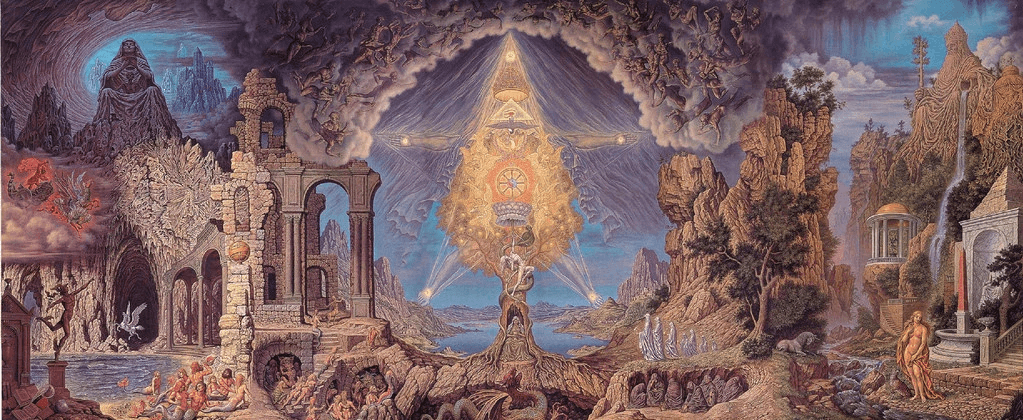
In a perspective similar to that of a French exegete, Jean-Claude Nilles, I maintain that the “living creature endowed with intellect” is a distinct aspect of Plato’s God, representing the mythologizing image of the Divine Intellect. In this perspective, it is necessary to preserve the mythologizing structure of Plato’s cosmos intact, without reducing its levels to one or another. Here is a comprehensive schema of the Platonic cosmogonic hierarchy:
THEOLOGICAL LEVEL
The Demiurge (ho demiurgos – the “highest” aspect of Plato’s God, also called the “father” – ho pater – of the cosmos);
Plato’s Good (tou Platonos tagathon – the intermediate aspect);
The Divine Intellect (nous, also called the “living creature endowed with intellect” – noeton zoon, the intelligible aspect of the Platonic God, through which the link between God and the cosmos is established);
ONTHOLOGICAL (METAPHYSICAL) LEVEL
Eternal Being (to on – the highest ontological level of creation);
Eternal Becoming (to gignomenon – the intermediate ontological level);
The Receptacle (he chora – the “lowest” ontological level);
PHYSICAL LEVEL
Created kosmos (which includes all the organic and un-organic beings);
Man, who is a unifying “synthesis” of the metaphysical and physical levels, must resemble the divine archetype.
Man and the cosmos are but “likenesses,” “icons” of God, whose intimate structure is generated and sustained with the help of the principles of the ontological level. This intimate structure, founded on the likeness of man to the Divine, underpins the concept of homoiosis theoi sometimes invoked by Plato.
The Soul of the World
No topic has been more fiercely debated by Platonic commentators than the structure of the soul of the world. In his monograph Le Même et l’Autre dans la Structure Ontologique du Timée de Platon (1994), Professor Luc Brisson described nearly all the interpretations of the famous fragment 35a–36d from the Timaeus dialogue, where, using substantial musical and mathematical knowledge, apparently derived from the Pythagoreans, Plato succinctly describes the structure of the soul of the world.
Before Luc Brisson, another French scholar, Joseph Moreau, dedicated a vast monograph to this subject: L’âme du monde de Platon aux Stoïciens (1939). Among the many aspects discussed over time, I will focus on one particular aspect, regarding the status of the soul of the world as an intermediary.
In the latter part of his study, Joseph Moreau shows that the Soul of the World “is an intermediary between the sensible Universe and its intelligible Model”); and “the soul is […] a cosmogonic symbol; in the history of the genesis of the Universe, it has an intermediary function.”
Luc Brisson, along with many other commentators, also supports this interpretation. The intermediary function is truly characteristic of the Soul of the World, representing a link not so much between the sensible and intelligible worlds but between the sensible world and the divine world (located at the altitude of that “supercelestial place” mentioned in the Phaedrus (247 c). The Soul of the World is the lens through which God views the created cosmos, which we can say, paraphrasing Jean Moreau, is a symbol that indicates through its signifying power the creative action of God.
The Soul of the World also represents the nature (physis) so sought after by the Presocratic philosophers. If the Timaeus dialogue is a dialogue “about nature,” it can equally be considered a dialogue “about the Soul of the World.” Rightfully, Brisson considers the fragment in which the Soul of the World is described as representing “le point d’équilibre d’une interprétation globale du Timée” („the point of equilibrium of a global interpretation of the Timaeus”).
Three elements constitute the Soul of the World: “existence” (ousia), “the same” (tauton), and “the other” (thateron). Without attempting to reduce these three elements to certain aspects of the Platonic philosophical discourse, I will suggest a “mythologizing” interpretation of the structure of the Soul of the World, using a Platonic symbol of the soul. Let us see what this is about.
In the Phaedrus dialogue, Socrates describes the human soul as follows: “We will liken the soul to the composite nature of a pair of winged horses and a charioteer” (246a). Later, we learn that “Now the horses and charioteers of the gods are all good and of good descent, but those of other races are mixed (for example, in the case of humans – my addition, RLK); and first the charioteer of the human soul drives a pair, and secondly one of the horses is noble and of noble breed, but the other quite the opposite in breed and character” (246a–b). In the Timaeus, speaking about the creation of man, Plato states that the “ingredients” (= “existence,” “the same,” and “the other”) used are “no longer with a uniform and invariable purity, but second and third in degree of purity” (41d).
Based on these fragments, we can observe a remarkable parallelism between the psychological symbol in the Phaedrus and the structure of the soul described in the Timaeus. Both the elements in the former – the horses of the chariot and the charioteer – and those in the latter – existence, the same, and the other – are equally impure. Consequently, logically “translating” this structure into the images of the winged chariot symbol, the charioteer would symbolize the concept of “existence,” the white horse the concept of “the same,” and the black horse the concept of “the other.”
I may be reproached that by proceeding this way: that I diminish the explanatory virtues of the philosophical description in the Timaeus in favor of the symbolic images in the Phaedrus. Nothing could be further from the truth! For Plato, the “scientific” (i.e., “abstract”) explanation was never the exclusive attribute of reason. Superior to it, the intellect can know and understand the world also symbolically, traversing the royal road of contemplation (described in Politeia as the “art of converting” the soul from the sensible to the intelligible).
The Body of the World
Present at the psychological level, the hierarchy and order of creation are also encountered at the somatic level. The entire description of the creation of the Body of the World highlights this fact:
Now if the body of the All had had to come into existence as a plane surface, having no depth, one middle term would have sufficed to bind together both itself and its fellow-terms; but now it is otherwise: for it behoved it to be solid of shape, and what brings solids into unison is never one middle term alone but always two. Thus it was that in the midst between fire and earth God set water and air, and having bestowed upon them so far as possible a like ratio one towards another – air being to water as fire to air, and water being to earth as air to water, – he joined together and constructed a Heaven visible and tangible (32 bc).
Given that the quoted fragment is quite transparent, I will only note that the mathematical organization and hierarchy of the cosmos constitute a serious reply to the charge of antisomatism directed against Plato, especially by some Christian theologians. How could this criticism be credible when we see that the body of the world is presented to us as being so meticulously constructed by the Father Demiurge? Without accepting the explanations of those who distinguish between multiple “ages” of Platonic dialogue elaboration – the youthful ones being antisomatic, while the mature ones being more conciliatory with somatism – I once again suggest the necessity of nuanced research based on the entirety of the dialogues and not just some of them, which suit the egocentric perspective of the researcher.
Anthropokosmos
Almost quoting from a text extracted from the fascinating Corpus Hermeticum, Luc Brisson rightly acknowledges that: “Man is a microcosm that recapitulates the macrocosm, but at a lower level. This is the essential point of the representation of man in Plato’s Timaeus.”
Indeed, the structure of the cosmos and that of man are in perfect correspondence. This structure is triadic, consisting of an intellect (nous), a soul (psyche), and a body (soma). Clearly, the Platonic anthropological vision is nothing but the reflection, at the level of the human, of the kosmos. As we have already said, anthropos and kosmos are the two faces of a single medal. This discovery led me to the investigation of Platonic cosmogony, which represents the core of my endeavor.
However, I have already established the foundation for any thorough study of how human knowledge occurs, correlated with the relationship between the divine intellect, the intelligible kosmos, and the sensible world. And, as a suggestion for other possible further developments, I am convinced that only within this context of an epistemology correlated with a Platonizing cosmo-ontology, will it be possible to elucidate the (apparently) mysterious doctrine of Aristotle about the “active intellect” (nous poietikos) and the “passive intellect” (nous pathetikos).
Thus, we have understood to take seriously the question posed by Socrates to Phaedrus, which, we believe, remains eternally valid, “Now do you think one can acquire any appreciable knowledge of the nature of the soul without knowing the nature of the whole man?” (Phaedrus, 270c).


Related Posts