Poetry that Breaks the Chains of Time and Place
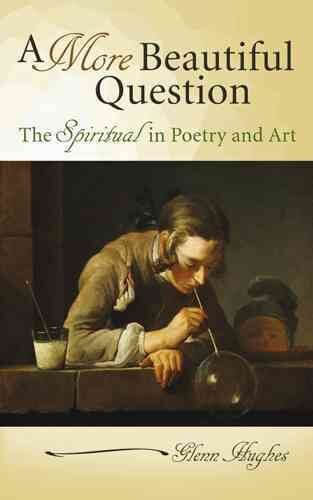
In popular media, a great deal of ink has been spilled over the loss of religious practice amongst people in the Western world. What has been neglected is an exploration of people’s spiritual orientation in our day and age, where there is not only a loss of religious practice, but also a loss of vocabulary to deal with transcendent experiences. In his book, A More Beautiful Question, Glenn Hughes observes that there certainly remains a spiritual energy in our day and age, but that this energy suffers from disorientation, born from “widespread attempts to find alternative religious symbolisms” in a post-Christian world, ranging from esoteric traditions to neopagan and occult practices to fundamentalist Christian and Islamic assertions. The work of philosophers has not helped our age of confusion. Hughes draws on the ideas of Bernard Lonergan, who alongside Eric Voegelin is one of the analytical anchors of his book, directing us with some humor to consider that philosophers, “for at least two centuries through doctrines on politics, economics, education…have been trying to remake man, and have done not a little to make human life unlivable.” Philosophers have achieved this notable feat through their own disorienting visions of immanentism, such as materialism, historical determinism, behaviorism, and scientism. I would add that, in this age of searching for new religious symbolisms for a transcendent anchor in life, reflecting on how scientists have participated in suffocating the wonders of the human person may also be worth our considerations. For example, a geneticist will reduce us to our genetic code, while a biologist will reduce us to a mechanical life form living in a cold universe governed by brute strength. Hughes, an ever-hopeful scholar in love with the world and the human beings who inhabit it, brushes aside such reductive nonsense with his work, A More Beautiful Question, a book concerned “with how art, and especially poetry, can function as a vehicle of spiritual expression and orientation” in this disenchanted world of ours.
Hughes is a meticulous scholar who often serves as a mediator between the difficult to comprehend work of Eric Voegelin and the interested student who yearns for substantive and rightly-oriented philosophy. This mediating work is most explicit in his book Mystery and Myth in the Philosophy of Eric Voegelin, but is also found in works such as Transcendence and History and A More Beautiful Question. Hughes is sensitive to the longings of the searching soul, which allows a type of friendship to grow between himself and the reader who is sincere in broadening their own horizons. Hughes is also an accomplished artist whose poetry and love of poetry informs his work when dealing with dense philosophical problems, so that his handling of Voegelin translates well to the reader. For example, in Transcendence and History he uses the work of Ezra Pound to illustrate the difficulties with situating oneself in-between human and divine modes of being, thus giving the reader another avenue by which to better internalize Voegelin’s ideas.
In A More Beautiful Question, Hughes demonstrates how good poetry can orient a person’s soul by focusing his study on three poets with three unique approaches to spiritual experience. The first is Jesuit poet Gerard Manley Hopkins (1844-1889), who understands that “all patterns of beauty in nature are, in their deepest being, self-expressions of Christ.” This naturally leads to the conclusion that our duty is to “praise and serve God through proper use of creation.” Pied Beauty is one of Hopkins’ poems that Hughes chooses to represent the poet. Here is the first verse of that poem, which accentuates a divine presence in creation and the dignified work of the person which, attuned to the rhythms of nature, becomes especially blessed in its own way:
Glory be to God for dappled things—
For skies of couple-color as a brinded cow;
For rose-moles all in stipple upon trout that swim;
Fresh-firecoal chestnut-falls; finches’ wings;
Landscape plotted and pieced—fold, fallow, and plough;
And all trades, their gear and tackle and trim.
The second poet is Emily Dickenson (1830-1886), who received religious formation in a Congregationalist community, but who ultimately rejected that community because, ironically perhaps, she was blessed with great sensitivity and openness to the mystery of divine presence. The assuredness of vision brought about by dogmatic thinking held no allure for Dickinson, who was at best skeptical of those Christians who presumed their salvation was secure, and who embraced religious symbols as settled facts. She did rely on religious language and imagery to “explore…her own…quest of what it means to live in the in-between of the tension toward the divine mystery, with all its doubts (and) unanswerable questions,” but her open-ended quest rendered religious symbols fluid and transparent, like passageways into divine presence. Dickinson’s open-ended engagement with divine presence relied more on a living faith than typical religious practitioners may properly appreciate, because she permitted the transcendence of the divine to be as it was without her intellect constraining it through simple, dogmatic formulas. One of the Dickinson poems Hughes draws on to reveal the poet’s open and searching soul is I meant to have but modest needs. Here is the first and part of the last verse of Dickinson’s poem:
I meant to have but modest needs—
Such as Content—and heaven—
Within my income—these could lie
And life and I—keep even—
But I, grown shrewder—scan the Skies
With a suspicious Air—
Dickinson represents the questioner who refuses to accept dogmatic answers to the transcendent mysteries found in human existence without critical reflection rooted in her own experience. In her work, Dickinson repeatedly “begins by affirming the reality of the transcendent pole…but then proceeds to explore the actual human relationship to it.” Here is the first verse of her poem, I know that He exists, which illustrates the point:
I know that He exists
Somewhere—in silence—
He has hid his rare life
From our gross eyes.
The third poet that Hughes calls on is T.S. Eliot (1888-1965). Similar to Dickinson’s poetry, Hughes understands Eliot’s work to be affirming “a mystically apprehended, radically transcendent divine ground” which Eliot expressed “through Christian experiences and symbols.” Most compelling for the modern reader, however, is that Eliot experiences a divine presence that “informs symbolizations of the sacred” in essentially all religious traditions, East and West, ancient and modern.
In A More Beautiful Question, Eliot is the poet who addresses the modern predicament created by our ignorance of the tension between time and timelessness. We tend to see our lives completely contained within nature, complete with the inevitable sufferings that imbue our corporal existence in a “disenchanted world.” Eliot does have confidence that most people have apprehensions of the timeless dimension of meaning, but rarely are we capable of incorporating the experience into our self-understanding. As Eliot writes in Dry Savages:
…there is only the unattended
Moment, the moment in and out of time
Nevertheless, as Hughes sees it, there is hope in Eliot’s work. He understands Eliot to be suggesting that these timeless moments in our experience are enough for many of us to gain a taste of freedom “from the lie of reductively temporal existence.” From Burnt Norton, some of Eliot’s words from Hughes’ selections:
The lotus rose, quietly, quietly…
a cloud passed…
the leaves were full of children…
containing laughter…
…human kind
Cannot bear very much reality
And from East Coker:
Whisper of running streams, and winter lightning.
The wild thyme unseen and the wild strawberry,
The laughter in the garden, echoed ecstasy…
There is also a way of darkness, or emptiness, that Hughes recognizes in Eliot’s work, which seems to be a more intentional manner of engaging with timelessness. From Burnt Norton:
Descend lower, descend only
Into the world of perpetual solitude…
…destitution of all property,
Desiccation of the world of sense,
Evacuation of the world of fancy…
As someone who has been formed by the work of Eric Voegelin, it is natural for Hughes to be most intrigued by the work of Eliot. He suggests that Eliot understands “history as a process that takes its most fundamental meaning from the pattern established by human experiences of timelessness,” which “revealed the significance of life as a journey toward God,” an idea that aligns well with Voegelin’s work.
A More Beautiful Question is not restricted to these three poets. Hughes has written an evocative work that avoids getting bogged down by the difficult language and ideas of Lonergan and Voegelin. For example, when trying to explain Voegelin’s idea of living in the metaxy, with a love of life combined with “the longing, triggered by beauty,” for a fullness that is infinitely beyond us yet fully present, Hughes turns to seventeenth century haiku master Basho for help:
Even in Kyoto—
hearing the cuckoo’s cry—
I long for Kyoto
When trying to articulate Hopkins’ concepts of inscape and instress, that being, an onlooker’s moment of harmony with an object or work of art and the divine energy that holds the form of that object together, Hughes turns to Rainer Maria Rilke’s poem Archaic Torso of Apollo to animate the idea:
We cannot know his legendary head
with eyes like ripening fruit. And yet his torso
is still suffused with brilliance from inside,
like a lamp, in which his gaze, now turned to low,
gleams in all its power. Otherwise
the curved breast could not dazzle you so, nor could
a smile run through the placid hips and thighs
to that dark center where procreation flared.
Otherwise this stone would seem defaced
beneath the translucent cascade of the shoulders
and would not glisten like a wild beast’s fur:
would not, from all the borders of itself,
burst like a star: for here there is no place
that does not see you. You must change your life.
While reading A More Beautiful Question, I was not surprised to realize that I was experiencing my own moments of liminality. As I read, I listened to a 4-record set of Chopin, played by Ivan Moravec, entitled The Poetry of the Piano. As the hours and days passed with Hughes’ book, the music that I normally relegate to the background emerged into the foreground, and an appreciably new form of intentional listening began to fill me with a sense, as Hughes articulates it, of the unity of all things within a cosmos imbued with mystery. Hughes is sensitive to these moments, but with a sense of humor he writes that he is also aware that it can be difficult for people to share what a piece of music or art may mean to them, where in sharing they “run the risk of sounding like an idiot.” Not wishing to sound like an idiot, I will add that I share my experience of Chopin while reading to illustrate that Hughes’ work is not only informative for students of philosophy and art, but also evocative and artful in its own unique way. The artist will read Hughes’ work and be left with a more mindful sensitivity to the art they engage with and the creative process they participate in.
Hughes also guides the reader on a personal meditation without ever imposing a program of discernment. For example, the first chapter of the book is titled “Childhood, Transcendence, and Art,” which naturally evokes a response from the reader as they place their childhood experiences next to the ideas Hughes is exploring. Hughes places our childhoods into that realm of experience referred to by Voegelin as “the primary experience of the cosmos,” a time when we sensed the wholeness of reality. Our childhood cosmos is “riddled with epiphanies, with intense moments of absorbing wonder and fascination,” the mystery of our experience part of a permanent reality. Hughes uses the poetry of Wordsworth to illustrate the experience, with the poem Intimations of Immortality:
There was a time when meadow, grove, and stream
The earth, and every common sight,
To me did seem
Apparelled in celestial light,
The glory and the freshness of a dream.
Hughes reminds us that all things on this earth must come to an end, and so it is that we grow out of childhood into “an increasingly disenchanted world,” where “we find ourselves to be individual players.” Society tells us that we have evolved out of our childhood superstitions. Filled with pride over our enlightened scientific perspective, we learn to smugly classify God as a psychological projection or a representative of infantile needs.
Ever enamored by the transcendent, Hughes reminds the reader that there is still hope for us. Those who are sensitive to the world within which they live have the capacity to recognize that “the human desire to know and love is unrestricted,” and that our longing for beauty and perfection, combined with our unrestricted questioning of the cosmos, points to a mysterious reality we engage with but never pin down. It is a mysterious reality that cannot be bound by material being or time. Hughes quotes Simone Weil to remind us that “all the goods of this world, past, present, and future, real or imaginary, are finite and limited and radically incapable of satisfying the desire that perpetually burns within us for an infinite and perfect good.”
The final chapter, “Art and Spiritual Growth,” continues this meditation. Hughes begins by citing Goethe, gently reminding us that when faced by the superior qualities of another person, “we have no safety but love.” Many of us suffer routinely from trying to dismiss or diminish the imaginative, cognitive, virtuous, and artistic achievements of talented people, but the only way for us to avoid self-limitation or self-delusion is to “suffer the vulnerable openness of loving” those whose greatness measures us, yet also welcomes us. Goethe’s lesson of love carries a twofold intention for Hughes. There is the law of love to live by, which deepens our connection to the world and the people in it, and there is the reminder to academics and professional art critics to avoid institutionalizing art, where progressivist dogmas can reduce great art to psychological perspectives or other time-bound prejudices of the post-modern scholar. Good art doesn’t argue, Hughes reminds us. Good art presents an experience to us, “asking nothing of us but to explore it if we wish to.” Good art, in other words, is lovingly evocative, but it respects our freedom; it does not tell us what to think or how to judge.
While recognizing the unequaled power of religious conversion, Hughes explores how good art can also lead to soulful conversion. In receiving good art with love, we receive “intricacies of perspective and insight” that touch on “our desire for loving communion with its greater enterprise of…spirit—its greater horizon.” The expansion of our horizon can lead to “a mild dissatisfaction with oneself,” with a sense of anxiety, or perhaps the realization that something in our life is “genuinely out of key.” The “diligent seeker” will accept the gift of this greater horizon and “reorganize” their living at this higher level of being to “keep pace” with the broadening of their horizon.
Drawing from Lonergan, Hughes highlights three critical levels of conversion that lead to a broader horizon of perceiving and experiencing reality. The first is the “rejection of the naïve assumption that ‘reality’ must consist only of what can be perceived by the senses.” The second is a moral conversion, where one begins to conscientiously base one’s decisions on what is truly good as opposed to allowing personal gratifications to rule one’s perceptions and actions. Good art can promote a moral conversion by “reminding us of our freedom,” and reminding us that we can live our lives “in a more meaningful…dignified, more excellent and more ‘beautiful’ way.” The final level of conversion for Lonergan is a religious conversion, though not perhaps as a religious devotee may anticipate. Lonergan’s analysis, Hughes reminds us, “is psychologically nuanced, noncreedal, explicitly universal in scope, and respectful of all the ambiguities and uncertainties involved in a person’s conscious affirmation of…a participatory relationship with a genuinely mysterious transcendent divine reality.” A person falls in love “with the ultimate source of all truth and goodness.” In other places, Hughes calls this falling in love with the “ground of being,” and being sensitive to the holiness of things “and to the infinite value, vulnerability, and true needs of persons.” Unless one is overburdened by skepticism, or worse, cynicism, the reader will allow Hughes’ meditation on conversion to guide an exploration of their own place in the cosmos, and to grow more aware of the route they have taken on their pilgrimage to arrive at this place in time. Hughes challenges the hesitant reader with the words of the 13th century Sufi poet Jelaluddin Rumi:
Forget your life. Say God is Great. Get up…
If you are here unfaithfully with us,
you’re causing terrible damage.
If you’ve opened your loving to God’s love,
you’re helping people you don’t know
and have never seen.
Hughes cares about the reader. He is trying to nudge us “to the boundary of an unrestricted falling-in-love with divine transcendence,” because he knows how it will profit the reader.
I will close this review of Hughes’ book by highlighting one of his own poems, published in VoegelinView, titled, A Visit to the Planetarium:
In the daft heaven of the planetarium,
stars and galaxies streaked away from us
expanding in multiples of ten
ad infinitum,
while a soothing, booming voice
spoke of space and wonder, until our minds
grew dull from numbers and din
and brilliant distraction.
Outside the museum were bare trees
in wintry light, squirrels with plump cheeks,
pale shadows of branches
on brittle snow,
and she was quiet. I loved her
infolding like this, and we walked crunching
over the snow-paths, greeting the rude
pinches of wind.
The poem shares an experience that reminds us that we do not merely exist within “an astrophysical universe but a cosmos.” Even a tree or a squirrel, insignificant next to the scale and grandeur of a galaxy, possesses a sacramental potency, bringing us into contact with timelessness. Furthermore, the physical breadth of our expanding universe, impressive to be sure, is matched by the unfathomable depth of our souls. To seek out what Voegelin termed “the balance of consciousness,” Hughes is offering us an illuminated path: the evocative and mysterious quality of good art, and the patience to pause before it with a heart open to love.
A More Beautiful Question: The Spiritual in Art and Poetry
By Glenn Hughes
Columbia, MO: University of Missouri Press, 2011


Related Posts