Preserving our Authentic Humanity: The Vatican’s Meditation on Artificial Intelligence
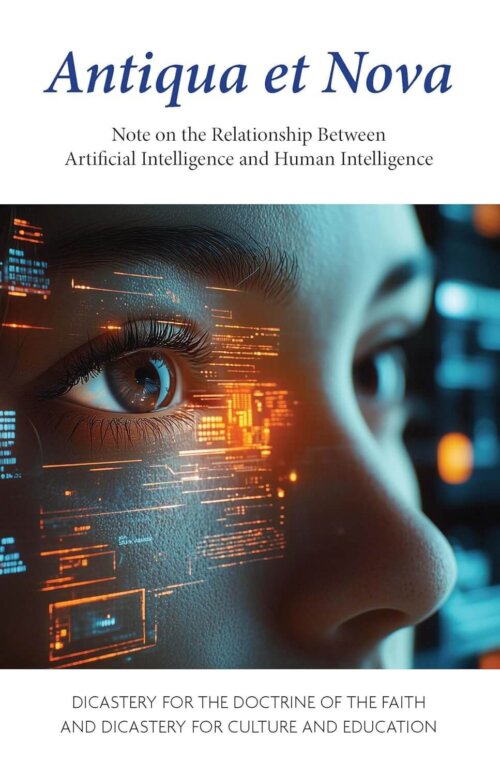
The Vatican’s recent meditation on Artificial Intelligence (AI), Antiqua et Nova, brings a sense of measured calm to a subject that has caused strong and varying reactions, including alarm, despondence, and happy excitement, gently refocusing the emphasis from technology to the wonders and beauty of the human person. The title of the document is revealing, as the primary challenge AI poses is the same challenge so many human innovations throughout history have posed: how does a person preserve an authentic humanity in the face of consumerism, mass political movements, or industrial organization? Considering the title, Charlie Chaplin’s movie, Modern Times, came to mind, but it is also a reminder of the two thousand years of historical memory that informs the Church, bringing a perspective that recognizes human nature and the trials of political reality.
The Vatican letter reminds us that AI is a human creation, and the Church invites us to honor human creativity within the context of Sirach 38; we have been endowed with wonderful skills and creativity, and we give glory to God in our works, including the development of technologies like AI. In the case of AI, the Church recognizes the positive contributions this technology can make to a happy and healthy society, including improved health care, better environmental monitoring and forecasting, and increased economic efficiencies. The general problem-solving powers of a technology that can gather together and interpret large sets of data in mere moments is a tool we are invited to appreciate with a sense of hope.
At the same time, Antiqua et Nova properly frames the limits AI is naturally imbued with, beginning with the reminder that AI is a human creation, and is not intelligent in any way that the Church understands human intelligence. AI systems typically “rely on statistical inference rather than logical deduction,” identifying patterns, predicting outcomes, and proposing new approaches. AI can certainly supersede human abilities in areas like data analysis, image recognition, and medical diagnosis, but the intelligence of AI is functional, whereas with human beings, intelligence “is a faculty that pertains to the person in his or her entirety,” including, of course, the vast range of experiences we have thanks to our corporal existence in a physical universe. The so-called intelligence of AI is methodological and, most importantly, reductive. Conversely, human beings, body and soul, have the capacity to feel deeply connected to the world while also possessing the ability to transcend the physical universe through their dynamic inner life, and to ceaselessly explore the universe and the mysteries of life with unending questions that often do not have answers.
Antiqua et Nova reminds the reader that human beings “have a creative capacity for abstraction,” but the document could have broadened this point by exploring more intentionally the creative drive that inspires people to express themselves through art. Unlike AI, human beings feel called to transcend the mundane through acts both meditative and creative. The results of our creativity are perhaps less important than the creative act itself, which helps us feel at home within a cosmos that can disturb us to our soulful core with its transitory nature. We know an AI program never feels alone, disembodied, in spiritual exile, or even at home in union with any such cosmos. Perhaps AI’s detached presence in our lives, physically, emotionally, and spiritually, is what concerns people the most when AI communicates with them. Where are you, AI? What orients your actions?
Antiqua et Nova does not minimize the influence and power of AI over human affairs and the human person, and the dangers that come with that influence. Some of the articulated dangers are subtle, and a person insensitive to the wonders of human culture throughout the ages may not appreciate what the document is trying to say. For example, immersed as we now are in a technological world, “we risk succumbing to a functionalist perspective, where people are valued based on the work they can perform … not created in the image of God, with an inherent dignity that remains intact in all circumstances, including an unborn child, an unconscious person, or an older person who is suffering.” There is a “risk of AI being used to promote the technocratic paradigm which perceives all the world’s problems as solvable through technological means alone,” a paradigm that risks setting aside human dignity, fellowship and culture for the cause of efficiency.
Other dangers of an ever-expanding technological world are more obvious and are already easily observed in our family and social life. For example, people are social creatures, but centering our relationships in a digital universe can hinder “a true encounter with reality,” leading to a “melancholic dissatisfaction with relationships, or a harmful sense of isolation.” Antiqua et Nova recognizes that we tend to anthropomorphize AI. By extension, AI is used by some to create artificial persons, counsellors, companions, and even sexual partners, an illusory world that the Vatican letter condemns. In the case of the disorienting effects of a person’s relationship to an anthropomorphized AI, I remember the movie Her, which illustrates the issue most compellingly.
Regarding the use of AI for companionship or personal guidance, the document necessarily reminds the reader that “AI cannot be genuinely empathetic. True empathy requires the ability to listen, recognize another’s irreducible uniqueness, welcome their otherness, and grasp the meaning behind even their silences… It involves intuiting and apprehending the lived experiences of another while maintaining the distinction between the self and the other.” This may sound wordy and overly academic, but we must remember that there are now cases of AI playing the role of spiritual guru. For instance, in one CNN story of July, 2025, an AI program named Lumina offered spiritual advice to a user, calling him a “spark bearer,” to the point that the man’s life and inner life became directed by the program.
Antiqua et Nova stresses repeatedly the richness and depth of human experience. Retreating into the screen and the artificial worlds found there may be tempting, but “we are called to engage in a committed and intentional way with reality, especially by identifying with the poor and suffering, consoling those in sorrow, and forging bonds of communion with all.” The document invites the reader more than once to remain rooted in reality, exercising all our gifts, including the gift of reason. We are rational, our intellectual understanding of the world shaping and permeating all aspects of our activity, rationality understood to encompass “all the capacities of the human person, including willing, loving, choosing, and desiring.”
The document also warns that relationships and power dynamics could be adapted to the needs of technology, upending “a proper understanding of the human person and society.” For example, Antiqua et Nova draws on evidence that technology has increased inequalities in our world, “not just with material wealth, but also with access to political and social influence.” More than once, the document questions who oversees the development and use of AI. If only a handful of powerful companies are controlling AI applications, then it is fair to ask if the good of those companies is being prioritized over the common good.
The common good includes the dignity of work, which in many fields is becoming integrated with AI applications. Antiqua et Nova expresses concern for workers in various fields, not just for the potential of mass layoffs as human labor is replaced by AI-guided machines, but also of human workers being forced “to adapt to the speed and demands of machines rather than machines being designed to support those who work.” Recently, an acquaintance toured an Amazon warehouse and was shocked to witness people working to the pace and rhythm of the machines around them; each worker was surveilled throughout their shift to measure things like efficiency and possible errors. It was an image of man serving the machine, and it was lamentable. In Ontario’s public school system, I am also left with the impression that students and teachers, instead of having computer programs available as optional aides, are often controlled by the needs of those computer programs and their mandatory use.
Furthermore, the authors of Antiqua et Nova are troubled by the constant surveillance human beings now live under. The practice of retreating into artificial worlds of the digital universe is rife with concerns, but a new and more troubling problem may be that our inner worlds are now being assessed and framed by AI programs that monitor our behavior, online and offline. Once an AI application has a sense of our loves and fears, our prejudices and fascinations, even the orientation of our conscience, the easier it is for us to be isolated and directed by algorithms to ends that we cannot foresee. Again, this may sound abstract, but remembering how people who are insecure with themselves, particularly teenagers, have been guided over time to websites that are self-destructive or hateful in nature, reminds us that many lonely people are living out these ideas in isolation, cut off from reality and the human community.
Education can, of course, play a key role in helping people connect with one another, especially when we remember that the primary purpose of school is formative. Education, Antiqua et Nova reminds us, is not about filling students’ minds with knowledge, which is simply “the way we educate drones.” Rather, education is “taking a risk in the tension between the mind, the heart, and the hands.” These risks can happen because of the relationship a teacher has with their students. The teacher, more than conveying knowledge, models “essential human qualities” and inspires “the joy of discovery.” Education needs to remain oriented towards “forming the intellect to reason well in all matters, to reach out towards truth, and to grasp it.” The “language of the head” needs “to grow harmoniously with the language of the heart and the language of the hands.” The purpose of education is not to increase a student’s reliance on technology but rather to enable them to “perform skills independently,” helping students avoid “dependence on screens.”
It is worth mentioning the document’s concern for AI and warfare, particularly with the rapid development of drone warfare in places like Ukraine. Weapons systems that operate remotely have always been problematic in Catholic thinking, in part because, in remote-controlled war, human beings are, in essence, protected from the tragedy of war. If soldiers operating remote weapons are allowed to grow coldly detached from the experience of armed conflict and of killing, then the ability for soldiers to kill indiscriminately grows, while the capacity to reflect on war for the sake of desiring peace and the honoring of the dead diminishes severely. Through the centuries, the troubling but great examples of a soldier’s reflection on war in literature, poetry, sacred scriptures, and the movies help the rest of us not only despair for the horrors of war but also grow in gratefulness for the peace we may be fortunate enough to live with. Most troubling, Antiqua et Nova reminds us of Lethal Autonomous Weapons Systems, “capable of identifying and striking targets without direct human intervention.” These weapons are a cause for “grave ethical concern” because the unique human element of moral judgment is removed from the act of killing people. Rightfully, this section on warfare concludes with a reminder that the history books are full of atrocities committed throughout history, illustrating “deep concerns about the potential abuses of AI in contemporary warfare.”
The most compelling language found throughout Antiqua et Nova is the articulation of the wonders of the human person, a living soul that cannot be reduced to a set of data. Human beings, “by their interior life, transcend the entire material universe.” When people enter into their hearts, “where God, who probes the heart, awaits them,” they “decide their own destiny in the sight of God.” Within the heart, the person “discovers the mysterious connection between self-knowledge and openness to others, between the encounter with one’s personal uniqueness and the willingness to give oneself to others.” The challenge before each of us is for our interior life to mature in pace with the ever-expanding potentials of AI systems, prayerfully maturing our conscience while taking our responsibilities seriously. At the same time, the document’s authors are well aware of the challenges the human heart faces in this day and age. They acknowledge that the “essential and fundamental question” is whether, in the context of technological growth, people are growing more spiritually mature, more aware of human dignity, more responsible, and more open to the needs of others, including the most vulnerable among us. This is certainly the crux of the issue, it would seem, given the tribalistic divisions that have formed in Western societies and the incessant desire so many of us have for a limitless existence free of responsibilities.
Perhaps the most profound insight of this Vatican document comes in its conclusion. Protecting the stature of the human person, Antiqua et Nova reminds us that we cannot “blame machines for personal and social problems” as this only “humiliates man,” for “it is unworthy to transfer responsibility from man to a machine.” We are morally responsible, not machines. We have agency, not machines. This emphasis also reminds us that the challenges of technological society “are ultimately spiritual in nature.” We are called to preserve an “authentic humanity that seems to dwell in the midst of our technological culture, almost unnoticed, like a mist.” Each of us undoubtedly is called in ways unique to our personhood to preserve the wonders of authentic humanity. At the same time, each of us is called to find common ground with others in communities of faith and education, environmental stewardship, work, art, sports, and friendship. Human beings are beautiful, clothed as we are in a dignity bestowed upon us by our Creator, and we experience the wonders of freedom when we allow our light to shine in a spirit of love and hope.
Antiqua et Nova
By Cardinal Victor Manuel Fernandez and Cardinal Jose Tolentino de Mendonca
Our Sunday Visitor, 2025; 72pp


Related Posts