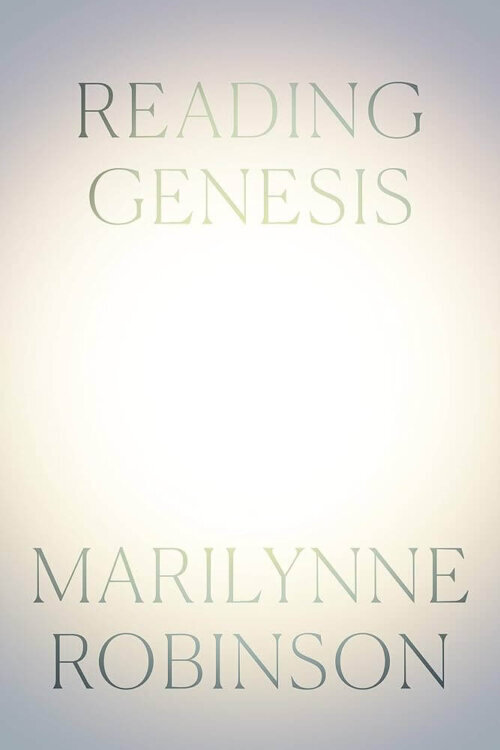
Reading Genesis Anew
“The book of Genesis begins with the emergence of Being in a burst of light and ends with the death and burial of a bitter, homesick old man … God loved Jacob and was loyal to him, no less for the fact that Jacob felt the days of his life, providential as they were, as deep hardship.”
In Reading Genesis, Marilynne Robinson shows how this “magnificent account of the onset of being” is for the most part, the story of a family. A family that like all families, has skeletons in its closet: but this family drags them out – even props them around. Because the most sacred aspect of history, the interest God takes in people like ourselves, requires such candor (though lack of candor is an old family trait). Throughout, Robinson shows both God and humans acting freely; she shows our “declensions” and how in a framework of covenants, “The Lord, in the thoughts of His heart, has yielded to His love for the incorrigible – in Old Testament terms, His Absalom; in New Testament terms, the Prodigal; in theological terms, the lot of us.”
Her argument is that God’s purpose remains undiminished, despite our diminishments. Humanity matters to God, and the way we treat one another matters to Him. Yet it is primarily God’s restraint in dealing with us and with our mistreatments of one another that allows history to happen. It is His restraint that allows any one of us enough personal cohesion to struggle with Him. We long for righteous resolutions, now. But the restraint of God is always ushering in greater abundance: “what could be lost if small earthly dramas of action and reaction foreclosed whatever might come in the fullness of time”?
Ms. Robinson is in her element as a novelist of human families. She, too, is the author of fatally flawed fathers and sons. The tenor of her voice here conveys something of the tenderness and tenacity with which a Creator ponders, inhabits and comprehends, and adheres to the creature. And she brings to her meditations not just a novelist’s cherishing-into-being of beloved, albeit wayward, objects, but a highly developed religious awe. In dealing with God’s reported appearance in Jacob’s dream, she comments that it is beyond her ability to imagine what state of mind and comprehension a vision of God would create in anyone. But her divine apprehensions are acute, and she conveys them well – of a God so unlike the pettily motivated people who often appear in these stories, His responses to them are unfathomable. He sees and hears. He forbears. He forgives. He blesses. He persists. “We are disastrously erring and rebellious, and irreducibly sacred. And God is mindful of us.”
She draws on her Calvinist tradition especially in her treatment of God’s persistence with us, and His ability to shape His purpose out of our past. The Calvinist tradition emphasizes God’s transcendence, His “simplicity” or wholeness or one-ness, His freedom of action, and His self-binding into covenant with humans. She wants us to see how reverence for a God like this has shaped the text. She also wants us to see how distinct a reverence is, in its conception of God and of the preciousness of humanity, from texts of other ancient cultures. The gods of the Enuma Elish are many, and are as cruel and querulous as Sarah was, to Hagar. When they destroy, it is not because they are grieved to the heart by our homicidal squabbling, but because they are themselves homicidal squabblers. They tremble at their own outbursts.
She also wants us to see how distinguished Genesis is in its concern for the outsider, and in its realism: a realism so unique in ancient literature it is “a sort of miracle”: “These men and women saw the face of God, they heard His voice, and yet life for them came down to births and deaths, love, transgression, obedience, shame, and sorrow . . .”
Reading Genesis is marketed as an “interpretation,” and is listed on Amazon in various categories of criticism and study. It begins with a brief explanation of Robinson’s approach to Genesis, which she takes to be a profoundly coherent product of deep pondering by pious and learned rabbis, over centuries, and to have been received as Scripture by ecclesiastical councils. She takes it to have been composed post-exodus, and its primary author to be Moses. Her interpretation continues as a loose essay on the creation account and the “primordial stories” (Cain and Abel, the flood, the division of languages at Babel) – these she especially contrasts with two Babylonian epics: the Enuma Elish and Gilgamesh. Her method assumes the reader is already largely familiar with Genesis. Especially in this section, Ms. Robinson contends that “the Genesis stories, rather than adopting or appropriating [ambient myths], instead engage the literatures to which they are often compared, accepting an image or a term but transforming its meaning within a shared language of thought.” (The possibility that similarities in older literatures could arise from similarly remembered events is not raised.) She argues that this transformation has a moral dynamic not found in other ancient literatures – Genesis emphasizes the goodness of creation, and a good purpose in its Creator, and a righteousness that ought to characterize human actions. Righteousness nurtures life – in Noah’s case, it can save a world. It is unrighteousness that destroys us. These themes carry into the patriarchal tales, with God’s intention to bless all human families in Abraham, who will “teach righteousness to later generations.” Throughout, she highlights the text in a more loosely associative and suggestive way. The text of Genesis in the KJV translation is included after her interpretation.
Ms. Robinson can write with elegant or emphatic simplicity: chunks of narrative, particularly, are often related in short sentences and direct words. But her flair for hypotaxis, for embedding clauses within clauses, and tacking clauses to the end of those – her delight in long words and long sentences – gives her voice a movement like the rocking of an ocean. The drawn-out cadences form rhythms that, like waves, feel constant and almost endless – but not quite predictable; and the whole huge continuous motion conveys a sense of enormous depth. It also conveys, as sound, one of the themes of the book: the “vast stretches” of time God takes, in his purpose for humanity. His providence reaches across “unnumbered generations,” a long intention embedded in the complications of our short, struggling lives. He takes such a long time over His work that no individual lifespan can clarify or construe it. Where a Babylonian woman might cite a gods’ random malice to explain a child’s death, for instance, “a Hebrew could say that her God had a great purpose unfolding in time, far too vast in its workings to be readily described as providential, except in faith.” Or again,
“We are being told a story different from epic or fable, and different from conventional history. The mind of the text hovers over a very long span of time, during which an absolutely singular providence works itself out through and among human beings who are fallible in various ways and degrees and who can have no understanding of the part their lives will play in the long course of sacred history … this narrative concerns itself with the singular history of a chosen people, one not primarily meant to offer examples of virtue or heroism or to support generalizations about ethical conduct but meant instead to trace the workings of God’s loyalty to humankind through disgrace and failure and even crime.”
The record of God’s loyalty, Robinson goes on to say, is “the world’s best hope.” And as a vehicle of hope, Reading Genesis is superb.
But “the first obligation in commenting on the text is to be faithful to the text.” As careful elucidation of a text, Reading Genesis is of more precarious merit.
This is largely because Ms. Robinson does not cite sources, or follow a rigorous and methodical path through the text. Approaching in a loose, associative way leaves her free to highlight, or to skip over text, as suits her own themes. At times she frames plausible discussions that presume on a degree of familiarity in the reader, but not a very high degree: in a number places the text is conflated or inaccurately presented: i.e., she conflates two distinct occasions where Abraham laughed, and where Sarah laughed, into one. She discusses the etymology of “trespass” – because, she says, the KJV translators chose not to use the words “debts” when translating the Lord’s prayer in Matthew. (But Matthew 6:12 in the KJV reads: “Forgive us our debts, as we forgive our debtors.”) About Isaac’s request for savory food, she writes: “Typically for the Hebrew Bible, gaze is averted from the question of the kind of wild creature Esau will hunt and kill.” (But the KJV translates that Esau hunted for “venison” several times in this passage, and the disparity between her statement and the translation is not discussed.) I could not find support for her assertions about the etymologies and usages of English words, though the usages in my dictionary went back before the KJV translation; and she does not list her source. Such imprecisions are frequent enough to cast doubt on her assertions generally, though many of her positions are more than seemingly plausible.
A more complicated issue, a kind of Procrustean parallel, is hard to illustrate briefly. Here, Ms. Robinson highlights connections which necessitate lopping off parts of the text, so that her connections are made at the expense of those drawn by the text. Her stated approach is one of reverence for the text as it stands, but these connections seem to require a hypothetical reconstruction of the text whose boundaries and content she does not define. So, for instance, her interpretation never mentions Seth (of whom Eve says that God “hath appointed me another seed instead of Abel, whom Cain slew”), even when directly referencing Genesis 4:26. A father-son parallel she draws between Noah (descended from Seth in the ninth generation in Genesis 5) and Lamech (descended from Cain in the fifth generation in Genesis 4), and her view of God’s “great leniency toward” Cain are problematic, if Seth is taken into consideration. And she stakes the overarching structure of her interpretation on God’s great leniency toward Cain.
The notes in Robert Alter’s translation suggest scholarly debate about how conflated the genealogies of Cain and Seth originally might have been, so Ms. Robinson may have reasons she does not discuss for taking Seth’s Enoch, who walked with God, as Cain’s “estimable descendant.” But the phrasing of Cain’s punishment is surely as vigorous as Adam and Eve’s: he is cursed from the ground which gaped open to receive the blood of his brother. This has an especially sharp edge against Cain’s rejected offering: a tiller of the ground, he brought an offering of its fruit. Cain is, in some way, being ejected from the garden all over: this is God’s response to Abel’s voice crying to him from the ground. But it goes against Ms. Robinson’s assertion that God takes no vengeance for Abel’s death – from which she draws a parallel across Genesis with Joseph’s forgiveness of his brothers. God’s language about Abel’s blood and many other details are passed over in her treatment of these scenes. About Abel, she merely writes: “Interestingly, [God] is not reported to have said anything to Abel, toward whom, with his sacrifice, He is said to have ‘had respect.’ The name Abel means ’emptiness’ or ‘vanity’ or ‘something transitory.’ The story was always about Cain. The sacrifices were of no real importance.” Earlier, she observed aptly that “this famous tale is a study in the fact that people see what they want to see, even in Holy Scripture, whose presumed authority should encourage careful reading.”
She describes the flooded world’s re-emergence so that I could almost see the sluiced tops of the mountains, and the shine and flash on all the multi-form animals when they are finally released from the ark. She connects the blessing of God on that post-diluvian world to the first blessing at creation. She sees that Noah, like Adam, fell. But she is intent on drawing a connection between Noah’s poetically structured curse of Canaan, and Lamech’s (of Cain’s descent) poetic boast over killing a young man. The wider catena of shocks that parallel the fall go unobserved: a taboo’ed (here, drunken) partaking of fruit / nakedness-and-shame / curse. And on the other side of Ararat, there are dismal echoes in the story of Lot and his daughters, alone in the high country after a great judgment. But we only hear Noah’s curse rebounding from Lamech’s petty boasts in Ms. Robinson’s telling, and there is no sound of anything more haunting and world-shattering. With all the type scenes in Genesis that foreshadow or amplify one another and future events (i.e., the sister-wife scene which shadows Israel’s descent into and divine ejection from Egypt; the betrothal or bride at the well; annunciations; deceptions involving garments and kids of the goat, etc.), the book deals only partially, as parentheses pointing to material in between, or it does not address them.
Finally, Ms. Robinson writes early in the book about why she sees the New Testament bound to the Old, and she quotes from the New Testament often. Yet on a number of topics she makes statements that contradict the New Testament authors’ conclusions, without referencing them. She elicits the purpose of God, toward the end of Genesis, from Joseph’s apprehension of it: “to preserve life.” This is one with God’s purpose in creation, in blessing creation, and in binding himself to engage with humans – in restraining his power and judgments. But the New Testament authors center this preservation of life in a covenant with Christ, and around Christ’s death and resurrection – and they have a different interpretation of topics like Abel’s significance, ritual sacrifice, the sacrifice of Isaac, God’s reconciliation of vengeance with mercy.
But again (and again), in long falls on the ear, the ocean of Ms. Robinson’s thought conveys the faithfulness of God. His purpose remains undeflected by our history. Reading her comments on how righteousness sustains life, I was comforted in my fears for the world and where it’s headed: one righteous person still matters. It made me want to strive harder to be that person. And reading her treatment of re-creation, post-flood – and of God’s refusal to again curse the ground for our sake – I understood better than I ever have why the earth comforts me. She connects the constancy of “seedtime and harvest, and cold and heat, and summer and winter, and day and night” to God’s constancy, to his covenant. God has imbued the earth with something of himself. Something so patient, so generous and fixed in its own purpose – it can take in all of our harrowed years and give back unperturbed abundance. It is God who comforts us in the shining grass or the quiet woods. The long stretches of patchy scrub that edge rural highways around here really do bear a resemblance to immense, outstretched arms.
I will reread Reading Genesis for how it conveys the essence of God and the essence of us – locked in struggle or embrace like Jacob and angel. It’s a simple conclusion, but I’m not as paratactically gifted as Ms. Robinson: I am so grateful for this book. For a scrupulous treatment of the text of Genesis, I supplemented with (and am indebted here to) Robert Alter’s notes and translation.
Reading Genesis
by Marilynne Robinson
New York: Farrar, Straus and Giroux, 2024; 352 pages


Related Posts