Scientizing Liberty: Gary Gindler’s Heroic Failure
When discussing political philosophy, it is important to be discussing political philosophy. Political philosophy is not “politics” as we use that term in societal parlance, and political philosophy is not political science or ideology. We hear terms like “left” and “right,” “conservative” and “liberal” and “progressive,” “socialist” and “capitalist.” But what does all this rhetoric really mean?
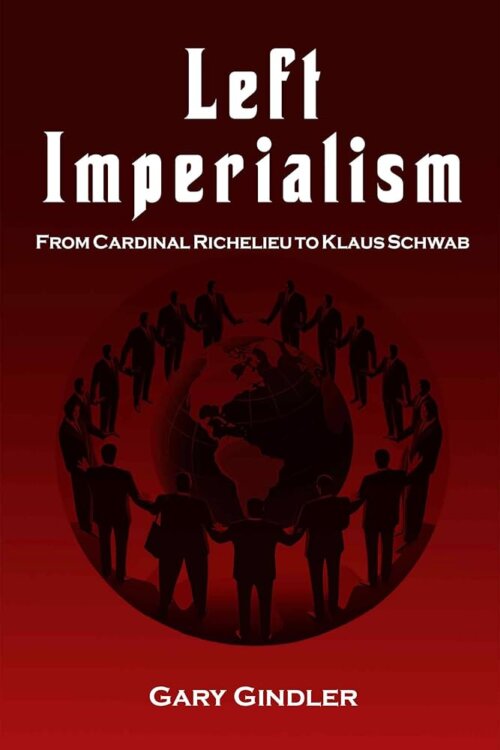
Left Imperialism: From Cardinal Richelieu to Klaus Schwab by Gary Gindler, is an attempt to deconstruct our current political rhetoric and reframe our understanding of contemporary political ideologies. This effort, in principle, is heroic and noble. We are saturated in a cacophony of noise that doesn’t help lead to greater understanding of the political crisis we find ourselves. Unfortunately, Gindler’s attempt leaves readers just as befuddled as before.
It should be noted right away that Gindler is a friend to liberty and self-governance, ideals that we should seek to revitalize and expand in the twenty-first century. A man born in the USSR who now calls the United States home, his own story is an inspiring tale of success and triumph. Readers will be delighted with the author’s individual-state paradigm in reframing the conversation of what it means to be favorable to progress and liberty and what the author implicates as regressive and imperialistic. However, Gindler’s efforts in offering a new explanation of political discourse, his “battle of terms,” is confused and shows a lot of misunderstandings despite an equally impressive rhetorical panache which includes citations of Darwin, Orwell, Hemingway, and others.
*
There is an irony of Gindler’s work given the author’s PhD in science (Theoretic Physics). Modern political theory and its derivative ideologies, as most political philosophers like Leo Strauss and Eric Voegelin explained, are the children of the Scientific Revolution of early modernity. Classical political philosophy concerned itself with the nature of the soul, wisdom, and virtue—how to live in accordance with nature which would lead to the development of virtue and the attainment of eudemonia (happiness). Classical political philosophy operates within a framework of humanity harmonizing with nature. Modern political philosophy, with its early foundation found in the Renaissance, and reaching its formal birth with Sir Francis Bacon and the classical liberals of the seventeenth century, concerned itself with the conquest and transformation of nature to create the “reign” and “empire of man” as well as the “relief of man’s estates” (per Bacon’s own language). Modern political philosophy is “scientific” in conformity with the Copernican and Newtonian revolutions of science wherein political philosophers attempted to understand human nature and human action in conformity with the latest discoveries of science paired with the economistic understanding of man in purely materialist terms—the acquisition of goods to satisfy the needs of the body. Gindler is following this tradition of modern political philosophy which includes the political philosophies he dislikes, like socialism and Marxism or what he describes more ubiquitously as the “Left.”
In his seminal essay, “Three Waves of Modernity,” Strauss explained the common feature of modern political ideologies: the belief that science, technology, and industry can transform the world and bring about a world of “universal peace and affluence.” This was the ideology constructed out of the New Science of Francis Bacon and the scientific revolution of the early modern period. In its “classical liberal” form, this scientistic ideology aligned itself with individuals and communities of particularity—the English capitalist, for instance, who put his individual desires first but never lost fact of his Englishness—and was aligned with the growing expansion of parliamentarian governance over and against aristocratic and royalist rule which was reactionary in its alliance with agrarian and diocesan attachments to the land capitalists wanted to develop. The association of classical liberalism with individualism, capitalism, and democracy was a circumstance of history since the scientism of the techno-scientific transformation of nature was opposed by royalist monarchism with its “throne and altar” politically committed to the more ancient way of organizing society around nobleman, land, and church: agrarianism.
Liberalism’s ultimate foundation, then, was not the individual, capitalism, or democracy but the belief in the scientific conquest and transformation of the world. This is what Strauss highlights with rigor and insight. Liberalism’s insistence on science and industry empowering individuals to attain the needs of the body was then picked up by the second wave of modernity, socialism, which inherited the belief in the scientific conquest and transformation of the world but reinserted the importance of community to human living which would pave the way for the socialist embrace of humanity over the local and the national. Socialism then developed a belief in the possibility of utopia, something that may have been implicit in classical liberalism but remained undeveloped and unrecognized until the socialist preaching of earthly perfection. The third wave of modernity, fascism, took from liberalism the scientistic ideology of conquest and the communitarian ideology of socialism to create the scientific nationalism that so defined it during its brief existence, rejecting the universalism of socialism and the individualism of bourgeois liberalism while embracing a conceptual nationalism premised on hereditarian biology and social Darwinism as Eric Voegelin explained (and using this biological and hereditarian science as the basis to organize an earthly utopia in union with the power of science, technology, and industry).
Gindler implies in his introduction, and again in his first chapter, that Left ideologies are primitivist and regressive—seeking to take humanity back to a primordial existence of premised around communalism. “Leftists continue to romanticize backward countries.” This romanticism is supposedly the outgrowth of their collectivist regressivism (a term now commonly employed by many to distance themselves from leftwing ideologues they find distasteful). While also a popular talking point on the contemporary right, this very much misses the crucial point of leftwing romanticism of countries opposed, principally, to the United States. The romanticism of the Left toward backward countries like Cuba, Venezuela, and North Korea is not because they are primitive but because they’re politically opposed to American hegemony.
To understand this phenomenon, rather than crudely label it a form of regressive politics, we must understand the misunderstanding many have concerning the heart of Marxism. We are familiar, as Gindler explains, that Marxism “viewed [historical] conflict through the primes of a struggle between two antagonistic classes.” This is true, but reductive, and misses the larger scope of the Marxist worldview. Marxism, being a modern and scientistic ideology, as defined above, embraced the scientism of the Enlightenment. Marxism holds to the same fundamental view of liberalism: the scientific conquest and transformation of nature (and that man is an economical animal). This scientific conquest and transformation of nature subsequently leads to human liberation, this human liberation from the constraints of nature are the fruits of labor. Through human work, humanity realizes their ability to self-create and self-transform, improving their lives in ways previously unknown to earlier generations. The problem, for Marx and the Marxist movements inspired by him, was that the current epoch of capitalism sought to limit that liberation and improvement. The class struggle that so defines Marxism only defines Marxism in its current historical epoch. Marxism is a modern and scientistic ideology, just like liberalism is, and just like fascism is. It is progressive, not regressive, in its self-understanding of the meaning and purpose of life and history. Marxism purports to progress us in the realm of human social science history just as Newton progressed us in astronomical science and Darwin progressed us in biological science. The United States, as the preeminent nation of capitalism, must be opposed by Marxists out of principle because it is the great buttress against human development and liberation as it is the great entity of the capitalist spirit constraining future human growth and eventual liberation. The leftwing romanticism of “backward countries” isn’t a nod to the low development of these countries but a principled political allegiance to these countries as they all oppose American, capitalist, power.
I want to now assert myself with a problem of the left-right paradigm used by Gindler, part of the broader problem in continuing to use this outdated rhetoric that defines political science but not political philosophy. National socialism was not a leftwing movement even though Gindler asserts it was. National socialism was a modern and scientistic ideology. Why? Because it was a modern and scientistic ideology and therefore shares many surface level similarities with the leftwing ideologies born in the same techno-scientistic intellectual milieu. As Paul Gottfried, the eminent paleoconservative and historian of fascism, has written and stated, fascism and national socialism were rightwing in the understanding of what rightwing meant in the early twentieth century: opposition to internationalist socialist revolution (which would lead both fascism and national socialism to oppose Soviet Bolshevism). If the left-right paradigm has any remaining usefulness in the twenty-first century, it is as a categorical term to denote the politics of universalism (the left) and particularism (the right); national socialism is, therefore, definitionally on the right as it opposes the universalist and internationalist politics of the left while nevertheless adhering to the same techno-scientistic foundation of thought that pervades all modern political ideologies.
The left-right paradigm, however, obscures the triumph of modern political ideology: the triumph of the scientistic ideology of conquest and transformation. Gindler sometimes quotes the eminent writer George Orwell, who explained socialism as that which is “technically achievable” to create a better, more prosperous, more peaceful world. Orwell’s statement elucidates the reality of socialism’s marriage with science and technology, that which is “technically achievable” is achievable through the power of technology and technology’s ability to reorganize and restructure society.
Rather than understanding our political dynamics in the left-right paradigm, understanding modern politics through political philosophy is absolutely necessary. We live in the age of ideology because the age of political philosophy, how we should live the good life with concern for the human soul and its relationship with nature, is dead (or deliberately suppressed). This is all the hysteria over Christianity and politics—fear of the destruction of the monopoly of political ideology and the return to the questions of first principles. We live purely in an age when the belief in the scientific conquest and transformation of the world to bring about “universal peace and affluence”—per Strauss—is all that is considered legitimate and any concern for questions of the soul, God, and the good life must be brushed aside as a superstitious threat to the modern ideological imperative.
Globalism is not the “highest stage of left imperialism” as Gindler asserts. Globalism is the highest stage of the scientistic ideology of modernity. Globalism is the complete and total conquest and transformation of the world through the power of technology. Science and technology transcend borders, communities, and religion. Science and technology relentlessly arrest nature and puts it against the rack of interrogation to discover its innermost secrets as Bacon explained. Thus, what defines modern politics is not the paradigms of left-right, individual-state, liberty-collectivism, but the scientific domination of nature wherein economics and human self-creation/self-liberation come to replace the seminal questions of political philosophy with which Plato and Aristotle were concerned.
This reality is well-known within the contours of political philosophy and has been for some time. Back in the 1970s, the Canadian Catholic philosopher Charles Taylor explained Marxism within the Enlightenment tradition of scientism and technological progress. Thus, leftwing political ideologies are very far from being primitivist and regressive as crude rightwing polemicists like to say and certain old-school liberals like Bill Maher now also proclaim. Rather, the Left is, and remains, one of the many variations of the modernist ideology of scientism.
Now we can turn to the true heart of the modern political dilemma. If we cannot escape the scientistic monopoly over politics—which is what classical political philosophy, especially in its Christian variation attempts to achieve in returning human minds and hearts to the questions of metaphysics, ontology, God, and the good life—then we are left with the scientistic duopoly that Gindler rightly identifies but for the wrong reasons. We are trapped in the individual-state paradigm, but not on account of the framework of collectivism-liberty that Gindler presents. Instead, modern politics is trapped based on capitalism-progressivism paradigm that defined the non-Marxist ideologies common to the Anglo-American world at the turn of the century with Marxism remaining the universal alternative to the capitalist-progressivism paradigm of the West.
Progressivism was the marriage of capitalism and socialism through the State guided by scientific experts. Progressivism, whether in its Fabian variety in the United Kingdom or in its “Progressive” form in the United States, concerned itself with the rule of experts. Progressivism was the synthesis of the scientism of capitalism and the scientism of socialism with the “merit” of individual experts who would constitute the new knowledge aristocracy. This is the oligarchy that Gindler correctly detects we are currently living under. But this oligarchy is not based on the conspiracy theories directed at Klaus Schwab but the logical outgrowth of the scientistic ideology of modernity which Gindler himself is trapped in. Progressivism is the ideology of the techno-scientific state while capitalism, as a term positively employed, is the ideology of individual self-advancement.
*
In his exceptional work The Shield of Achilles, Philip Bobbit explained the wars of the twentieth century as a contest between liberal democratic capitalism, fascism, and socialism. Liberal capitalism kept open the possibility of individualist empowerment through science and technology which stood over and against the state-sponsored scientism of fascism and socialism. Now, however, liberal capitalism is suffering from the conflict of state-scientism vs. individualist-scientism. In popular rhetoric, the left advocates state-sponsored scientism whereas the confused and fractured right endorses the belief that the power of science and technology should be decentralized in the hands of individuals and local communities and not the state. We might say that the centrist persuasion is about retaining some independence of corporations from the state while also advocating the cooperation of corporations and the state to continue the expansion of scientific conquest and domination over the world.
The history of political philosophy helps us understand the real political dynamics at play. A nation like China is an expression of the modern scientistic ideology of state-controlled scientism (which is often called “socialism” or “communism”). The administrative and bureaucratic entity known as the European Union is an expression of the modern scientistic ideology of state-sponsored or state-legislated scientism, the “progressivism” that is the rule of experts, defined by the complexities of rules and regulations aiming to achieve some ideal parity. The United States is pulled between becoming an expression of state-sponsored scientism (the Democratic Party) and defending the existing but diminishing corporate and individualist models of scientism (the Republican Party in its “establishment” and “populist” variations respectively). Virtually all contemporary politics derive from the scientistic ideology of modernity, which is ironically where Gindler is trapped as his final chapter “Summa Ideologicae” shows. He defines all political ideologies and terms in scientific-economic ones. This reveals how pervasive the scientistic ideology has spread. Even many who are sympathetic to individual liberty and who recognize individual liberty is under threat cannot conceive of individual liberty apart from the scientistic-economic terminology of “wealth.” This returns us to those political terms, where left and right, socialist and capitalist, conservative and liberal, are all defined within the scientistic-economistic mentality that capitalism, socialism, Marxism, and national socialism all derive. Though Gindler tries to tease out differences, those with a formal knowledge of the history of political philosophy realize they are merely different expressions of the same phenomenon. This is very different from the soulful considerations of Plato, Aristotle, or Aquinas that defined classical political philosophy. It is also radically different from the philosophical understanding of conservatism, liberalism, and socialism offered by someone like Roger Scruton who does not define conservatism, as Gindler does, as the ideology which “advocates the primacy of the people’s wealth over government wealth” but rather the preservation and passing on of the ethical and emotional wisdom found in culture: art, architecture, music, literature, poetry, philosophy, and religion.
Despite the conceptual flaws of Left Imperialism, the reader is left with no confusion as to where Gindler stands on the question of the relationship of the state and the individual. He is a friend of individual liberty. As a friend of individual liberty, he is friend of mine and I think I stand on good ground saying Eric Voegelin would consider Gindler a friend of the cause of liberty too. Given this reality, I would encourage Gindler to read Leo Strauss and Eric Voegelin, both of whom are conspicuously absent in his index of subjects and references. In doing so he will recognize the danger of the technocratic world we live in, the scientistic politics that has monopolized political discourse and thinking which he himself falls into, and the need to break free of the techno-scientistic monopoly that stifles political discourse and thinking.
Left Imperialism: From Cardinal Richelieu to Klaus Schwab
By Gary Gindler
St. Paul, MN: Paragon House, 2024; 288pp


Related Posts