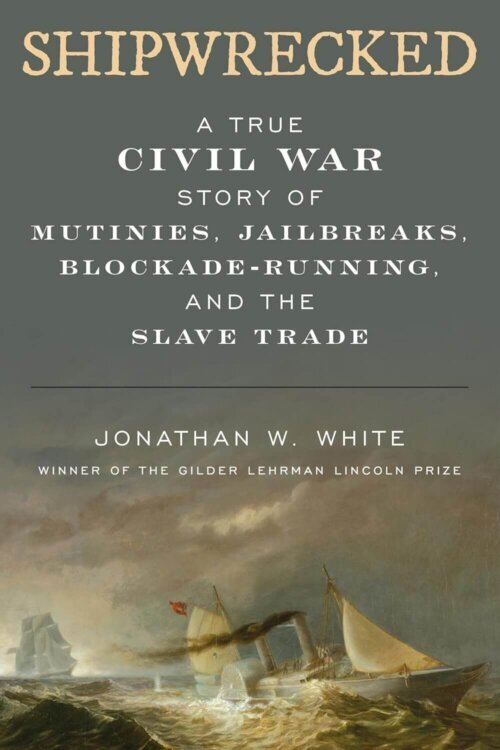
Shipwrecked
In Thomas Jefferson’s original draft of the Declaration of Independence, the final charge against King George was to be focused on slavery. Jefferson wrote that the King
has waged cruel war against human nature itself, violating it’s most sacred rights of life and liberty in the persons of a distant people who never offended him, captivating & carrying them into slavery in another hemisphere, or to incur miserable death in their transportation thither. This piratical warfare, the opprobium of INFIDEL Powers, is the warfare of the CHRISTIAN king of Great Britain. Determined to keep open a market where MEN should be bought & sold, he has prostituted his negative for suppressing every legislative attempt to prohibit or to restrain this execrable commerce….
This proposed passage, which was deleted from the final version of the Declaration, is remarkable for a number of reasons. First, the passage sheds light on a key point of contention between Abraham Lincoln and Stephen Douglas in their famous debates of 1858. Douglas claimed that “[t]he signers of the Declaration of Independence never dreamed of the negro when they were writing that document. They referred to white men, to men of European birth and European descent, when they declared the equality of all men.” Lincoln, in contrast, insisted that the Declaration’s assertion that “all men are created equal” truly was intended to apply to “all people of all colors everywhere,” as he once put it, in the sense that all people by nature possess the same rights to “life, liberty, and the pursuit of happiness.” Jefferson’s proposed paragraph on slavery makes it clear that Lincoln was absolutely correct that the Declaration’s authors (or at the very least its main author) believed that Black people were included within the meaning of the phrase “all men are created equal,” for Jefferson suggests that enslaved Africans by nature have the same “sacred rights of life and liberty” as anyone else.
Jefferson’s deleted passage is also notable for the moral fervor with which it denounces the transatlantic slave trade, including the horrors of the Middle Passage, as an “execrable” practice that is tantamount to “piratical warfare.” Of course, Jefferson’s attempt to absolve the American colonists of any responsibility for the horrors of the slave trade by blaming it entirely on the King is highly problematic. In contrast, in 1865, when Lincoln referred in his great Second Inaugural Address to “the bond-man’s two hundred and fifty years of unrequited toil,” Lincoln did not suggest that the first 150 years of this unrequited toil should be blamed on the British government that had controlled the colonies. Instead, Lincoln argued that all 250 years of slavery, stretching back to the early seventeenth century, constituted an American “offence” for which the terrible bloodshed of the Civil War could be seen as divine punishment.
Jefferson himself conceded that the King was not solely to blame for the slave trade’s perpetuation when he wrote that his proposed passage on slavery “was struck out in complaisance to South Carolina and Georgia, who had never attempted to restrain the importation of slaves, and who, on the contrary, still wished to continue it.” Moreover, once the Americans gained independence from Great Britain, they did not immediately ban the slave trade, as Jefferson’s deleted passage might lead one to have expected them to have done. Instead, in another concession to Southern states, the Constitution of 1787 prohibited Congress from banning the slave trade before 1808.
The U.S. Congress, “[i]n apparent hot haste,” as Lincoln put it, did indeed pass a law in 1807 so that the slave trade to the United States would be banned as soon as possible under the Constitution – namely, January 1st, 1808. In 1820, Congress passed an additional law which declared American participation in the slave trade to be a form of “piracy” – which is, as we have seen, how Jefferson described it – that would be punishable by the death penalty.
Nevertheless, as the historian John W. White discusses in his fascinating new book, Shipwrecked, an illegal slave trade involving American captains and ships persisted. Shipwrecked is a biography of Appleton Oaksmith, who in 1862 was convicted in a Boston federal court of preparing the Margaret Scott for a slave expedition that was to set sail from New Bedford. This was not the first time that Oaksmith had been suspected by federal officials of being involved in the slave trade. The previous year, Oaksmith’s ship the Augusta had been seized in Long Island when officials became convinced that it was being outfitted as a slaver. In both cases, Oaksmith maintained that he was merely preparing the ships for whaling journeys; the authorities did not find this credible, though, in part because the whaling industry was then in decline.
The fact that the Margaret Scott and the Augusta were to depart from Northern ports serves as a reminder that Lincoln was completely justified when, in his Second Inaugural Address, he called attention to the North’s complicity in the great crimes of slavery by speaking not of “Southern slavery” but rather of “American slavery.” As White discusses, New York and New England were “hubs for slave trading,” oftentimes with Cuba as the destination for those who were enslaved. New York City, in particular, “had deep ties to the slave trade,” as White notes, and there were “many acquittals, mistrials, and hung juries” when prosecutions of slave traders were attempted there.
While federal prosecutors did successfully convict Oaksmith in Boston, he somehow managed to then escape from jail and flee to Cuba. This jailbreak was just one of many astonishing twists and turns in Oaksmith’s life, each of which White describes in a detailed and engaging manner. Skillfully working with nineteenth-century sources including letters, newspaper articles, and diary entries, White manages to bring an impressive sense of immediacy to his narrative and thereby makes it read at times like a gripping novel. White makes particularly good use of the diaries and letters of Oaksmith’s mother, Elizabeth Oakes Smith, who was a renowned poet, novelist, essayist, and lecturer.
Among the many reasons why White’s book deserves a wide readership is that it has a great deal to teach about the Lincoln administration’s role in finally bringing an end to American participation in the transatlantic slave trade. It is unfortunate that Lincoln’s efforts in this regard are not better known to the general public. There has always been a portion of Americans who believe – quite falsely, of course – that while Lincoln was devoted to preserving the union, he did not care deeply about the issue of slavery. If these Americans were more aware of the Lincoln’s administration’s efforts to combat the slave trade, they might be less likely to subscribe to this absurd belief about Lincoln’s supposed indifference to stopping slavery. After all, the time and resources that the Lincoln administration poured into the effort to end the illegal slave trade, which usually involved slavery in Cuba and Brazil rather than in the American South, had no direct connection to the administration’s goal of winning the Civil War and thereby preserving the Union. As White notes, Lincoln’s effort to stop the slave trade can thus be seen as a product “of Lincoln’s life-long hatred of slavery.”
The most well-known part of the story of Lincoln’s effort to battle the illegal slave trade is probably the case of Captain Nathaniel Gordon. Whereas Oaksmith was convicted of preparing a ship for an intended slaving journey, Gordon was caught in 1860 off the coast of West Africa with 897 enslaved people already aboard his ship. Tried and convicted under the 1820 federal anti-slave-trade law, Gordon was the only American who was executed for this crime. As White discusses, Lincoln refused to pardon Gordon, even though over 11,000 New Yorkers signed a petition urging him to do so. While White has an excellent chapter on the Gordon case, he focuses more on the Lincoln administration’s attempts to bring Oaksmith to justice; in doing so, White succeeds in shedding light on an important but now little-remembered chapter of the story of how the transatlantic slave trade was finally ended.
As the full title of White’s book suggests, Oaksmith’s life story is of historical interest not only because he was implicated in the illegal slave trade. Instead, Oaksmith found himself involved in many other notable historical events, all of which are illuminated by White’s book. To learn about Oaksmith, then, is to learn a good deal about nineteenth-century America. For example, Oaksmith played a brief but significant role in General William Walker’s “filibustering” activities in Nicaragua. Starting in 1855, General Walker sought to place Nicaragua under American control, and he even declared himself the nation’s president. As White discusses, in 1856, Walker “placed significant responsibilities upon Oaksmith, making him Minister Plenipotentiary to the United States and an agent of the Nicaraguan government.” Moreover, after he escaped from a Boston jail following his slave-trade conviction, Oaksmith became involved in blockade-running on behalf of the Confederacy, even though he was a Northerner who had once denounced secession. After the war, Oaksmith fled to England. He eventually returned to the United States to seek a pardon, which he received in 1872 from President Grant. In 1874, Oaksmith became a state legislator in North Carolina. Oaksmith served in the state house of representatives along with seventeen African Americans. Surprisingly, as a state legislator, Oaksmith was “ardently anti-Klan and in favor of protecting the rights of ex-slaves,” as White puts it.
While White paints a vivid portrait of Oaksmith, he still remains, in the end, a somewhat enigmatic figure. Oaksmith’s parents were both famous writers and Oaksmith himself was a published poet. In a letter to Secretary of State Seward in which he protested his imprisonment, Oaksmith wrote: “I am, by birth, education, and instinct, a gentleman….” In the same vein, his mother wrote that Oaksmith was by no means “a desperado, and a low carouser,” but rather “a man of dignity and refinement, a Poet, and a most affectionate and devoted Son.” Oaksmith always maintained that he was innocent of any involvement in the slave trade. Yet, readers of White’s book might ultimately conclude that Robert Murray, the marshal of the Southern District of New York who sought to stamp out the slave trade, got it right when he wrote to Seward that Oaksmith “is one of the most expert scoundrels engaged in this nefarious business, highly educated, and possessing talents that would grace almost any position in social or civil life, if honestly applied.” Similarly, Oaksmith’s uncle may have been largely correct about Oaksmith when he told him in a letter: “[you] never breathed an honest breath since your childhood and [your] whole life has been marked with a series of swindling and crime that falls to the lot of a very few convicts.”
White himself refrains from stating his own opinion regarding whether Oaksmith really was planning to use the Margaret Scott and the Augusta as slavers. Near the end of the book, though, White does at least imply that he thinks that Oaksmith might very well have been guilty of involvement in the slave trade. For after discussing how Oaksmith took part in a meeting of the American Foreign Anti-Slavery Society in 1877, White speculates about Oaksmith’s motives as follows: “perhaps he was doing penance for past wrongs.”
White also suggests that even if Oaksmith was guilty, there were some troubling aspects to the legal treatment that he received from the Lincoln administration. For example, after he was suspected of having outfitted the Augusta for a slaving voyage, Oaksmith was detained without formal charges at Fort Lafayette. As White notes, “Lincoln’s suspension [of habeas corpus]” was “the legal basis for Appleton’s” imprisonment at Fort Lafayette “even though he had done nothing pro-Confederate at that time.” (Oaksmith’s blockade-running on behalf of the Confederacy took place years later). Participating in the slave trade is surely among the most heinous acts imaginable, but even if one assumes that Oaksmith was guilty of this crime (as seems likely), this crime was not directly connected to the rebellion that the suspension of habeas corpus was aimed at suppressing. In discussing these matters, White raises some interesting and important questions about the government’s handling of civil rights and liberties during the Civil War.
Among these questions is whether it was justifiable for the American government to ask Cuban officials to kidnap Oaksmith so that he could be returned to the United States. Oaksmith had fled to Cuba after his conviction in the Margaret Scott case. The United States did not have an extradition treaty with Spain, which was then in control of Cuba, so there was no legal way to have Oaksmith brought back to the United States. Nevertheless, upon a request made by the American government in 1864, Cuban officials agreed to send local police to capture Oaksmith so that he could be returned to the U.S. on an American warship. This attempt to kidnap Oaksmith was a failure, though, and he managed to once again slip away.
As White discusses, this attempted kidnapping was in many ways similar to an earlier incident involving Jose Augustin Arguelles, who served as a lieutenant-governor in Cuba. In November of 1863, Arguelles captured a ship that was illegally bringing 1,105 enslaved people to Cuba. However, after receiving $15,000 in government prize money for intercepting the slave ship, Arguelles chose to secretly sell 141 of the enslaved people himself (while claiming that they had died), for a profit of about $100,000. After committing this stunningly evil act, Arguelles traveled to New York City. The Captain General of Cuba learned of Arguelles’s crime and asked Secretary Seward to seize him and return him to Cuba, despite the absence of an extradition treaty. Seward readily agreed to this plan, and Arguelles was sent back to Cuba, where he was sentenced to nineteen years of hard labor. Critics of the Lincoln administration – including even some Radical Republicans – complained that because there was no extradition treaty, the seizure and return of Arguelles was an illegal violation of the “right of asylum.” In his Message to Congress in 1864, though, Lincoln offered a powerful rejoinder to his critics by stating that “the Executive” had both the “power and duty…under the law of nations, to exclude enemies of the human race from an asylum in the United States.”
It is interesting to compare the Oaksmith and Arguelles kidnappings (or attempted kidnapping in Oaksmith’s case) to the kidnapping of Adolf Eichmann by Israeli agents in Buenos Aries in 1960. One difference is that the Argentinian government was, of course, not told in advance about the plan to capture Eichmann, whereas Cuban and American officials consented to — and participated in — the kidnappings that were to take place in their respective territories. That said, all three cases were similar in that “the realm of legality offered no alternative to kidnapping,” as Arendt put it regarding Eichmann, given the absence of any extradition treaties. Arendt ultimately concluded that “Those who are convinced that justice, and nothing else, is the end of law will be inclined to condone the kidnapping” of Eichmann. Precisely the same thing could be said in the cases of Arguelles and Oaksmith.
In Shipwrecked, White brilliantly tells a true story that is often stranger than fiction. At the same time, the book insightfully explores a number of important legal and moral issues pertaining to nineteenth-century American politics. Both academics and the general reader will find the book to be a highly worthwhile read.
Shipwrecked: A True Civil War Story of Mutinies, Jailbreaks, Blockade-Running, and the Slave Trade
by Jonathan W. White
Lanham, MD: Rowman & Littlefield, 2023; 336pp


Related Posts