Will the Real Francis Bacon Please Stand Up?
Laurence Berns (1928-2011) was a beloved tutor at St. Johns’s College in Annapolis, Maryland for nearly 40 years. His scholarship, including his translation of the Meno and his unpublished but widely circulated translation of Aristotle’s Politics, extended his influence far beyond St. John’s. His essays on the origins of philosophy, the relation of philosophy and religion, and the American polity have, thanks to their depth and clarity, helped scholars and teachers understand and think through complex questions. Berns’ essay on Hobbes, for example, in the History of Political Philosophy is invaluable for teaching Leviathan; another of his essays on Shakespeare’s King Lear is among the best introductions to Shakespeare as a political philosopher.
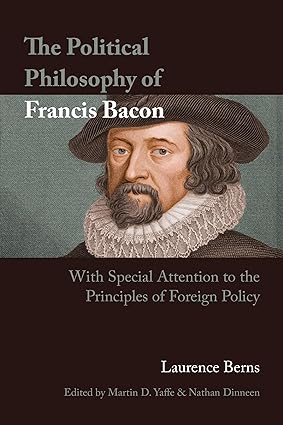
So, like many readers, I was surprised by the recent publication (posthumously) of his dissertation, The Political Philosophy of Francis Bacon with Special Attention to the Principles of Foreign Policy, a work originally submitted in 1957. To be sure, Berns had written a brilliant essay on Bacon’s New Organon (1978) where he distinguishes the “idols of the mind,” those ways in which our perceptions of the world obscure the workings of nature from the “ideas of the divine mind.” Berns explains that the idols of the divine mind do not refer to God’s mind but the workings of nature that we can expose by our own scientific research. The essay explains Bacon’s contributions to the development of modern science, but points to Descartes, who invents the mathematics that allows us to express the laws of motion, as the critical piece to completing the Baconian project.
Still, Berns regularly wrote about and taught early modern philosophy throughout his tenure at St. Johns, so it is not entirely surprising that Berns wrote his dissertation on Bacon. However, regarding the “principles of foreign policy,” there is little indication in Berns’ published work of an interest in the subject. It seems as if Berns had devoted seven years of study to producing a work whose main theme, foreign policy, he abandoned as soon as it was complete. How can we account for this strange turn?
In his introduction to Berns’ book, editor Nathan Dinneen explains the backstory: Berns enrolled in the “Committee on International Relations” at the University of Chicago and assembled an all-star committee for his doctoral committee, including luminaries such as Hans Morgenthau in International Relations and Bert Hoselitz in Economics. But it was the third member of his committee, Leo Strauss, who ultimately had the most profound impact on Berns’ education. Berns enrolled in nearly all of Strauss’s courses in the 1950s at the University of Chicago. Indeed, throughout the dissertation, there are brief but fascinating summaries from these courses on Plato’s Republic and Gorgias, Aristotle’s Politics, Xenophon, Hobbes, Machiavelli, and others. Just as Strauss began with a critique of modern social science as inadequate because unaware of its debt to the ancients, Berms sets up a dialogue between social science and classical political philosophy.
Modern social science is unable to account for the many contradictory statements found throughout Bacon’s writings. Their attempts to distill a single comprehensive set of principles for conducting foreign policy have not succeeded; moreover, they were not able to advance the study of Bacon by establishing a method of interpretation or offering a coherent account of his teaching. Without knowledge of the very tradition that Bacon’s work rests upon, contemporary social scientists were unable to see clearly the radical ways in which Bacon challenges and undermines that very tradition. They began instead by accepting as true many of the premises that Bacon himself helped to establish. As a result, they interpret the contradictions found in his work as the result of carelessness or over-reliance on an outdated and no-longer-relevant tradition. Of course, this makes it nearly impossible to recognize the wisdom found in Bacon’s writings. Thus, Berns begins his account by noting the critical areas where Bacon appears to contradict himself, on the relation of Bacon’s teaching to ancient philosophy, to Machiavelli, and to Christianity. Modern social science takes for granted the value of learning, the benefits of science for humanity, and the harmonious relation between philosophy and politics. But Bacon could not take such claims for granted; to the contrary, he was compelled to establish them.
Strauss’s — and Berns’ — recovery of classical political philosophy begins by foregoing a general hermeneutic and instead allowing the interpretation of a text to be guided by the author’s own instructions. A reader must be particularly sensitive to the terminology employed in the work and avoid substituting terms that insinuate or imply unwarranted conclusions into the argument. In an interview shortly before his death, Berns describes what he learned as a graduate student from Strauss: First and foremost, Strauss taught him how to discuss difficult issues in a jargon-free manner. “Even theoretical issues can be approached in a way that is at once properly theoretical so that they ‘do not lose their connection with the fundamental experiences from which the ideas are derived.’” Berns also learned that the depth and breadth of the authors of these books was greater than he had heretofore encountered or imagined. This insight prevented him from jumping to conclusions too quickly before grasping the entire argument.[1]
In his dissertation on Bacon, these lessons are evident. Despite the title of the work, Berns does not begin with the questions of foreign policy and economics but rather with the question of how to read Bacon. Unfortunately, there is no simple set of hermeneutical principles to expose Bacon’s comprehensive goals. Instead, Berns argues in chapter one that such wisdom can be had only by careful reading. His study begins, therefore, with what he calls “the problem of interpretation.” Bacon hopes to engage thoughtful readers indirectly by introducing problematic, even contradictory claims, throughout his work. This encourages careful readers to think through the problems for themselves. To take one example, on the relation of philosophy to politics, Bacon praises virtue. At the same time, he notes the tendency of philosophy to focus on standards and concepts that ignore the “harsh facts of political reality.” Philosophers imagine a “reign of virtue” and leave us without practical guidance for improving the lot of humanity. Bacon’s shocking praise of Machiavelli and the “evil arts” must be understood in this light. Such praise is not a celebration of evil but rather “pedagogically necessary for inducing the minds of the learned to turn from (their) exclusive preoccupation with what men ought to do.”
But if we abandon the restraints of virtue and morality, then what remains to guide us in political life? Having introduced this problem, Berns now turns to the question of foreign policy, a topic that he promised to treat in the title of his work. The results are surprising. Berns begins by explaining that ancient political philosophers have relatively little to say about foreign policy and even appear indifferent to it. They focus instead on domestic policy and the improvement of the citizens. For Plato and Aristotle, the true greatness of a state is not a matter of its size or wealth, but rather the character of its citizens and the justice of its regime. For such goals, the small, self-sufficient city-state, which eschews expansion and the pursuit of comfort and luxury, is preferable. In such a state, virtue and authority are united in the leaders who provide a personal example of a noble and patriotic life.
In sharp contrast, Bacon praises the advantages of a large, extended republic led by the “yeomanry or middle people” rather than an intellectual or moral elite. The ambitions of the common people, as Machiavelli argues, are easier to satisfy and less threatening to the stability of the state. Yet Bacon does not wholly follow Machiavelli’s argument. The difference that emerges between them is the status of learning. Whereas Machiavelli envisions an elite devoted to the pursuit of glory, power, and empire, Bacon reserves a place for learning. “The empire of man,” he writes, “depends wholly on the arts and sciences.” The empire that Bacon seeks to establish is one where the pursuit of learning focuses on science and technology, studies that are consistent with the aspirations of the people for comfort and security. This appears to resolve the tension between philosophy and politics, but only if philosophy is understood in a new way.
Berns’ study culminates in his examination of the “theological-political problem” in chapter five. Bacon approaches this question by attacking atheism, which he argues is fatal to society. Atheism undermines the dignity supplied by the teaching that man is created in the image of God. Without such a teaching, we are susceptible to understanding ourselves “as base creatures, akin to beasts.” Curiously, Bacon does not follow his attack on atheism with an analysis of the Gospels or an interpretation of the Bible. Instead, in his Wisdom of the Ancients, Bacon turns to the deeper meaning of fables and poetry, found even in pagan stories. He recounts the story of the sirens, the demonic sisters who lure – and murder — passing travelers with their song. Bacon argues that the story is a metaphor for the deadly lure of pleasure, which is so strong that even the decaying corpses of previous travelers cannot check its appeal.
While philosophy may have some success in checking the attraction of desire, it cannot overcome death and the desire for immortality by fame or merit. Its influence over humanity remains precarious. Other voyagers, according to Bacon, Ulysses, and Orpheus, discovered different remedies for “the lure of corrupt passions.” Berns notes here that Bacon promises the reader three remedies for the call of the sirens when, in fact, he provides only two. In a critical moment in his argument, Berns writes:
Why did he make this ‘error,’ saying on the one hand that there were two remedies, on the other hand, three? An unsuspicious reader might reply that Bacon was perhaps careless. Bacon was such a busy man, someone might suggest, that he was in too much of a hurry to notice this small, numerical difference perhaps. In general, however, his books were never written that hastily…
What sort of reader would casually dismiss Bacon as careless and lacking in methodological rigor? We have suggested above that Berns’ work is a kind of dialogue between contemporary social science and an older form of political philosophy. If so, then this is the moment where the dialog has reached its conclusion. The remainder of chapter five explores Bacon’s analysis of the theological-political problem, and the final chapters of the work give an account of the trajectory of modern philosophy and social science in light of this resolution.
By framing the theological-political question in terms of practical issues, namely the requirements of a healthy regime, Bacon makes a subtle yet decisive turn away from revelation in favor of philosophy. The meaning of revelation is interpreted in light of the needs of political life. But Bacon’s solution does not simply turn authority over to philosophy. The solution that Bacon has quietly suppressed is that of Ulysses who put wax in the ears of his sailors, that is, so that they avoided temptation in the first place. The possibility of resisting pleasure for most people is futile, and the pursuit of virtue as the goal of political life is preposterously ineffectual. Instead, Bacon opts for the strategy of Orpheus, namely singing a song so attractive that it effectively drowns out the song of the sirens. Rather than check or control the passions, we can substitute stronger passions that contribute to the security of the state.
Philosophy, too, must accommodate itself to this solution to the theological-political problem. The classical goal of philosophy as the search for the good must be reconsidered ostensibly because Christianity has already settled the question of the highest good. But Bacon’s argument is far more radical in undermining philosophy. The quest for the good privileges the contemplative life over and against the good of society. Bacon not only lowers the political goals of society, but he also rejects the notion of the highest good. In its place, he argues for a “mixed” good that can be actualized. Bacon’s version of philosophy does not aim at wisdom conceived as the highest perfection of man, that is, contemplation of the “eternal, unchanging pattern of self-sufficient excellence” (119). Rather, we contemplate practice or actions to calculate their secondary and tertiary consequences. Here Bacon’s notion of empire finally comes into sight as the abandonment of metaphysics.
The “deepest motive of Bacon’s life and work” was, Berns suggests, to reconcile philosophy and political life by creating new authoritative opinions favorable to science. His “foreign policy” amounts to recruiting partners for the advancement of technology. The sort of poetry appropriate for this mission is outlined by Bacon in the New Atlantis. This is the proper starting point for our reconsideration of science and technology in general, and social science in particular.
By paying careful attention to Bacon’s instruction, Berns manages to recover the ambitious Baconian project of founding a new order ruled by science and technology. At the same time, he shows us the costs of such a project in terms of both piety and philosophy.
The Political Philosophy of Francis Bacon with Special Attention to the Principles of Foreign Policy
Edited by Nathan Dinneen and Martin Yaffe
Political Animal Press, 2024; 202pp
NOTE:
[1] “[Strauss] was beautifully articulate and he would discuss the most difficult issues but always in a beautifully simple language. …I realized that his language was altogether jargon free. It was the simple language of direct experience, and then if it was theoretical, it was properly theoretical. But even then the theoretical language would always kind of refer you back to the fundamental experiences from which the ideas were derived. And it certainly …changed the way I expressed myself after that.” See https://leostrausscenter.uchicago.edu/laurence-berns/


Related Posts