The Hollowing of Democracy: A Review of Camil Roman’s “The French Revolution and Its Legacy”
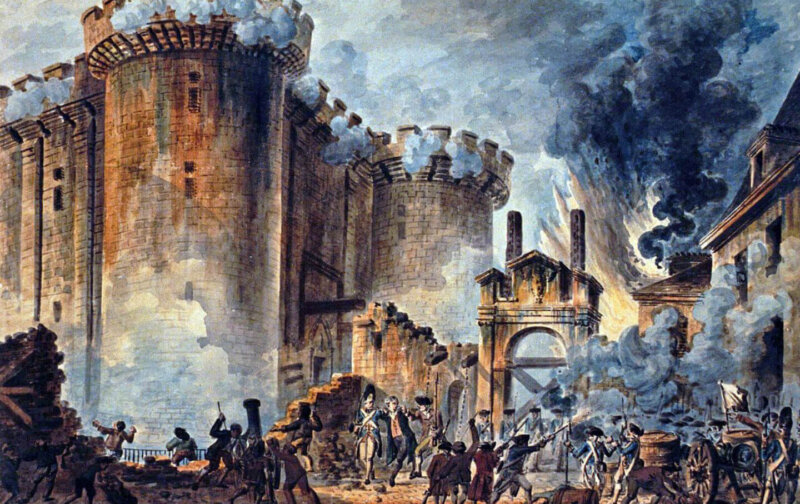
Representative democracy suffers from an inbuilt tension. On the one hand, the democratic ideal is rule ‘of the people, by the people, for the people’ as Lincoln phrased it. On the other, in societies of millions popular sovereignty must necessarily be delegated to elected representatives – raising the possibility that many, or even most, of the supposedly sovereign people will be left feeling unrepresented.
This tension has been exacerbated in recent decades by a variety of factors – the transformation of politics into a full-time profession populated by graduates of elite universities, the diversification of societies and fragmentation of social bonds, the erosion of class politics which aggregated voters in relatively coherent blocs with shared interests across a range of political issues. All this increases the distance between voters and those who are supposedly elected to represent them. This in turn feeds into a generalized mood of discontent and alienation from politics, which helps explain the appeal of populist movements or figures who claim to genuinely represent the people.
But in truth both ‘popular sovereignty’ and ‘representative democracy’ were always ambiguous concepts. What, exactly, is ‘the people’? Is it anything other than an enabling myth or necessary fiction? In our atomized and deracinated societies, can democratic opinion mean more than the aggregate of individual opinions and interests? But in that case, what does it mean for a politician to ‘represent’ the people, or some section thereof? Is it enough to effectively pursue their interests? But who decides what these are – the people or their representatives? Moreover, democratic theory seems to assume that elected representatives are not just agents charged with performing specific tasks but in some sense embody the popular will – an idea which seems to owe as much to metaphysics as political science.
Once you think about it for any length, it becomes increasingly unclear what we might mean by the ‘the people’ – other than a mass of individuals with disparate interests and values – or how this entity might be adequately represented. Representative democracy appears to be suspended over a void.
This is essentially the argument of Camil Roman’s stimulating book The French Revolution and Its Legacy (Routledge, 2025). The book is not a history of the revolution but an analysis of its meaning as the foundational moment of modern politics, centered on an in-depth reading of two pivotal points in its unfolding – the Tennis Court Oath and the execution of Louis XVI. By this means it aims at ‘an analysis and interpretation of democracy as a social-political form’ (2025:4). The author argues that the violent dismantling of the old regime left a void – what Lefort famously termed an ‘empty place of power’ – that was filled not by popular sovereignty but ‘the representation of representation’. As he writes, ‘modern democracy as a form does not represent anything at all. It stands for nothing, it has no firm relation with anything concrete’ (2025: 6).
Roman therefore challenges accounts of the Revolution that frame it in a narrative of progressive versus non-progressive forces, or the advance of various forms of social, economic and political rationalism. Where conventional interpretations might trace the gradual emergence of a stable, normative constitutional order from the upheavals of the Revolution, Roman sees the eruption of a theatrical, performative, mimetic practice of power which persists to this day. From this perspective, the central question of modern politics is not how best to represent the people and their interests, but how to most effectively perform the role of representative of a demos that exists only in the collective imagination. Democratic politics is little more than a stage on which a shifting cast of actors engage in competitive histrionics to claim the role of tribunes of the people. The French Revolution, therefore, far from being consigned to history, remains a ‘fundamental problem of the contemporary’ (2025: 1).
The People’s Two Bodies
In his characterization of modern democracy, Roman draws on the work of political scientist Harald Wydra who writes of ‘the people’s two bodies’. On the one hand is the actual sociological reality of the people, fragmented between a multitude of often competing identities, groups and interests. On the other is the symbol of the people as one, an imagined whole capable of political expression and collective action. For Wydra, we need to go beyond thinking through juridico-institutional formulas centered on popular sovereignty, fictional contractualism, and methodological individualism. Modern democracies had their formative experiences in specific, historically-contingent crises. In each case, pre-democratic institutional practices had to collapse in order for democracies to emerge. Democracy involves a ‘permanent interregnum’, an authority vacuum based on the tension between the promise of liberation and the need for a center of authority.
Liberal representative government emerged out of the seventeenth-century struggles between two contradictory justifications of representation: one as ‘resemblance’, ‘similitude’ and ‘consubstantiality’ (championed in England by supporters of the parliamentary cause), and the other as consented ‘authorization’ (championed by the royalists). The democratization of liberal representative government – the essential contribution of the French Revolution – paradoxically entailed abandoning the ‘metaphysics’ of representation as likeness and consubstantiality. Instead, it fell back on the Hobbesian (royalist) argument according to which one sovereign ruler may govern by consented authorization and represent the people, adapting this to the claim that a handful of elected representatives may govern in the same way. Yet, it has never escaped the contradiction posed by its inability to represent the people according to the principles of similitude and consubstantiality.
Indeed – and here I am expanding on Roman’s argument – this contradiction is perhaps more acute than ever today. In the relatively recent past, elected representatives tended to be bound to their voters by virtue of a shared social class, religious confession, or locality. Today they are interchangeable assemblages of sharp suits and whitened smiles, effectively appointed to their positions by political parties which ‘represent’ nothing beyond competing factions of a globalized elite. Note, for example, the paucity of MPs in Britain’s Labour Party – founded in 1900 as the Labour Representation Committee – who have ever held a working-class job. The ambiguity of representation is a source of recurring tension in democratic politics, dramatically manifested in the upsurge of today’s ‘populist’ movements.
Representative Democracy as Permanent Liminality
If representative democracy rests not on the solid foundations of a popular will that can be effectively channeled by elected leaders, but the smoke and mirrors of performative efforts to represent representation, political instability is not a temporary aberration from the norm but a default state. In Roman’s words, ‘democracy does not point to a stable sign but solely toward perpetual movement in circles of transformation’ (2025: 3). The French Revolution therefore initiated politics as perpetual metamorphosis. Since political representatives lack a meaningful connection to a concrete ‘people’, the ‘representation of representation’ which they substitute is inherently unstable, requiring as it does the ongoing stimulation of political passions (think of Trump’s never-ending theatrics and their seemingly inexhaustible capacity to stimulate highly emotional reactions from supporters and opponents alike). The implication is that contemporary politics has more in common with the performance of a magician or illusionist than the kind of sober, rational debate championed by Habermas – and this is not only a pathology induced by the mass media but an integral feature of representative democracy itself. The result is what the political philosopher Eric Voegelin termed a ‘second reality’: a progression by which thought and language become separate from reality and its objects, leading to the rise of imaginary, purely social and semantic constructions which may in turn come to dominate the social.
This is where the author uses concepts developed in an unexpected field – anthropology – to develop his analysis of a historical event (the French Revolution) and contemporary political practice (representative democracy), as he argues that a ritual process underpins the manifestation of democratic power.
‘Liminality’ is a term originally developed by anthropologists to characterize ritual conditions that were temporary but formative. In his study of rites of passage, Arnold van Gennep argued that such rituals share a three-fold sequential structure. They start with rites of separation, that draw a line between ritual time and space and that of everyday life; continue with the central ‘liminal’ phase, the passage itself, involving some kind of performance or trial, which if successfully completed brings about a change in the character or status of the performer; and end with rites of re-aggregation, celebrating the successful completion of the transition and the re-integration of the participants into ordinary life, frequently with a new status or role. Later, anthropologist Victor Turner employed the term ‘communitas’ to describe the experience of the middle or liminal stage of a rite of passage. Communitas refers to an intense community spirit or a feeling of social equality, solidarity, and togetherness which occurs when individuals are stripped of their usual social status and conventional labels, allowing them to relate to one another as undifferentiated, equal human beings.
More recently, the concept of liminality has been extended beyond the study of small-scale societies to become a way of exploring the character and dynamics of modernity. Sociologist Arpad Szakolczai argues that modernity can be characterized as a state of permanent liminality, in which temporary, transitory emergency or out-of-ordinary crisis situations have become lasting. ‘Permanent liminality’ captures the transitory, fluid quality of modern life, in which we are subjected to a permanent revolution, an open-ended transformation where any source of stability is systematically dissolved. It is in terms of inducing such permanent liminality that Roman interprets the French Revolution – viewing it as a rupture that has never been closed, a suspension of taken-for-granted order that was never succeeded by a return to stability.
As Roman argues (2025:31), liminality allows us deal with moments of radical uncertainty like revolutions and wars not from a cause-outcome perspective but by emphasizing the transformative power of such experiences. Liminal times and spaces are characterized by a radical contingency that makes possible the reimagining of social relations, norms, values, identities and patterns of behavior that are otherwise taken for granted. This can be exciting – witness Wordsworth’s famous lines capturing his youthful response to the French Revolution: ‘Bliss was it in that dawn to be alive/But to be young was very heaven’. But when liminal conditions are endlessly prolonged they become exhausting, anomic, even boring. In the end, this was also the case with the Revolution: people longed for a return to stability and welcomed it even in the form of the tyranny of Napoleon.
Roman devotes a number of pages to unpacking the revolutionary slogan ‘Liberty, Equality, Fraternity, or Death’. He argues rather than being numbed by its familiarity, we should pay it careful attention. The virtues cited in the revolutionary motto express the core experiences and emotional structure of a rite of passage. ‘Liberty’ evokes the initial rites of separation, in which the routines and conventions of ordinary social life are deliberately left behind. ‘Equality’ describes the status of initiands in the liminal stage of a rite of passage where everything that differentiates them has been stripped away. ‘Fraternity’ encapsulates the experience of communitas as well as the new collective identity taken on by initiands. The revolutionary slogan therefore reflects the liminal foundations of modern democratic practice, ‘the condition of existential suspension that prepares society and individuals for perpetual transformation’ (2025, xii). It is a manifesto for political metamorphosis.
While liminal situations can simply happen, they can also be artificially created. Such forced inducement of liminality is inherently violent and destructive, often associated with rituals of sacrifice. This destructive aspect of liminality and its suspension of all meaningful stabilities is expressed in the concept of the liminal void, evoked throughout the book. What Lefort termed ‘the empty place of power’ is identified by Roman with this liminal void, described as an artificial matrix of open-ended transformation. The Tennis Court Oath serves as a symbolic event instantiating the power of the liminal void, instituting a revolutionary communitas whose ideological enthusiasms are contraposed by Roman to the love of concrete things like one’s city, home and friends. It was here that the experience of the revolutionary motto received its most crystalline expression, as captured in Jacques-Louis David’s painting of the event.
In Roman’s detailed analysis, this painting – with its striking combination of empty space and frenetic motion – captures the revolution’s recreation of the political as a liminal void, a matrix of open-ended flux and transformation, at the same time as it depicts the emergence of revolutionary communitas. But where Victor Turner tended towards a positive view of the liberatory and ecstatic experience of communitas, Roman pays more attention to its dark side. At the same time as they were emancipated from the strictures of ordinary social life, the initiands in a rite of passage were reduced to a ‘tabula rasa’, a blank slate open to being reshaped by the values evoked in the ritual. Roman discovers a similar dynamic in the Revolutionary communitas conjured by David’s painting. The metamorphic power of revolutionary politics results in what Roman terms ‘social cloning’, the massification of participants as zombie-like ‘living dead’ who have sacrificed their individual personalities and become vehicles for the mimetic contagions and fluctuating passions of the democratic public sphere. We might say that Roman finds in the ecstatic communitas of The Tennis Court Oath a precursor of today’s digital public sphere, with its echo chambers, viral memes, twitter mobs and social media pile-ons, where the members of an atomized population can undergo the delirious pleasure of submerging themselves in contagious spasms of moral indignation and tribalized self-righteousness.
Sacralizing the Liminal Void
But Roman goes further, to suggest that the French Revolution not only initiated a political process based on endless flux and transformation, but sacralized it. He argues that political power inevitably has about it something of the sacred, because it rests on an evocation of the ultimate values of a society. The French Revolution, rather than producing a thoroughgoing secularization of politics, involved the de-sacralization of the body of the king and the political order that centered on it, and the re-sacralization of political power in the novel form of the revolutionary communitas exemplified in The Tennis Court Oath. Rather than, as previously, applying only to the king, the sacred thereby expanded to encompass all those social and political institutions which could claim democratic legitimacy.
The transfer of sacred authority culminated in the trial and execution of Louis XVI. A sacrifice was required to consecrate the new democratic communitas and substantiate the new political imaginary – hence the execution of the king and the subsequent Terror. The execution of Louis was not a purely political event, but a ritual which destroyed the central organizing principle of political life under the old regime, shattering the moral universe and social and political practices of the past, and incorporating participants into a new political community. For Roman, this sacrificial rite of separation is the cultural-historical foundation for the modern democratic imagination (2025: 177-8).
Modern democracy, as born in the French Revolution, is based on the disincorporation of power (2025: 9) – and in this regard, we might add, it is fundamentally distinct from Greek democracy or the republican constitution of ancient Rome. Consequently, ‘far from being a limited, accountable and secular form of government as conventional accounts emphasize, modern liberal democracy has given birth to a sacred political power’ that is unlimited, unaccountable, and produces a religion of political metamorphosis (2025, xiii). Here Roman echoes (though he does not reference) the thinking of another analyst of modern democracy and the modern state, the French writer Bertrand de Jouvenal, who argued that the idea of the nation emerging from the French Revolution allowed the metaphysical assertion of society against the individual, as a whole leading a life of its own which is superior to that of its parts. The consequence, as De Jouvenal puts it, is that ‘the rights that belong to individuals, their subjective rights, give place to an ever more exalted morality which must needs be realized by society’. There is no extension of power which cannot thereby be justified. If the state claims to represent the general interest, no local or particular interest can legitimately oppose it. Yet, as De Jouvenal argues, while sovereignty may be theoretically the property of the population as a whole, in reality it can only ever be exercised by a few. The modern state therefore, while claiming identity with the people, ‘in the nature of things remains above them…It crushes each individual beneath the weight of the sum of the individuals represented by it; it oppresses each private interest in the name of a general interest which is incarnate in itself’. Moreover, in the absence of a concrete and politically-effective demos, particular interests end up fighting to control this centralized mechanism of power. Modern democracy, we might say, is a ‘noble lie’ which hides the reality of a transition from monarchical absolutism to a more instrumentally effective absolutism controlled by an oligarchy of special interests.
Whose Democracy?
The French Revolution is central to the political myth of modernity. As Roman writes, in conventional accounts it represents the birth of democratic politics, a wholesale break with the past, ushering in a new age of democracy, political rationalism, science, progress, humanity and mandatory happiness. In the author’s words, ‘interpretations of the French Revolution and modern democracy that do not simply reify their official narratives and ideological terms are preciously few’ (2025, xi). It will be clear that such a charge cannot be directed at his own work. But while this may offend contemporary sensibilities, Roman raises fundamental questions about the origin and true nature of what liberal democratic societies claim as their highest ideals – questions that are more pressing than ever today.
Rather than treating the French Revolution simply as a historical event, Roman’s book is a genealogy of contemporary politics and a diagnosis of its pathologies. Modern democracy, he argues, rests on three primary assumptions: the limited nature of individual and collective power; the accountability of power; and the secularization of power. Each involves a serious distortion of reality. Democracy is a kind of conjuring trick, in which the ‘representation of representation’ aims to cover up the absence of a concrete people who might endow their representatives with legitimacy and hold them to account. Democratic politics, far from being characterized by rational and sage deliberation, is inherently theatrical, performative, mimetic and emotive. Political life becomes simultaneously a merry-go-round of perpetual metamorphosis, and somehow fundamentally unreal. Thus, today, almost every election is presented as a ‘change’ election, yet once they have tossed out the government and voted in the opposition electorates tend to be left complaining about the same problems as before. The French Revolution inaugurated modern politics as permanent liminality, an open-ended rite of passage with no conclusion. Because democratic power is liminal, it is also unaccountable and unlimited: a power baptized in the sacred rites of revolutionary communitas will respect no persons and recognize no boundaries.
Here a question naturally presents itself: if representative democracy is inherently unstable, how have liberal democratic states nonetheless enjoyed lengthy periods of relative stability and endured for decades or, in some cases, several centuries? Just as Patrick Deneen argues in Why Liberalism Failed that liberalism was only able to function due to the accumulated social capital it inherited from traditional societies – a capital it has systematically degraded – one might likewise suggest that representative democracy has worked insofar as elected figures have been able to represent, not a notional ‘people’, but concrete communities built around physical localities, workplaces, religious congregations, social classes, and networks of friends and clients. As these have weakened and fragmented, the underlying void at the heart of modern democracies has become harder to disguise. The result is a political system that increasingly veers between, on the one hand, technocratic governance that legitimates itself on the basis of expert knowledge and mechanical proceduralism, and on the other, identarian politics and populist protest movements.
These contradictions and tensions are only likely to grow worse. Roman’s genealogy of modern democracy affords little hope for a return anytime soon to ‘politics as usual’ under the tutelage of a ‘sensible center’ managing a broadly liberal consensus. It is more likely that a succession of ever-more improbable clowns will step into the void of political legitimacy exposed by an atomized society and a digitalized public sphere, while real power remains the preserve of wealthy oligarchs and technocratic elites. How long the institutional façade of ‘representative democracy’ can survive such a situation is an open question – though it is worth bearing in mind that centuries after the princeps had usurped the authority of the Roman Republic, the Senate still maintained its hollow deliberations, the Consuls paraded with their lictors, and the forms of republican government were kept up despite being long emptied of substance.
The French Revolution and Its Legacy
By Camil Roman
New York: Routledge, 2025; 240pp


Related Posts