To Arms: A Review of “The Firearm Revolution” by Catherine Fletcher
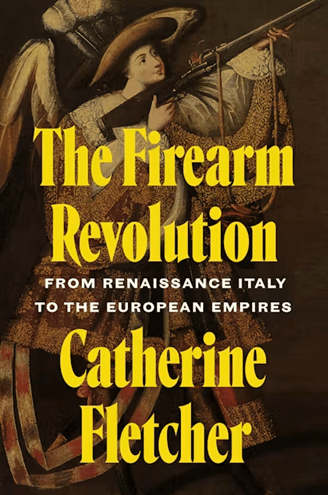
In the United States, gun ownership is most often associated with the political right. Indeed, second amendment rights is one issue that social conservatives, libertarians, neoconservatives, and the New Right share. “Faith, Family, and Guns” or “God, guns, and gold” are popular expressions among conservatives. Guns are also symbols of masculinity, freedom, and self-reliance. Conservative social media is often decorated with images of buck skin-adorned pioneers with guns or more contemporary tactical soldier touting his or her M7. For the left, guns, unless utilized for social justice ends, generally appear as dangerous and evil objects that are wielded by dangerous and evil people—one of the popular images on the left is of conservatives fearfully “clinging their guns.” Nonetheless, there is a generally awareness, especially in the social media age, that the understanding of guns—whether good or ill—is often tied to one’s culture and historical circumstances. As historian Catherine Fletcher demonstrates in her recent work, The Firearm Revolution: From Renaissance Italy to the European Empires, firearms had a much more complicated history than simply either symbols of Godly freedom or dangerous oppression.
Guns were likely in China as early as the beginning of the twelfth century and possibly spread to Europe via the Mongols. Guns may have appeared in Spain as early as 1324 and were in England by 1326 and Russia by the 1380s. Fletcher notes that guns are not frequently studied as shapers of modernity, while other stables such as sugar, coffee, and tobacco have been. She further notes t that we do not usually associate guns with Renaissance Italy and humorously and intelligently notes that none of the deaths in Shakespeare’s plays, for example, are caused by guns. However, as early as 1431, long wood stock handguns appeared in Italy, and they would grow to be a prominent battlefield weapon during the Italian Wars of 1494-1559. A commemorative tapestry from the battle of Pavia during the wars, depicts guns. Among Leonardo da Vinci’s exquisite innovative designs is for a wheel lock on a gun. The Beretta company, purveyor of firearms as gorgeous as Botticelli’s paintings, has its origins in the early sixteenth century. Fletcher notes that Renaissance historian Paolo Giovio argued that it was gunpowder, along with print and Christopher Columbus’s voyage to the New World, which made the Renaissance such a period of “good fortune.” The English Francis Bacon expressed a similar view.
Renaissance figures were further aware of the advantage guns have colonial explorers such as Hernando Cortez, whose armed men stormed Tenochtitlan in 1521, although Fletcher argues that Amerindians and Africans themselves quickly utilized guns. The Ottomans, of course, as was evidenced by the fall of Constantinople in 1453, were skilled in the use of firearms. Gun powder enabled new avenues of violence and war, and thus drew some moral condemnation, viewed as unchivalrous, evil, and even unmanly. It was only in the eighteenth century, Fletcher points out, that guns became known as a gentlemanly weapon that enabled one to avoid physical confrontation.
Guns used in war (along with other changes in political and military culture) led, paradoxically, to the eventually downfall of the warrior elite. In his Book of the Courtier Baldassare Castiglione describes a world of both war and intelligent leisure among courtiers. However, ironically, as guns became more common on the battlefield, the lives of kings and nobility became less centered on warfare. Various forms of regulation of gun use were present in Renaissance Italy. Fletcher gives the example of Vincenzo the cow herder who received a license for carrying a gun for hunting that bore the caveat that Vincenzo could not carry the gun in crowded public places out of risk that it would go off. Renaissance rulers were further concerned about the ability for guns to be concealed by bandits and assassins.
Fletcher notes that the discussion of handguns in Renaissance Italy somewhat mirror contemporary discourse. Viewed as dangerous by some early Churchmen, in Fletcher’s native UK, most handguns have been banned 1997 (the 1996 Dunblane Primary School shooting helped effect this band). She also argues that firearms added to the military revolution that helped form the modern state, noting that arms manufacturing had an influence on politics early on in Italy. In The Firearm Revolution, Fletcher explores how guns were produced and regulated in Italy as well as how they were perceived by the general population, referring to their process of acceptance as “assimilation.” While viewed askance by some, guns eventually became works of art and even had religious associations.
Fletcher observes that there was a contrast between how guns were viewed in everyday life and how they were depicted in literature. While they were associated with the devil and with cowardice in sixteenth century treatises, personal correspondence, such as Francesco Maria della Rovere, the Duke of Urbino, reveal a love and admiration for guns—Duke Francesco wrote of his anticipated pleasure at receiving an arquebus from Germany. Upon initial arrival, guns were viewed with, in Fletcher’s words, “ambivalence.” Interestingly, Michel de Montaigne wrote about the ability for one to make rational decisions while utilizing firearms, which acted more haphazardly and quickly than swords. Guns, however, were prized became an important part of gift giving and courtly culture. Guns decorated various forms of Renaissance art, but guns themselves were also decorated and became works of art and were decorated with various historical and mythological themes. Some of the common mythological themes included the Trojan War as well the Biblical story of Judith slaying Holofernes. Sometimes classical images could be combined with prayers such as a German wheellock that depicted the Rape of Lucretia and contained the phrase, “Lord God protect me and save me from my enemies.” This love/hate relationship with guns would take an especially pronounced form later in the United States.
One of the strangest of many strange things to have happened during the 2020s is the emergence of a new super weapon. This weapon is not a next generation nuclear devise or a new, long-range gun: it is the drone, which, as has been demonstrated by the Ukrainian FPV (First-Person View) kamikaze drones, the cheap but sophisticated new weapon has upended the tank’s reign as (at least symbolically) the king of battlefield weapons. Moreover, the internet itself has become a battleground as Fourth Generational War has become increasingly determined by social media reporting and/or propaganda. Nonetheless, the guns still remain—especially in the United States—a powerful symbol of freedom, strength, and self-reliance—even if, as Catherine Fletcher has demonstrated, guns were not always viewed as noble things.
The Firearm Revolution: From Renaissance Italy to the European Empires
By Catherine Fletcher
Princeton: Princeton University Press, 2026; 314pp


Related Posts