The Political Philosophy of Pierre Manent
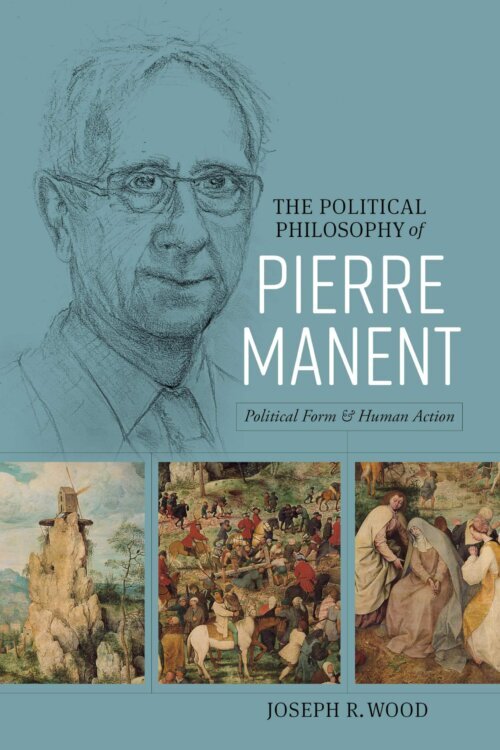
Pierre Manent is widely recognized in France as one of the most insightful political philosophers writing today. While he is not as well-known in the United States, a growing and dedicated group of American thinkers are taking notice of his work, in part due to the translation of all his major writings into English. A select number of American scholars, such as Daniel Mahoney, Ralph Hancock, and Paul Seaton, have actively contributed to the study of Manent’s thought in the United States, and now, Joseph R. Wood’s recent work on Manent’s political philosophy can be added to that list.
Wood, a professor of philosophy at Catholic University of America, has written an in-depth review of Manent’s intellectual themes to date, focusing on the central notion of the political form as detailed in Manent’s Metamorphoses of the City: On the Western Dynamic (Metamorphoses), published in French in 2010. At the same time, Wood provides the reader with a survey of Manent’s writings, including his prior scholarly books that prepared the groundwork for Metamorphoses, and his subsequent political thought flowing out of the comprehensive history of the West presented in Manent’s major work.
Manent’s Beginning
As Wood notes, Manent’s thought is not easily categorized, being both multi-faceted in subject-matter and expansive in historical reach. In part, this is due to Manent’s intellectual biography. Born into a politically communist family in Toulouse in 1949, Manent was exposed to Catholicism and Thomism during his school years. Wood comments that, while a believer, Manent came to Christianity through a more cerebral than spiritual route and continues to maintain a certain critical stance towards the Church’s political interventions and social pronouncements.
Eventually, Manent made his way to Paris and the Ecole Normale Superieure, where he first encountered philosophy, but in a rather desiccated “industrial” form obsessed with the task of “taking apart [Cartesian and Kantian] systems and putting them back together again.” This dissatisfaction had two results. On the one hand, it drew Manent to the more humanly substantive and engaging philosophy of the classics, especially Plato and Aristotle. On the other hand, it brought him into the orbit of the famed French scholar and political commentator, Raymond Aron.
With this background in mind, Wood situates Manent’s thought as bounded by three vertices of a triangle – politics, religion and philosophy – with none of these domains overwhelming the others. Inside the triangle is Manent, along with the tools of intellectual history that he deploys to understand the three great ways of being, both on their own terms and as they interact with one another. And here Wood is keen to note that Manent, while impressed with the “almost irresistible plausibility” of contemporary historicism, rejected the historicist self-understanding of modernity as an ideological trap that failed to take account of the history of man as political, “in his deliberative action and in his universal human nature subject to law.”
Manent’s Project
With history at his disposal and surrounded by the tensions inherent in the three vertices of his triangle, Wood outlines an itinerary for Manent’s work that engages questions in the context of his intellectual influences. The first question concerns the modern difference whereby modern philosophy, and modern man generally, are “dominated by the hope and by the fear of a radical transformation of the human condition.” This bifurcated stance implies both that modern man, seeks to live solely and uniquely under the guidance of reason as rationality, culminating in Hegelian philosophy, but simultaneously rebels against reason “in the name of faith [Kierkegaard], or of action [Marx], or creation [Nietzsche] or of thinking [Heidegger].”
Manent determined that the most pressing task was to understand and assess the decisions made at the origins of the turn to the modern that would eventually give rise to reason’s self-immolation. First, An Intellectual History of Liberalism, appearing in French in 1987, highlighted the historical landmarks of liberalism as presented in the works of Machiavelli, Hobbes, Locke, Montesquieu and Rousseau, followed by the post-Revolutionary responses of Constant, Guizot and Tocqueville. Focusing on the institutional arrangements flowing from modern thought, An Intellectual History outlines the framework of our contemporary liberal and democratic regimes.
This was followed by The City of Man, that traces contemporary man’s perception of who and what he is, along with how this new presentment of man seeks to evade classical definitions. The first half addresses our modern self-consciousness subjected to the authority of History, sociology and economy. The second half outlines our means of self-affirmation as we reject a substantive definition of man in favour of a denatured assertion of the will under the trio of rights, creation and labor.
The City of Man is a dense and synoptic work but also one in which Manent signals both his abiding philosophic concerns and the future path he lays out for himself. In a passage replete with meaning Manent describes the modern rejection of nature that he uncovers as producing a separation between a hidden nature that is presupposed but ignored, and social facts that merely appear without any unifying link to a substantive human nature. In response, Manent suggests the possibility of two syntheses. One is the Kantian synthesis which, in the end, only appears to aggravate the problem of separation in “dizzying fashion” leading ultimately to the last great modern philosophic movement of existentialism in which Heidegger’s genius will seek to unmask the hidden and presupposed nature. The second synthesis presents the notion of nature, of substance, as a true synthesis of universal and particular, and as Manent will comment: “Perhaps a reworking of this notion that would rediscover its original meaning would overcome the objection of analytical thought, the obstacles of modern perception, but the fact is that modern philosophy has never really explored this avenue.” In this one line, Manent foreshadows and sets the goal of his own task: to rework, in the political register, Aristotle’s venerable notions of nature, substance and particular difference to envelop Roman history, the Jewish and Christian covenants, and the modern difference.
Before arriving at this task, Manent provided one last survey of the modern terrain in his A World Beyond Politics: A Defense of the Nation-State. In this offering, published in French in 2001 and originally intended for students at the Institut d’Etudes politiques, he presents a series of contemporary political themes under the doctrine of separations explored more fully in his preceding books. The book ends with a portrait of our current diffused lives, lacking political substance, seeking a formalistic unity through the empires of law and morality.
Manent’s Metamorphoses
As Manent recounts in a series of interviews published as Seeing Things Politically, it was Aron who impressed the importance of the political on his young student, while religion entered though his Thomist school and the Parisian salon of Stanislas and Aniouta Fumet. But as Wood points out, Manent sought something beyond the mundane political, a sort of transcendent ground. Immediately, Aron told Manent to read Leo Strauss’ Natural Right and History. This gave Manent the philosophic insight he was seeking. Strauss, unlike so many of his contemporaries raised serious doubts about the benefits of modern philosophy, while unlocking the esoteric truths common to the ancient mode of philosophizing.
However, as Wood makes clear, Manent was never fully satisfied with the Straussian themes of the lone philosopher over against the city, or the sharp contrast Strauss drew between ancient and modern philosophy as the fulcrum of western history. It is on these points that Manent strikes out on his own intellectual adventure, informing Wood’s own work on Manent’s treatment of the political form.
For Manent, the political form takes on a key ontological role. It expands the familiar Platonic and Aristotelian notion of the regime that so marked the Greek cities. Instead of the various regimes and their cycles, the city-state as a form comes into view as the instantiation of the first and initiating moment of the West’s political nature modulating through a series of subsequent forms leading to the modern nation-state.
Several factors come into play here. As Manent makes us keenly aware in his Metamorphoses,
It appeared to me more and more clearly that the formation of the Greek city represented a much more substantial anthropological transformation, if one can use the term, than the modern democratic revolution, which moreover was in some sense built upon the Greek one. Instead of seeing history as facilely running toward us, toward the grandeur and miseries of our democracy, I saw it more and more clearly unfolding starting from the prodigious innovation that was the first production of the common.
As Wood masterfully makes clear, two important things come to light. First, Manent recreates the classical birth of the city as a reasoned putting in common, beginning in war and then leading to the arts of peace. Unlike Hobbes or Locke who begin with fear and hunger in the state of nature, Manent, relying on Homer, Vico and Aristotle, lays out before our eyes, a reasoned story of humans placing goods and deliberation in common, and thereby bringing about the citizen as both political actor and as subject for philosophic reflection.
But Manent does not stop with the Greeks, only to leave them shimmering as one gem from our historical past. Instead, his Metamorphoses presents an histoire raisonnee of the West’s political past. Rather than casting history as progress leaving behind the Greek discovery, Manent sees the city as the fundamental form of politics that is then subjected to a series of transformations, but with each one carrying forward the essential nature of the city that reflects man’s political nature.
Manent Departs Strauss on Rome
In a certain respect, one of the best ways to understand Manent’s new histoire raisonnee is to draw attention to the points on which Manent differs from Strauss. Wood helps us in this task by dividing Manent’s history along lines that highlight the Manent-Strauss differences.
The first concerns the city and the empire. The Greek city comes to view as a self-contained whole, at least in the sense that the city’s citizens know each other and make decisions in common. In this regard, the term government, with all the apparatus we apply to it today, did not truly exist among the Greeks. Two of the great dynamics in the city were the ongoing interplay between the few and the many, coupled with the city’s interactions with other cities. Of importance here is the singular fact there was no “one” that ruled over them all – kingship was largely unknown in Greek cities. And finally, even when Athens gained for itself an effective maritime empire, at no point did it transform structurally from a city into the imperial form.
Turning to Rome, we see the unprecedented example of a city morphing into an empire. While the Greek cities maintained a familiar and intimate compactness, Rome, in many respects so different from its Greek counterparts, distended itself and grew beyond the synoptic limitations of the city. Structurally, this resulted in the weakening of the common entity. As Wood emphasizes, for Manent, this is evident in the office of the Roman magistrate who bears Rome on his shoulders, separating the citizenry from their share in Roman political deliberation. Similarly, by contrast, the unified Greek citizen bifurcates in Rome into a universalized sense of common humanity without strong political characteristics on the one hand, and the private Roman citizen, each with his own nature, on the other.
Two key aspects must be noted here. The first is the distended, weakened, even enervated and threadbare politics that arises in Rome as it turns itself into an unlimited empire. For Manent, this corresponds to the well-known superficiality of philosophy itself as we pass from the giants of Plato and Aristotle to the cynics, skeptics, stoics, epicureans, and the apolitical neo-Platonists. But from among these phantoms of their past greatness, Manent seeks to rescue the great orator cum philosopher, Cicero, precisely because he so majestically attests to the confusion and the dismemberment plaguing both politics and philosophy. Indeed, Manent will endow this diffusing action with the moniker of the “Ciceronian Moment” which, as Wood makes clear, will last in the West until the great movement of modern philosophy reinvigorates western political life in the seventeenth and eighteenth centuries.
The second aspect of note here is that in wrapping Cicero and his conundrum within Aristotelian nature, both philosophic and political, Manent is moving away from Strauss’ clear division between the virtuous ancients and the pragmatic moderns. Manent’s lens for focusing this difference is the debate between Leo Strauss and Eric Voegelin precisely on whether or not Greek political philosophy could account for the figure of Caesar. Strauss argued it could and would simply assign him the role of tyrant in the cycle of Aristotelian regimes. Voegelin contended that the Greeks could not account for Caesar because he represented that select moment when a polity had become so corrupt that the tyrant was the necessary corrective and hence in some respect, the good choice, a view anathema to Strauss.
In this argument, Manent tends to favour Voegelin and in doing so he departs Strauss’ ancient versus modern framework, but at no point simply sides with modern historicism. Rather, by employing the notion of the political form as nature’s expression of politics, Manent subsumes the Ciceronian Moment within the nature of the political form. Even under the indeterminacy of the imperial form, political nature continues to operate and to call man to a reasoned response to the common thing, however weak it may be.
Manent and the Christian Synthesis
From Cicero and the distention of politics and philosophy, Wood directs us to the other great vector of Manent’s triangle – religion. And here again, Manent will deploy his notion of the political form to great effect while working on a very different problem. If pagan Rome represented the weakening and privatizing of politics, Christian Rome will disparage it altogether. This is a challenge of a whole different order.
While the empire presents itself as a weaker political form, it still comes to sight as a political form. By contrast, Christianity offers a far more robust and ultimately fulfilling city – the City of God – but it will do so with the most sublime indifference to politics as it spreads its empire of the faithful across the globe. This is what Manent will refer to as the “Christian Proposition” and it will hover over the West, aggravating and in many respects prolonging the Ciceronian Moment by presenting a multitude of political, philosophic and theological models to the West.
The question before western man, is whether he will emulate the model of the ancient city, not to mention its philosophers; or, will he prefer Rome, and in that case, will it be Cato or Caesar, and their historians; and yet again, will it be the Church and its saints with their theological virtues? As Manent will note, modern man viewing all of this from the end of the fifteenth century, found himself with what appears to be one solution: cut the Gordian knot right through and teach Europeans to turn away from all these imaginary republics. And so enters Machiavelli.
But before we turn to the Florentine, we must note again that Manent takes a turn away from the Straussian approach, specifically as regards the possibility of a Christian synthesis. On this point, Wood is especially helpful. In the last third of the Metamorphoses, Manent engages in a long discussion of Augustine and the Christian Proposition. As many Straussians make clear, Strauss drew a strict distinction between Jerusalem and Athens that had no place for the Christian synthesis. Manent, however, is not so quick to go down this road and tarries with Augustine a bit longer. Reflecting his previous concerns with Strauss’ distant philosopher, too divine to touch human concerns, Manent reminds the reader that it is the Jewish covenant, carried into Christianity in the person of Christ that plays a mediating role between the universal and the particular. Once again, by challenging a key aspect of Strauss’ thought, Manent makes room for a reasoned approach to the Christian Proposition, as he did with the Ciceronian Moment, in his Aristotelian nature of political forms.
Enter The Nation
Amidst this contending series of models – Greek, Ciceronian, Christian – Europe, especially in the West after the collapse of Charlamagne’s empire, began to produce, somewhat organically, the nation. Built around common language and territorial integrity, the nation with its expanding notion of monarchy, began to assimilate and mediate the various models that would, on the personal level, develop into the figure of the Christian gentleman: somewhat political, not fully a philosopher, and just slightly too worldly to be a saint. It’s at this point that Manent ends his Metamorphoses, with the mediating nation.
But as noted above, what would become the modern philosophy of Descartes, Spinoza, Hobbes and Locke, sought to cut the gordian knot, to replace the tangled complexity of the western inheritance with the clarity of one alone, the Machiavellian principle of uno solo that will be developed into the sovereign of the modern nation-state.
Here we arrive at an interesting juncture. As Wood points out, the nation is not quite the nation-state. Instead, the modern state with its sovereign leviathan, its representative civil society, its democratic processes, and its equalizing social infrastructure, is grafted on and carried forward by the nation itself. Manent describes this process in his short book, Democracy Without Nations?, published in French in 2006, which serves as a useful endnote to the longer history described in Metamorphoses.
But Democracy Without Nations also provides us with Manent’s warning: the apparatus of the state, devoted now to human rights and globalization, has detached itself from the national political form that gave it life. According to Manent, this detachment is having devastating consequences, including the very destruction of western political life. And unlike the early modern period when the West was presented with an array of models to follow – Greek, Roman, Christian – our current state leaves us entirely depoliticized, having rejected all political forms.
Manent’s Path Forward
At this stage, Manent has achieved his histoire raissonnee, giving us his great arc of western history from the Greek city to the European nation’s apparent twilight. But he does not leave us in despair at the end of history. Even as he completes this historical sweep, his writing begins to suggest a path forward. Wood ends his own book on this very note, drawing our attention to what Manent has taught us so far, as well as how other thinkers, especially those in a similar phenomenological tradition, might complement his work.
For Manent, his Democracy Without Nations?, along with recent political works on Islam and France, natural law and human rights, Montaigne, and Pascal, begin to envisage a reworking of the western inheritance that might, given the uncertainty of human things, reinvigorate Europe and the West generally. Ranging from the return of Israel as the light to the nations next to the political form lacking in Islam (evermore present as part of the West), to the mediation of the Christian covenant and the power of the American imperial republic, Manent’s latest works weave together his three vertices: politics, religion and philosophy. In this new situation, the West is tired and beset by new challenges but still able in some sense to build bridges over the centuries of its past and configure new arrangements to give voice to our political nature. Wood has done a masterful job of presenting this work in his own book, which is of great benefit to English readers new to Manent’s vast intellectual scope and ambition.
The Political Philosophy of Pierre Manent: Political Form and Human Action
By Joseph R. Wood
Washington DC: Catholic University of America Press, 2024; 270pp


Related Posts