The Uses of Spiritual Memory
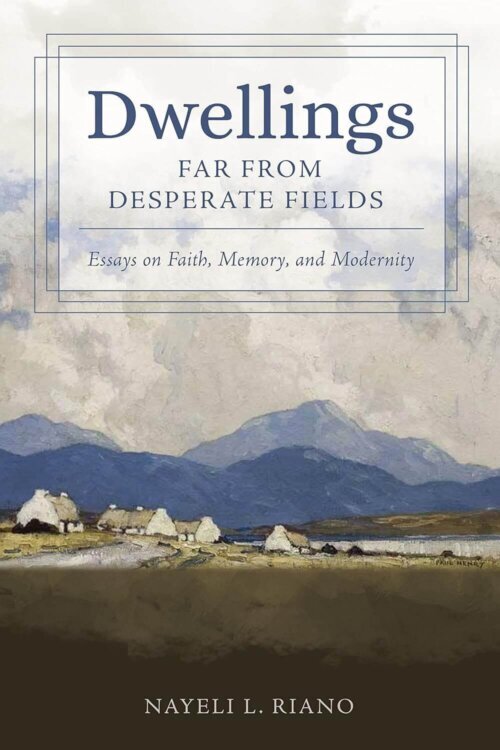
Does art and literature matter? In our age of vandalism and philistinism, it seems not. Activism in the name of the latest leftwing fad, “decolonizing” art and the bookshelf, is all the rage. For those of us who love art and literature, it serves us well to be reminded that “Art is a testimony to the relationship between hope and memory.” Spiritual memory, moreover, “suggests a continuation and connection between the past and the present that we can learn to appreciate and understand through an engagement with our spiritual faculties.”
Dwellings Far from Desperate Fields by Nayeli Riano is not your ordinary work of literary criticism. There are no digressions about Marxism. No condemnations of capitalism. No excoriation of certain dead white European males as racist, sexist, or misogynistic. Instead, Riano takes us across space and time with eyes of charity and mind of insight as she tours the libraries of Albion and the paintings of Europe. Her purpose is simple: to make us fall in love with the great artistic and cultural products of our patrimony.
The idea of “spiritual memory” guides the gentle reader across the pages where we meet the likes of William Shakespeare, Edmund Spenser, William Butler Yeats, T.S. Eliot, George Santayana, and many others. If spiritual memory the enchanting state of mind that connects past and present, then the impetus of spiritual memory is a sort of artistic resurrection—an attempt to bring to life the memory of history contained in the many great works of art, be they the written word, formed marble, or stained-glass windows.
Saint Augustine famously argued that we are our memories. Memory, therefore, is a manifestation of the spirit of love. The manifestation of that spirit of love in memory is a sign of God who is Love itself. “Memory,” therefore, brings “a sense of reverence.” How right!
Riano’s project is more than just analysis and teaching. Her project is an attempt to rekindle the sacred flame of memory that has been extinguished in our age of technological distraction and historical amnesia.
If we remember history and the culture of history at all, it is as something negative—to be rejected. This permits the desecration of culture, the obliteration of loving memory, and the erection of a new mind in its place: one formed and guided, of course, by those commissars of anti-culture masquerading as guardians of beauty, goodness, and wisdom.
In our age of distraction, art is an enemy. Thus the war on art we witness today. To gaze upon the works, say, of Michelangelo, or the architecture of the Byzantine and Gothic cathedrals that still amaze eyes of wonder in Europe, is to become an enemy of the modern world.
Technological distraction is meant to pull your memory away from the lofty and drag your senses into the realm of the boiling and hissing cauldrons that nearly killed Augustine. We must struggle against these distractions and temptations to find the beauty, goodness, and truth in the artistic wonders stretching back to Homer and onward to Eliot, Auden, and Santayana.
It is generally accepted, as our author acknowledges, that it is “suffering that makes for the best art, be it musical, visual, or literary.” We, therefore, who suffer in the maelstrom of the brutalism of the empty rainbow have it within us to be the greatest of artists. For we must suffer ourselves to resurrect our own spiritual memory to have a relationship with the art of the past which pulsates through our hearts and minds in the present.
That suffering journey is what Nayeli Riano undertakes in her remarkable treatment of art, literature, and poetry over the course of just 196 pages. Do not let the brevity of this tome fool you. It is not a skim volume by any means. It is rich and delightful read, page by page, chapter by chapter, artist by artist.
Additionally, unlike the most incomprehensible of scholars who seem to deliberately write to keep the unwashed masses out, Riano writes with a charm and simplicity that invites readers of all stripes to take her hand and learn and walk with her. She is an enthusiast in the best possible understanding of the term, and her infectious enthusiasm feeds our own soul as we read alongside her.
It is evident that our author has a mindset of “enchantment” guiding her. This sense of enchantment is necessary to resurrect for anyone who wishes a relationship with art. Riano perfectly summarizes this most noble endeavor that many of us are also engaged with: “There are places where enchantment still exists for the visitor who allows himself into that world. It is an exclusively singular journey that the individual must choose, for enchantment is a state of mind, a willing disposition, that no other man can force on another.”
Although it is the hope of our author to bring that enchantment to us, we, the reader, the visitor, the wandering traveler across the space of time of history that art reveals to us, ultimately have the final say. But Riano’s book is gentle and kind in easing our mind to that spirit of enchantment. The wisdom that gushes forth from its pages invite us to sit at the table of enchantment and drink and feed on its soulful and nourishing content. And nourished the reader undoubtedly is when finishing this book.
“Usually,” our sagacious author writes, “spiritual memory engages with great art to catch glimpses of truth, of transcendence, that are still tied to our natural world. The result is that we are changed; left with certainty of what is, even if we cannot describe it perfectly.” Riano writes that the artistic life is not necessarily meant to achieve conversion. But in reading her splendid little book, one might just feel that that is what happened.
Dwellings Far From Desperate Fields
By Nayeli Riano
Middletown, RI: Stone Tower Press, 2022; 201pp


Related Posts