Young Adult Literature and the Purpose of Art
A glance at the middle-grade and young adult shelves at Barnes and Noble or the local library will tell you of the unhealthy state of literature for today’s youth. Many of the books that line such shelves promote language of “inclusivity” and “empathy.” Many of the books that line such shelves, though perhaps not vessels for liberal ideology, are simplistic and poorly written. Classics for young children, such as Corduroy or Blueberries for Sal, still sell out – but little of this quality is being written and distributed today. Classics for older children, such as A Wrinkle in Time and The Chronicles of Narnia series, likewise still do well, but again, books like these do not dominate the shelves of libraries and bookstores.
Literature for older children – what some call “middle-grade” literature – has been all but overshadowed by the “young adult” category. Teaching has allowed me to observe that many older-elementary children – that is, the sort of children who ought to be reading middle-grade novels and soon begin to get their hands on simple classics, like Louisa May Alcott’s Little Women or Mark Twain’s The Adventures of Tom Sawyer – no longer progress from quality children’s or middle-grade literature to easy-to-read classics but rather jump from Narnia and similar books to The Hunger Games and the like. Many parents have no problem with their children readily taking on the “young adult” label and all that it entails.
But this category of “young adult” literature is a category that did not exist one hundred years ago, a category that had no place in the mind of many of our forebears in Western Civilization. In the high schools and even middle schools of a hundred years ago, teenagers read classic literature. In fact, Western culture before the 1930s and 40s did not recognize young adults and teenagers as a distinct age group, as Michael Cart highlighted in a 2018 article for Smithsonian Magazine. Instead, most in the West conceived of two groups in society: adults and children.
As Cart explains, the rise of a distinctly teenage age group gave rise to a distinct teenage culture and, eventually, young adult literature. Although literary historians disagree on the precise beginning of young adult literature, several recognize that the mid-twentieth century saw the definition of the genre. Young adult literature was given its name when a librarian and writer changed the name “Books for Older Boys and Girls” to “Books for Young Adults” in 1944. Maureen Daly’s 1942 novel Seventeenth Summer is recognized by some as one early iteration of a genre that would come to be defined by teenage romance and other themes of “coming of age.” The work of writers such as Judy Blume and J.K. Rowling likewise proved significant for the development of a specifically “YA” literature.
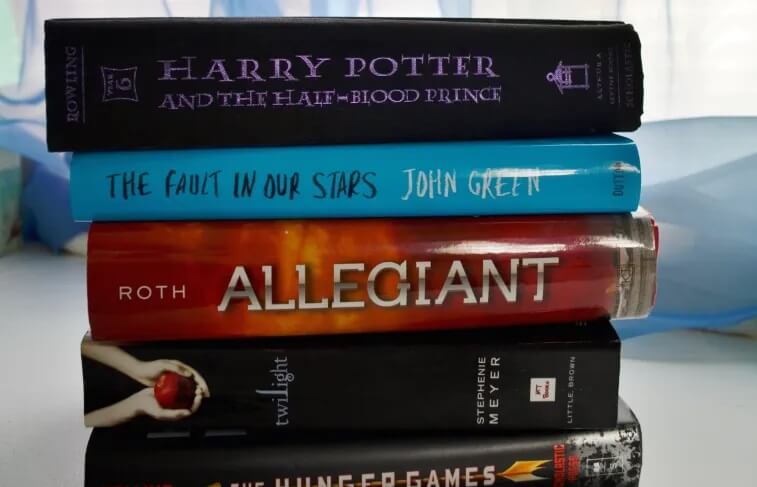
We now live in an age when these stories – books like The Fault in Our Stars and The Hate U Give – propel across bestseller lists and classrooms and libraries. And such books entrance readers not only in the years between 13 and 18, but also beyond: many of today’s YA readers are adults.
We ought to ask ourselves what such books are for. What purpose do they serve?
There are, of course, several purposes that the genres of young adult, middle-grade, and children’s literature serve. Evidently some children’s literature is written primarily to teach children the skill of reading, but much of it is also written to provide children with beautiful but simple stories they can latch onto as they learn the mechanics of reading. Good children’s literature – literature with rich characters and storylines that convey important truths in a compelling manner, literature like that written by J.R.R. Tolkien, C.S. Lewis, and Madeleine L’Engle – serves a very similar purpose as any good literature. It serves to delight and teach at the same time, to both show and tell of goodness, truth, and beauty.
In fact, writers such as Tolkien and L’Engle maintain that they do not in fact write “for children.” In her memoir A Circle of Quiet, L’Engle writes the following:
“Why do you write for children?” My immediate response to this question is, “I don’t.” Of course I don’t. I don’t suppose most children’s writers do. But the kids won’t let me off this easily…
Sometimes I answer that if I have something I want to say that is too difficult for adults to swallow, then I will write it in a book for children. This is usually good for a slightly startled laugh, but it’s perfectly true. Children still haven’t closed themselves off with fear of the unknown, fear of revolution, or the scramble for security. They are still familiar with the inborn vocabulary of myth.
L’Engle’s words reveal that she conceives of her “children’s” novels accomplishing the same purpose as her other work, though perhaps through a medium – the medium of myth – not easily accessible to adults.
But how does young adult literature and its aims compare to this? Ideally, good young adult literature, like good children’s literature, would serve the same purpose as all literature. Perhaps some young adult literature does serve to picture truth and beauty through story – sections of the Harry Potter series, for example, may do so.
But much of young adult literature today is primarily concerned with, as one article in a teenage magazine argues, “representation.” Young adult literature seeks to express the particular trials and tumults of teenagers. As such, much popular young adult literature is consumed with sex, substances like drugs and alcohol, and relational drama. Many young adult writers likewise desire to expose teenagers to issues of “social justice.” Along with this, YA literature is written in an entertaining, easily accessible style, such that readers are sucked into the world of the book in a similar way that they might be sucked into a Netflix show. YA ranges from “dark fantasy” such as A Court of Thorns and Roses to dystopian novels such as Divergent to realistic fiction about sexuality, race, or other “social justice” issues such as The Hate U Give – and yet all of these types within the YA genre are written in simplistic and gripping style that is unlikely to challenge or improve the literary, conceptual, or historical understanding of readers.
Is a genre whose highest aim is not transcendent truth but realism likely to foster a depth of understanding? Is a genre that centrally aims at representation, expression, and entertainment likely to create love of goodness and beauty? I think it unlikely.
The problem with much YA literature is not that it expresses difficult realities to children. Many classics express difficult realities – the works of Twain and Alcott that I mentioned earlier certainly do – and we ought to encourage children to engage with these difficult realities in appropriate ways. But the problem with YA literature is that it often expresses difficult realities in a way that does not uplift moral virtue or even intellectual skill. The Hunger Games will improve neither children’s delight in goodness nor their vocabulary, but it may increase their longing for a romantic relationship and their craving to be catered to by what they read.
In a 1967 New York Times column, S.E. Hinton, author of The Outsiders, argues from the proposition that “teenagers today want to read about teenagers today” for realism in YA literature. Underlying Hinton’s argument is the assumption that art accomplishes its purpose when it realistically reflects life.
L’Engle, again, offers some helpful words that differ from Hinton’s. L’Engle writes that we ought not think of art as a mere mirror of reality but as an icon of it, revealing order and beauty and truth. Art must do more than show us what is real, it must show us the higher truth that includes the reality of everyday life. Art, L’Engle writes, “takes the chaos in which we live and shows us structure and pattern, not the structure of conformity which imprisons but the structure which liberates, sets us free to become growing, mature human beings.”
Let us encourage our children and our students and our friends toward such things – let us pursue this “structure which liberates” ourselves.


Related Posts