On The Philosophy of Mircea Eliade
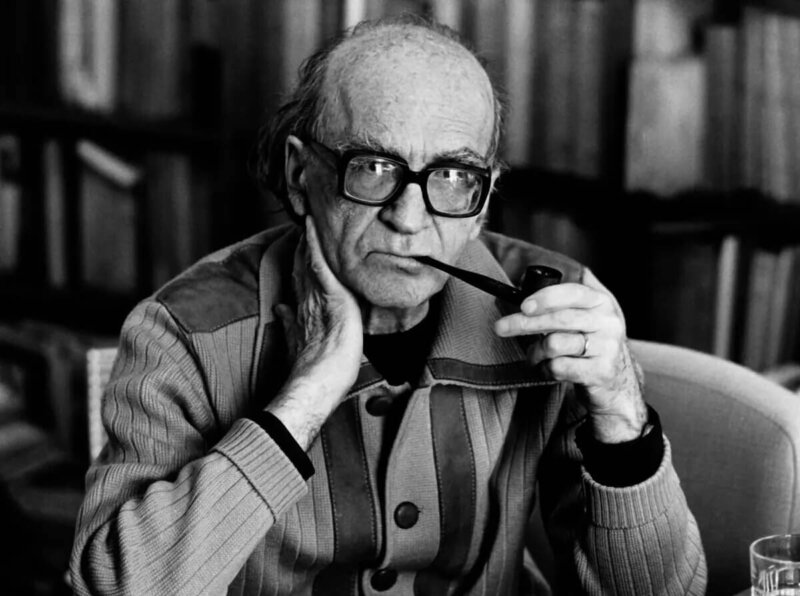
Well known in the academic world as a scholar in the History of Religions, it is usually ignored that Mircea Eliade had a strong philosophical formation. Taking into consideration this particular aspect is essential for a proper understanding of his works. Although he embraced the rigor of the historian’s discipline, he did so with the intention of illustrating a comparative method derived from a unified and coherent conception developed through his encounter with two philosophers: Nae Ionescu and Surendranath Dasgupta. This specific profile—that of a philosopher “converted” to history—gave rise to his monumental body of work.
Repeatedly, Eliade emphasized the eminently philosophical character of his writings, insisting on the speculative theoretical vision that underlies his activity as a “phenomenologist” of religions. In an autobiographical fragment from 1953, he wrote, “From the very beginning I would like to clarify one thing: the series of studies and researches which, apparently, might be considered ‘scientific,’ I regard rather as ‘philosophical.’”
Then, acknowledging that “these philosophical writings have sometimes been taken for simple scholarly contributions to specialized problems (Oriental studies, history of religions, ethnology, and folklore),” Eliade indicated the method by which their philosophical character can easily be discovered, “Read them without notes and references and you will rediscover the problems of philosophy.”
His studies are therefore not just researches of historical erudition, but “works which, despite appearances, belong to philosophy rather than to purely scientific scholarship.” Reflecting on humanity’s struggle to solve the tragic problem of death and the constant decline of history, Eliade behaved like a philosopher who dedicated his life to think on the perennial problems of human condition.
Even before leaving for India, Eliade stated the necessity of a philosophical foundation for studies in the history of religions, proposing ambitious research in comparative philosophy for this purpose:
It seemed to me that I knew enough about the origins of Greek thought and the Presocratics, and I intended one day to study the classics closely. That is roughly how I envisioned the next five or six years of study at the time: comparative philosophy was to prepare the research in the comparative history of religions.
Another particularly significant autobiographical fragment regarding the philosophical foundation of Eliade’s work is found in a diary entry from April 13, 1962, inspired by an autobiographical text by Søren Kierkegaard in which he explained the nature and logic of his own writings, “If one day I were to write a similar interpretation of my books, I could show: a) that there is a fundamental unity to all my works; b) that the scholarly work illustrates my philosophical conception.”
These statements entitle us to maintain that the “fundamental unity” of Mircea Eliade’s writings is nothing other than the direct consequence of his philosophical conception which, although not systematically presented, is coherent. The lack of a systematic presentation of this philosophical conception is due to the fact that his apparently disparate works contribute, as he says, “not to a ‘system,’ but to the grounding of a Method.”
It must be specified that his scholarly writings are the principal, though not the only, part of Eliade’s work from which his philosophy can be extracted. This clearly results from another diary fragment in which the author states that the profound unity of his writings includes all of them, “both literary and historico-philosophical.” In any case, it is not difficult to notice the philosophical character of Eliade’s novels, novellas and short stories. His fictions are a true vehicle for the great themes proper to philosophy and metaphysics.
A researcher of Eliade’s fictional literature, Gheorghe Glodeanu, was convinced that what distinguishes “the Romanian writer’s fantastic prose from that practiced in Western literatures is its strong philosophical dimension.” Ugo Bianchi, an Italian historian of religions remarked the philosophical premises of his colleague’s writings. Petru Caraman, speaking of the Chicago professor as “a remarkable philosopher, especially a metaphysician,” thus highlighted Mircea Eliade’s essential call—that of a philosopher. Vasile Tonoiu, one of the most erudite Romanian exegetes, likewise maintains that “his entire work can also be appreciated as the expression, most often deliberately depersonalized, of a philosophical vocation.”
Although he repeatedly expressed the desire to make his philosophical conception explicit, unfortunately Eliade never wrote a book that fully revealed it. His philosophy is implicitly present throughout the body of writings published over more than six decades of intense activity, as we may infer from statements such as the one in which he notes that the meaning of his life and work “will only be clarified starting from the whole.” This is why the only possibility of fully recovering Mircea Eliade’s philosophy is offered by adopting, as a principal methodological premise, the ideal expressed in a note dated May 29, 1979: “My ideal is to be known ‘holistically.’”
Formed under the direct guidance of Nae Ionescu, an eclectic and controversial Eastern Christian thinker, and Surendranath Dasgupta, a Hindu metaphysician, Eliade practiced the history of religions as a philosopher, intending to meditate “on ‘primitive’ mythologies and religions as Nietzsche and Rohde philosophized on Greek beliefs and creations.” He warns us that when one studies the religions of antiquity, “one is not doing ‘erudition’—but is confronting the problems of today’s philosophy.” Probably this approach, in which philosophy and religion meet again, represents one of Mircea Eliade’s boldest contributions, in a context in which the secularization of philosophy has become the rule of an increasing sterile academic world.
Suggesting the existence of a subtle harmony between his theoretical concerns and the European philosophical movement, and then asserting that the entire theory of symbols is “the path by which one can reach a renewal of the problematic of contemporary philosophy,” Eliade emerges as a metaphysician and theologian of religions, the creator of a body of work generated by a solid philosophical core.
The major difficulty that may call into question the reconstruction of Eliade’s philosophy is its unsystematic character. Influenced by Indian speculative schools, the scholar did not present his conception in the form of a system, a style characteristic of Western culture. Even if at times he assumed labels such as “phenomenologist,” “structuralist,” or “hermeneutician,” he made it clear “that, as far as he was concerned, there were delimitations from what is commonly understood by these cultural qualifiers.” In order to demonstrate the existence of a “philosophy” of Mircea Eliade, I shall limit myself in this brief article to showing that the principle of the irreducibility of the sacred can be understood as a transposition of the ontological principle of the irreducibility of Being.
In the introductory word to his monumental Traité d’histoire des Religions (1949), the Chicago professor stated:
A religious phenomenon will reveal itself as such only when considered in its own modality, that is, when studied on a religious scale. To attempt to delimit this phenomenon through physiology, psychology, sociology, economics, linguistics, art, etc., is to betray it; it is to miss precisely what is unique and irreducible in it, namely its sacred character. (…) Of course, we do not attempt to deny that the religious phenomenon can be usefully approached from various angles; but above all, it must be considered in itself, in what is irreducible and original in it.
Thus, as a basic concept of Eliade’s thought, any attempt to reduce the sacred to one or another of the particular aspects of diverse religious facts is considered erroneous. This particular point of his conception of the sacred can be identified in speculative metaphysics after Martin Heidegger. A similar reductionist phenomenon, visible this time in the field of the history of philosophy, was denounced by major metaphysicians, among whom Étienne Gilson and Pierre Aubenque may be mentioned. In the context of a dialogue with the Romanian thinker Corneliu Mircea, Aubenque spoke of “a kind of slippage of isolated philosophical ideas that led to the constitution of systems, that is, closed, totalizing ensembles that claimed to explain the totality of experience, the totality of being.” Thus, certain thinkers attempted to “reduce” metaphysical being to one or another of its particular aspects.
In reality, Professor Aubenque shows, those systems were based “on an impoverishment of the understanding of being and were characterized by the reduction of being—as we understand and think it—to a single one of its aspects, considered dominant.” This is why “a kind of reductionism took hold of philosophy, because there was a desire to subsume the totality—which is a living, open, and, I believe, infinite totality—under a determined genus, a determined category.”
Professor Pierre Aubenque’s criticisms, directed against the reduction of Being to one or another of its particular aspects, are identical in substance to those of Eliade, which target the reduction of the sacred to certain particular aspects of the religious fact. The French philosopher comes closest to Eliade’s conception when he explicitly states that “there is something sacred in Being.” Moreover, Eliade himself established the kinship between the sacred and Being when he postulated that “the concept of the ‘sacred’ seems, in a certain way, equivalent to the concept of Being.” Important authors have already noted this identity between the notions of “sacred” and “being.”
In Romanian exegesis, Sorin Alexandrescu and Vasile Tonoiu are those who insisted on the ontological dimension of Eliade’s concepts. In a lecture delivered in Bergamo on the occasion of a colloquium on Mircea Eliade, S. Alexandrescu analyzed in detail the relations between Eliade’s conception and those of the illustrious representatives of phenomenology, Edmund Husserl and Martin Heidegger, insisting on the similarity between the concept of the “sacred” and that of “being.” His conclusions are as follows:
“There is a great analogy between Eliade’s definition of the sacred and Heidegger’s definition of being: the two domains are transcendent with respect to those of beings and the profane; the sacred and being are ‘real’ and make possible the existence of the other two domains, the profane and beings; at the same time, the former ‘disclose themselves,’ ‘reveal themselves,’ manifest themselves (through epiphany) in beings or in the profane; it is impossible to define being and the sacred in a precise, positive, substantial manner (any definition of being turns it into a being!).”
Continuing his argument, Tonoiu inevitably refers to the most influential speculative thinker of the twentieth century, Martin Heidegger. The proximity between Heidegger’s ideas and those of Eliade is manifested in the fact that “being is defined and manifests itself in beings, according to Heidegger, in the same way in which the sacred is defined and manifests itself in the profane, according to Eliade.” Speaking concretely about the “equation of the sacred with Being itself,” Tonoiu shows that “the sacred institutes and reveals being, passes into what is, is being itself as true and meaningful reality.”
In support of his claims, he cites a fragment in which Mircea Eliade postulates the identity between hierophany, which is a revelation of the Sacred, and ontophany, which is a revelation of Being, “At the level of archaic cultures, hierophany is at the same time an ontophany; the manifestation of the sacred is equivalent to a revelation of being, and vice versa.”
Through the numerous testimonies contained in such texts, we can establish legitimate analogies between Eliade’s conception and those of traditional European metaphysics—Platonic and Aristotelian—assimilated by patristic and scholastic thought. Beginning with the Romanian period of his studies, between 1932 and 1940, the Chicago professor was constantly preoccupied with the problem of Being. In a letter addressed to Nicolae Argintescu-Amza, he specified that his university lectures in 1934 had as their central subject the problem of esse (i.e., Being), presenting comparatively Asian metaphysics and pre-Aristotelian philosophy. It is therefore not accidental that he often referred to classical European philosophers such as Parmenides, Plato, Aristotle, Plotinus, Augustine, Origen, Thomas Aquinas, and Nicholas of Cusa. The philosopher Mihai Șora, who had been a student at the University of Bucharest, recalled that Mircea Eliade systematically discussed the problem of Being in his courses.
Finally, another piece of evidence, drawn from the author’s journals, shows that while he was in India between 1928 and 1932, Eliade ordered from Romania the Italian edition of Aristotle’s Metaphysics in order to prepare, as he himself said, through research in comparative philosophy, his future studies in the history of religions. His reflections on Aristotle’s “being” and on the thought of Martin Heidegger, to whom he devoted an entire lecture delivered in Geneva in 1954, allowed him to provide a philosophical foundation for his own thinking which, although expressed through works of the history of religions, discusses the great themes of Western metaphysics. All this clearly shows that the historian Mircea Eliade cannot be fully understood unless the philosopher Mircea Eliade is known and understood.


Related Posts