The Struggle to Believe in Modern Cinema
The post-Christian world has fundamentally changed the way that Hollywood interacts with religion. Christianity was once the normative belief system in the United States. The Catholic Legion of Decency had the power to enforce two decades’ worth of self-censorship through the Hays Code against the horrors of godless Hollywood and its lecherous values.
The decline in religion has meant that cinema has largely fallen into the realm of the secular. While not entirely hostile to religion, modern cinema is not indebted to it. The age when Hollywood would make mainstream Bible epics like Ben Hur and The Ten Commandments is long gone, with such unironic expressions of faith limited to arthouse films and independent cinema.
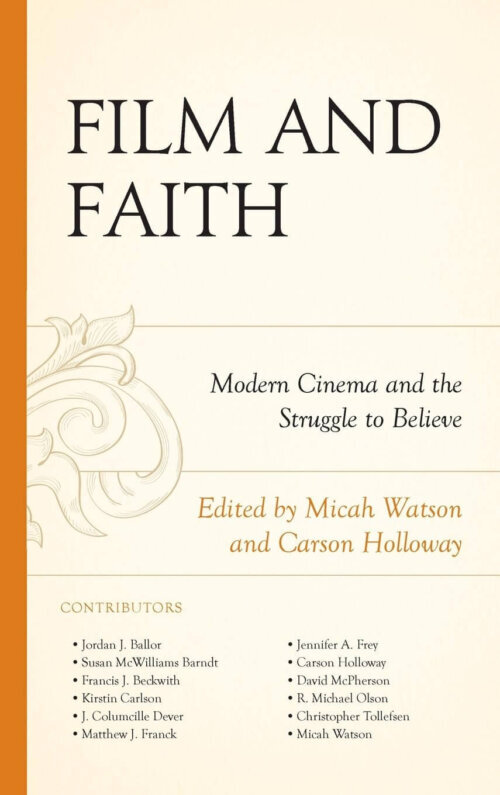
However, this does not make cinema irrelevant to modern Christians. Film still shares a culture with the faithful. Christians have a great deal to say about life, morality, and artistic expression. This is the mission of Calvin University and University of Nebraska scholars Micah Watson and Carson Holloway, in their recent essay collection Film and Faith: Modern Cinema and The Struggle to Believe.
“At first glance, religious beliefs do not seem to be an important theme in contemporary cinema,” says Watson and Holloway. “Such works [like Ben Hur and The Bells of Saint Mary’s] belonged to what we might call an age of religious triumphalism in the history of film, broadly reflective of an earlier time in which the winds of secularism hadn’t begun to blow in earnest. They were the products of a culture in which religious belief was taken for granted and affirmed.”
Overseen by Samford University’s Lee Trepanier, this series of essays tackles the ways that modern films can be viewed in light of faith. With notable exceptions like Babette’s Feast, The Northman, and the works of Terrance Malick, the films that these scholars set out to examine are generally pedestrian and accessible works of popular entertainment. The Dark Knight, Avengers: Infinity War, and Gravity are blockbusters, while It’s A Wonderful Life, Not Country For Old Men, and Gran Torino are broadly popular classics.
It is easy to point out the religious symbolism of recent smaller films like Silence, Noah, Exodus: Gods and Kings, Passion of the Christ, or Jesus Revolution. These are works by Christians and atheists directly addressing religion. The films listed in Film and Faith have no such pretensions. With notable exceptions, they’re best considered secular, pseudo-pagan, or vaguely spiritual. It is to the collection’s strength that each essay can dissect these works so efficiently and offer a fresh view of their strengths and faults through a Christian lens.
Certainly, each film’s virtues vary wildly. Each scholar, coming from the fields of theology, philosophy, and political theory, hits their film from different angles. Matthew J. Franck is broadly critical of the theology of Gran Torino, in which he suggests Kowalski’s self-sacrifice is actually a violation of Catholic social teachings. Francis J. Beckwith dedicates admirable space to defending It’s A Wonderful Life from contemporary feminist and Catholic critics, with the latter specifically addressing Patrick Deneen’s critique of the Christmas classic as “a capitalist coup” due in part to its endorsement of unfettered modern housing development disturbing traditional social arrangements.
These lenses prove invaluable, particularly in films that one wouldn’t expect to have a particularly Christian dimension to them. Holloway makes a remarkable case that No Country For Old Men’s nihilism only functions in a world where tradition is severed from genuine faith and lacks the trust in God to right the wrongs of a “contrived” extreme form of evil. J. Columcille Dever offers a brilliant analysis of Robert Egger’s The Northman that draws upon J.R.R. Tolkien’s approach to honoring and respecting the pagan imagination, as he outlined in his famous lectures Beowulf: The Monsters and The Critics and On Fairy Stories.
In all of these cases, these nihilistic, capitalistic, or pagan works are shown to point to the Christian message of hope and grace in a fallen world. Watson offers some of the book’s most direct reflections in his discussion on The Dark Knight trilogy, by showing that these films, which depict very few religious characters or reflections on faith, offer one of the most compelling depictions of redemption and human nature in contemporary cinema—what Watson calls a “proto-gospel.”
As Watson points out, the franchise begins by outlining Bruce Wayne’s journey to learn the importance of why it is wrong to do the right thing for the wrong reason. “In Christian ethics, this particular moral line is the called the Pauline principle, based on Saint Paul’s firm rejection of doing evil for the sake of good results.” From this, he charts Batman’s growth into Bruce Wayne’s true identity, his confrontation with radical evil, and Batman’s incredible grace and sacrifice toward a city that his enemies are all too eager to obliterate in an act of divine justice. He even offers grace and kindness toward his traitors, who become his allies by choice by seeing the justice he offers. Order rights itself and radical evil do “not have the last word.”
The collection, split between three movements that explore sin, grace, and radical evil, does a remarkable job of expressing how modern secular filmmakers have produced works that Christians can understand, engage with, and grapple with critically. These works are flawed, theologically and morally, but they are still syncretic with the values of the Christian and can be engaged with. The modern Christian has plentiful opportunities to engage critically with popular art in a fruitful way and show how the story of the gospels is still at work, even imperfectly.
Film and Faith: Modern Cinema and the Struggle to Believe
Editors
Lanham, MD: Lexington Books, 2023; 220pp


Related Posts