Encountering and Creating the Beautiful
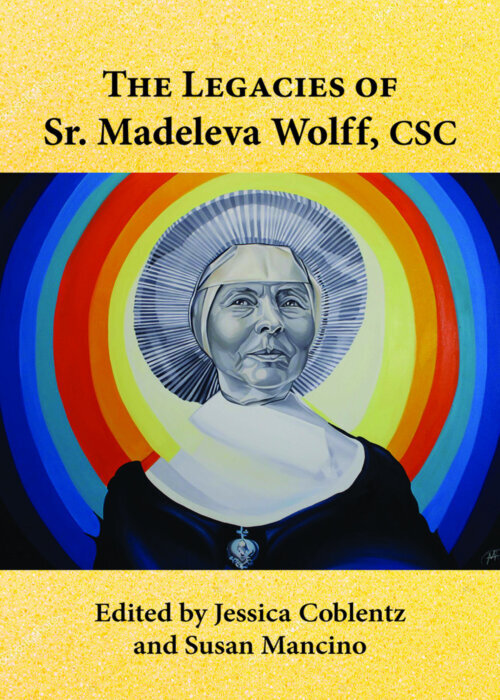
In our day and age, the rush and fury of digital distractions and slick advertising campaigns threaten to leave us in suspended animation, with eyes glued to a screen while we forget the ground upon which we walk. Behind the institutions we benefit from, and the rich cultural traditions that carry us from one milestone to the next, lie stories of inspired vision and sacrifice. I suspect that most people have never heard of Sister Madeleva Wolff, a Holy Cross Sister who pioneered the development of higher education for women at Saint Mary’s College in Notre Dame, Indiana, but her life’s work is one of those foundational cornerstones that make up our cultural ground today. A collection of thirteen lively essays recently published by Paulist Press, The Legacies of Sr. Madeleva Wolff, CSC, is a fascinating read for the depth they bring to a study of Madeleva’s life and work. In particular, Madeleva’s spirituality, centered on the beauty experienced in Creation, becomes the root for her understanding of education and the orientation of her poetry. These essays will strike a chord for the reader, evoking a meditation on the nature of God, the power of a teacher inspired by a vocational call, and the relationship between poetry and beauty.
The essays focused on Madeleva’s spirituality and poetry bring to mind Saint Thomas’ notion of amicitia, the friendship between God and person, that is completed through a mutual love. Madeleva’s experience of beauty in the natural world and her writing of that experience reveals an intimacy with timelessness that not only informs her intellectual work as a scholar and lead educator, but her creative work as a poet. Margaret M. Gower’s essay on “spirituality of vision” draws attention to Madeleva’s affirmation of the sacramentality of creation. Christians are called to “see God in creation, so that we can encounter God in creation.” In recognizing beauty in the world, “we are offering our attention to God, as in prayer.” Part of the appeal of this prayerful practice is that it is universal in scope, open to all people with sensitive souls who feel called to pause before the beauty and wonder found in a given moment, anywhere in creation. This transcendent experience of God’s love “may be experienced through the senses as well as the soul,” Madeleva writes, involving “the entire person, including the body.” Margaret Eletta Guider draws attention to Madeleva’s memoir, where in the conclusion, Madeleva articulates her spirituality in perhaps its most mature form. She writes of the “relaxed grasp,” of living “without props, to experience holy indifference, to loosen one’s hold on all that we leave behind.” Guider goes on to suggest that Madeleva’s spirituality may hold greater significance today for women religious in the United States than sixty years ago, an intriguing comment that I would have loved to read more about.
A person is not a passive subject in this transcendent experience inspired by beauty. The human experience of God involves a mutual love. Eva Hooker, in her wonderful study of Madeleva’s poetry, highlights the poem, “Design for a Stream-Lined Sunrise.” Here we read Madeleva’s words, where beholding beauty can create the beautiful:
If you must draw mere beauty,
Subtend one third of the whole arc of heaven
With a gray chord of cloud
Stretched from the quick southeast to the still dubious west.
Edge all the chord with white, bright mutable silver.
Draw it on cloudlessness at daybreak,
If you would draw mere beauty.
But you cannot do this
Because the artless air achieved this brief design for sunrise
Once and forever,
Today at dawn,
And then this long line, cutting with sheer simplicity of silver
The breathless, deep-blue arc of the south,
Because, because of my beholding,
Beyond potential beauty, beautiful.
Hooker rightly draws attention to the intimacy between the poet and the beautiful moment. The poet, too, is a beauty-maker; “design exists because of her.” Through a careful reading of the poetry, Hooker enters Madeleva’s experience, drawing on the words of Meister Eckhart to accentuate this intimacy between God and the soulful observer of beauty; “The eye with which I see God is the eye with which God sees me.” When the poet beholds beauty with deep attention, they honor the beholden “with a kind of presence,” and create the beauty with their own creation, namely, the poem. This notion of the lover of beauty creating beauty extends beyond poetry as we know it to include, as Madeleva explains, “a poetics of every art: the seeing, the making, the singing of music, of the graphic arts, of fiction, of the sciences…of education…of charity.”
Of course, in a modern world dominated by images, notions of beauty can also be soulfully disorienting. As an educator of young women, Madeleva was sensitive to this concern. There are “constraining notions of women,” Gower writes, “beauty characterized by primping,” that can be “distorted and used to hurt persons.” Madeleva encouraged the “beauty of being,” and wanted her students to be educated “for God’s sake.” Each student was made “in the image of God,” and their work at the college was to “perfect that resemblance.”
Catholic education at Saint Mary’s College included a study of the world and of eternity, of morality, and of developing a sense of wonder over the beauty encountered in creation. This education led to some practical results. Madeleva expected her students to “learn to think quickly and clearly, to judge honestly and fearlessly, to act bravely and unselfishly, to work tirelessly.” She upheld education as a rare gift indeed, for “this life of the mind is a holy thing. It is an experience of immortality.” David Clairmont stresses that Madeleva “was not afraid to accompany her students into their deepest questions about faith, personal integrity,” and perhaps as a recognition of the turbulent times of cultural change in the 1950s and 60s, of “changing social roles.”
Madeleva identified “standardization” and “security” as the primary challenges to Christian education in the 1960s. “The college girl today must fight the difficult fight of keeping her independence, of being simply and completely herself,” Madeleva wrote. Regarding security, she did not want her students to enter adulthood looking to the government to provide safety and comfort. As a goal of her educational program, Madeleva wanted her “daughters” to know that “we are secure only when we can stand everything that can happen to us.” As students came to love truth and to prepare for a “good death by growing in love of God and service to neighbor” they would be guided by the relationship between teacher and student, “with a mind equally attuned to classic and modern images.” Responding to the “needs of the time,” the teacher prepared the world “for better times than now,” educating the “mind and the heart.” The teacher was equal to the student except in the realm of experience, in the time “spent reading, writing, and conversation about what is most important in life.” However, this distinction would slowly fade as students continued their studies through the years, becoming prepared as future parents and leaders.
Madeleva was a poet and a scholar. Katie Ann-Marie Bugyis’s review of Madeleva’s study of Chaucer was an informative and stimulating read, as was Thomas O’Grady’s essay on her tour of Ireland, which produced perhaps the most beautiful poem shared in this collection, “Snow Storm.” Here is the opening stanza of the poem:
The air is white and winds are crying.
I think of swans in Galway flying.
Madeleva’s commitment to poetry, study, and culture generally, is revealed by her relationships with accomplished writers such as Father Charles O’Donnell, William Butler Yeats, C.S. Lewis, J.R.R. Tolkien, and G.K. Chesterton.
As far as contemporary university education is concerned, Sandra Yocum’s essay on the development of theological studies for women through the 1940s sets the table for the reader. In light of the struggles our universities are currently suffering through, revealed in part by the recently released Yale Report on Trust in Higher Education, these collected essays remind the reader of the beauty, depth and liberating power of a liberal arts education properly oriented and cared for. Of course, in 2026 the times have changed indeed, and some of this change is acknowledged with a hopeful edge in the final essay by the current Saint Mary’s President, Katie Conboy.
Through the past two millennia, Catholic schools have often demonstrated a remarkable ability to absorb changing conditions of culture and history. One can only hope that the Spirit that animates Catholic schools like Saint Mary’s, a Spirit whose presence Madeleva inherited as a gift as much as she co-created with in bringing to light new manifestations of Catholic education, will not be lost. As Susan Mancino observes, Madeleva’s faith was the cornerstone of everything she did. It inspired her work as a teacher, right down to the school’s trees and landscape, an artful and peaceful space she co-created with others, as Sally Geislar highlights in her essay. In defense of Catholic education, these essays remind me that the call for Christian educators is to treat their vocation seriously, and to mature in their own faith so that they can learn to see every place as created by God, and every moment as one where God can be encountered. Such a spirituality lived mindfully will ensure a student’s learning is guided by the same wonder and awe we hope to instill in them. The Legacies of Sr. Madeleva Wolff, CSC, is a stimulating and informative read for all people of faith, for those seeking faith, and for Christian educators at every level of study.
The Legacies of Sr. Madeleva Wolff, CSC
Edited by Jessica Coblentz and Susan Mancino.
Paulist Press, 2026


Related Posts